The Last Train Out of Here (interview)

Guy Denning Discusses Anarchy, Political Art, and the Current Ideological Climate with Prox from Inside the Rift.

After getting involved with the Punk and Anarchist movements of the 80’s, artist Guy Denning found himself absorbing the tenets of ideological dissent and acquired the ability to distinguish poignant political art from propaganda. This would eventually come to define him as a critical thinker who wasn’t afraid to deviate from the status quo and “go there” whenever necessary. While he most certainly had no qualms about exploring divisive themes, his hefty subject matter was a bit too real and on the nose for many art establishments during that time. He found himself on the receiving end of several rejection letters and sought out other ways to differentiate his talents from what was normal at the time.
The decision to forgo traditional higher education was the foundation and impetus for his beautifully-ugly works as it created an atmosphere for the man we see today.
The pain and grit (aesthetically or otherwise) that can be gleaned from Guy’s visual musings touch on existential and psychological themes embedded into the collective human psyche.
Self-taught, driven, and imbued with a genuine love for the arts, Guy has become a favorite for many aspiring creatives and thinkers.

Prox: There is a gritty proletariat feel to your work. What do you think contributed to your decision to produce imagery that has this aesthetic?

Guy: I like portraying people. It’s as simple as that. I think art always says at its core ‘this is us’ – even when it’s abstraction or high-conceptualist installation. It boils down to ‘I made this’ so it stands in for the artist, or an aspect of the artist’s conception of how they wish to be perceived.
I’m endlessly fascinated by the physical presence of the body in all its forms and I love the presentation of emotion that the theatre of the body performs on an everyday basis.
When you say ‘gritty’ I’m not sure if you mean in its physical, messy making or the literal subject matter I’m depicting. Subject matter is easy and I just always draw or paint what interests me at any given moment and that generally involves a subject that could be considered political – if that’s what you mean by gritty.
If it’s the nature of the use of the media – well that’s just an extension of the art historical idealism of Greenberg’s Modernism (but without the anti-literalist dogma). I love the medium. I like moving the conte, pencil, sharpie, and chalk around the paper and then erasing it just to remake it. I like avoiding clean lines when a clean line is too easy and a broken pencil will give a more interesting line. Drawing on packaging is more interesting than drawing on crisp, fresh, ‘artist quality’ paper. I want to create and destroy in the same piece of work and let the viewer see, not just the finished result, but all the work and chaos that led up to that point where I decided to leave it before it was too broken or too finished.

Prox: Is there anything that you’re trying to say symbolically with the high-contrast motifs that you like to use? Do the colors say anything about life from a moral perspective in your opinion?

Guy: I don’t think so. I’ve grown up with the western canon of art and, following that, the punk aesthetic of early crude photocopied zines, posters and art. It’s just a personal choice that I’m comfortable working within. I choose the visual impact of Carravagio and not Titian, CRASS and not Duran Duran, Expressionism and not Impressionism, Kline and not de Kooning. And drawing underpins my painting. It’s the basic architecture – line and tone. Personally, in my art at least, colour is an adjunct to the impact of line.

Prox: A word that often comes to mind as I examine your work and story is “fuel” (your pieces even remind me of the outstanding fumage art that is being produced by Steven Spazuk). While in the past it was anger and various substances that helped you create, what fuels you now?

Guy: The main driver is the knowledge that I know I can do better. I don’t want to drop into a signature style or get trapped making the same thing over and over just because it pays the bills. I’ve only just started and I’ve got more ideas than I’ve got time.
I want to explore my media more, investigate new avenues of creativity and pull them all together as a cohesive unit that means something important to me, and hopefully those that get to see it… or read it, or hear it…
I want to make work that remains relevant to future generations. I want the families of the people that have bought my work to see a relevance in what their parent or grandparent bought and to keep it – even if only out of respect to the memory of that lost family member. I’m essentially modeling dirt and I want to give it significance.

Prox: Pain seems to be a theme you’re interested in exploring with your work. What do you think pain (if anything) can offer to the developing artist and human being? How did it help you?

Guy: I’m averse to pain. Pain doesn’t figure in my work – unless you’re considering emotional pain. I used to suffer from manic depression and was medicated to near oblivion until my wife got me off the cocktail of  chemical warfare. I was pretty fucked-up and for me the pharmaceuticals were just exacerbating the problem. The issues underpinning my mental state weren’t being addressed and to top it I was worried that if I was ‘cured’ I would lose my ability to create. It was not a healthy state to be in and was damaging to all those around me as well as myself. I now deal with depression in a totally different and very personal way. I watch myself and police myself and have my own therapies that keep me where I need to be mentally.

Prox: You’re no stranger to political artwork but I’m curious about the gradation and subtlety of such a discipline. How do you get your message across effectively without being disrespectful or hokey? Does one need an in depth knowledge of the issues they’re attempting to analyze?

Guy: I think because I’m just honestly painting and drawing out how I feel in the moment. It’s rare that I’m considering a social issue and then think ‘Oh – I must respond and make art about this to change the world…’  Back in the eighties when I was writing and pasting up on town walls it didn’t matter about being disrespectful and hokey. (I had to look up ‘hokey’- we don’t have that one in the UK. The only ‘hokey’ we know is in an old time family/community dance called ‘the hokey-cokey’ – left arm in, left arm out, shake it all about sort of thing… very erm… community…) Anyway… I didn’t sign the street work so it didn’t matter how the message was taken. I think I got the directly, blunt political work out of my system because I spent ten years basically taking the piss on street walls (usually at the expense of government policies, fascists, etc) and friends would tell me whether I’d hit the mark or missed it by a country mile. I was also mixing with a lot of very politically informed people through the eighties, and this was very pre-internet. I was talking with people a generation older. Trade-unionists, communists, anarchists… some of them were artists and they’d explain the difference between propaganda and effective political art. This was a political education too. If you wanted information outside of the mainstream it had to be searched for and one particularly rich vein was the Bristol anarchist and north Somerset crusty punk and traveler set. My ideological anarchism, first fired up by the lyrics of CRASS, were given more critical weight by blagging copies of newspapers like Black Flag and free pamphlets from the Bristol Anarchist Bookfairs. That formative time was responsible for my having a broad knowledge and an inquisitive nature when presented with the mainstream media – which then, I think, was just called the media. I don’t know, I’ve never analysed that aspect of my learning too much. I know my anti-war stance was formed by visiting the WW1 war cemetery in Verdun, France when I was a kid. And my eighteen year old head was opened to all manners of ecological carnage being inflicted on the planet by a thirty-something hippy-punk who called himself Stig with a seemingly endless supply of photocopied leaflets from his inside coat pocket.
I think these people, and others along the way, made a pretty naive, safe, country boy challenge what he was told or read before accepting it as any kind of truth. That’s still always critical in my work. And I try not to be specific, but general in my approaching of any potentially contentious subject. Find the connections with related problems or injustices… and they’re always there. Don’t be didactic – let the viewer do the work too.

Prox: We’re living in some pretty divisive times (at least stateside). What do you think art can do to help us get through this tumultuous era?

Guy: What it has always done. Offer some sense of light in the dark and prove that humanity isn’t hurtling off the precipice in unison. Art won’t change the world but it can highlight a society’s and culture’s problems and sometimes even by unwittingly being part of the problem itself. Look at the lunacy of the top-end art market where novelty and high price are the sole signifiers of worth. Its extremes have been considered the aspirational norm for the hyper wealthy and I think we’re now seeing increasing challenges to that.
I’ve noticed a change in what’s coming out from the art colleges lately and I think the recent excesses of the last few decades are going to become irrelevant in the longer term. Artists seem to be placing more value on the importance of craft and the validity of accessibility again; they want their work to talk to a broader audience and for it to also be appreciated for the work that’s been put into it. That’s a good thing in my book.
Humanity has been making this art stuff now, in one form or another, for more than 35000 years. I like to think that it’s the artists, musicians, singers, and story-tellers that have contributed the most to stop us from eating each other.

Prox: Any new artists, books, music, or shows you’d like to recommend?

Guy: The last non-fiction book that I bought when it was published was Naomi Klein’s No is not enough. I’d recommend all of Klein’s books and think they deserve the broadest audience possible – if I had the money I’d buy a copy of each for every school library out there. Also Debt: The First 5000 Years by David Graeber is a fascinating and informative read that turns up some interesting perspectives on our assumptions about the histories of human and political economies.
Music this year has to be Godspeed You! Black Emperor’s new album Luciferian Towers. I know it’s been criticised as being more of the same but in my opinion you can’t have too much of a good thing. Personally they’re the most wonderful band to work to when I’m busy in the studio.
The only TV show that I was really looking forward to was the new Star Trek series – I’m a total sci-fi nerd and Trek just takes me back to my childhood when there was that naive joy and associated expectation that the future (in our lifetime) would deliver the goods (jet-packs, peace and endless prosperity) for humanity. Needless to say that optimism was soon knocked out of me! Another film that I enjoyed this year was Villeneuve’s Arrival. Perhaps that was the equivalent optimist sci-fi for a new generation. I’m still waiting for Frank Herbert’s Dune series to be made as the multi-series epic it deserves.

Prox: Would you like to share some information on any upcoming releases you have on the horizon?

Guy: I’m always working on new ideas. Some will progress to a coherent exhibition set and others won’t. Currently I’m making a set of drawings that refer to a particular historical moment that I feel exemplifies the significance of graffiti in our current world. I don’t really want to say any more for fear of it not working out as I’ve planned, but if it all goes well I hope to show them in Paris in the first half of 2018.

Prox: Final Thoughts?

Guy: That perpetual hope that humanity (or the leaders of humanity) will realise that our current economic model should be consigned to the ideological waste bin as a very failed experiment. I always hope that change will come about through rational thought and consideration so that it’s unnecessary for a violent switchback. But I know I’m whistling in the wind with that, and that depresses me – particularly on a personal note now that I have grandchildren who stand to inherit the mess that we could have changed.

original article online


2677 the last train out of here 35 x 20 cm december 2016
“The last train out of here”, conte and collage on card, 35 x 20 cm, 2016

back to blog menu


“2017 Another year of discontent”

I decided to turn my daily drawing routine (a sort of regular exercise for the head, eye and hand) to a project to record an image from a political demonstration every day through the year of 2017. The source materials are the news and social media, in print and via the internet.


The alternative petrol-head’s calendar of the year


back to work chronology menu

Exhibition set – “A month of discontent (September)”

The ongoing project to record an image from a political demonstration every day – starting with January 2017 and now on to September. The source materials are the news and social media, in print and via the internet.

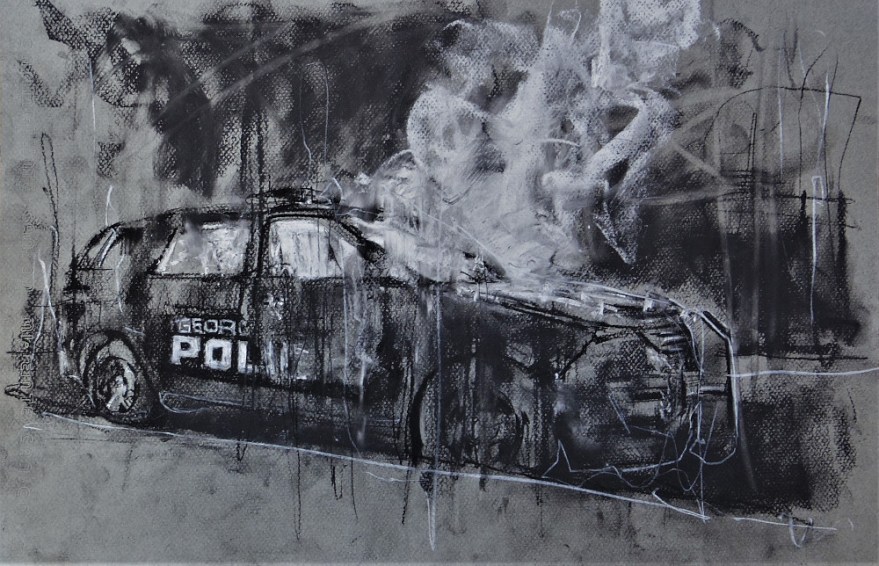
3454 'campus fire', conte and chalk on paper, 50 x 32 cm, september 2017
 ‘campus fire’, conte and chalk on paper, 50 x 32 cm, 2017

back to exhibition set menu


Exhibition set – “A month of discontent (August)”

The ongoing project to record an image from a political demonstration every day – starting with January 2017 and now on to August. The source materials are the news and social media, in print and via the internet.

'end of summers, conte and chalk on paper, 50 x 32 cm, 2017
‘end of summers’, conte and chalk on paper, 50 x 32 cm, 2017

back to exhibition set menu


Exhibition set – “A month of discontent (July)”

The ongoing project to record an image from a political demonstration every day – starting with January 2017 and now on to July. The source materials are the news and social media, in print and via the internet.

"G20", conte and chalk on paper, 30 x 50 cm, 2017
“G20”, conte and chalk on paper, 30 x 50 cm, 2017

back to exhibition set menu

Exhibition set – “A month of discontent (June)”

The ongoing project to record an image from a political demonstration every day – starting with January 2017 and now on to June. The source materials are the news and social media, in print and via the internet.

'Toma de Caracas', conte and chalk on paper, 50 x 32 cm, 2017
‘Toma de Caracas’, conte and chalk on paper, 50 x 32 cm, 2017


back to exhibition set menu

“Blue Skies”


I’ve been working on the show’s twenty four paintings for two years. I started them with no idea as to where they’d be shown but continued anyway. About a year ago I was offered a solo show by Box Galleries in Chelsea so I ploughed forward with the enthusiasm, and sometimes panic, that a deadline date provides.
This new work is a partial return to older themes I explored in the 90s, but with the benefit of fifteen or so years increased technical knowledge of oil painting. Originally this theme dealt very specifically with issues of gender, sexuality and mental health but though returning to this theme pictorially this set of paintings also refers now to the process of painting itself, environmentalism and the increasingly confusing world that we all have to navigate. The origin of the figuration was largely given by one of my favourite paintings, “Young Spartans exercising” by Degas. It’s in the permanent collection of the National Gallery and I was instantly fascinated by the painting when I first saw it. That interest, and the inspiration it offers, has never gone away.
That pictorial origin might not be immediately apparent, but there are many other nuggets of inspiration from other sources that have also contributed to this set of paintings. Lyrics from music or film titles that I’m listening to and watching as I have worked may be included, perhaps sometimes to be buried under oil paint or to be extended into a phrase that meant something to me at that given time of working. Pithy phrases from writers who I’m reading or the news at any given time may make an appearance – perhaps to stay untouched, perhaps to be modified, perhaps to be subsumed within the many layers of physical and mental media on the canvas’ long studio journey.
This is my usual method of working; feeding on the world and spitting it back out on the canvas. It is just me, using my work to record where I am at any given working moment; mentally, physically, spiritually, to the point where, even when I look back on them, I cannot remember the absolute specifics of the reasoning for including all of these elements.
Each painting becomes essentially a recording of its own making.
Perhaps the ‘Blue Skies’ title comes from a mild crisis of middle-age; a sense of realising that there are more years behind than ahead and that all that optimism of childhood and youth was misplaced. Blue sky painting… expressing the wanting of a better world in the mode of expression that I feel most confident.

“Blue Skies” at Box Galleries, London exhibiting through October 2017.

back to work chronology menu

Exhibition set – “A month of discontent (May)”

The ongoing project to record an image from a political demonstration every day – starting with January 2017 and now on to May. The source materials are the news and social media, in print and via the internet.

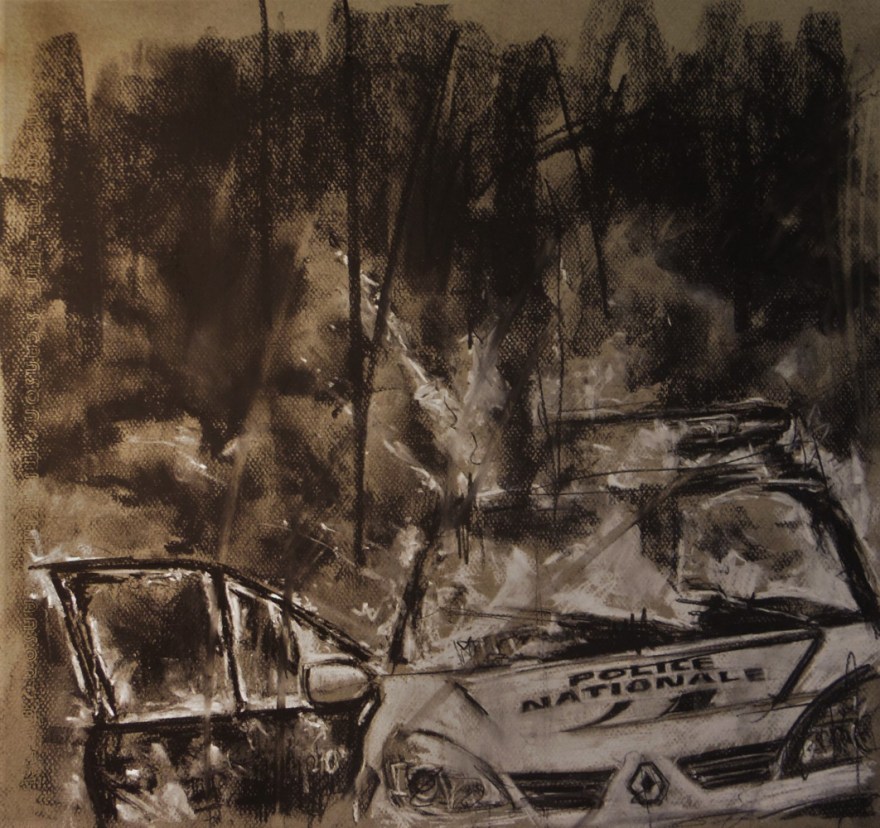
3318 where there's smoke 50 x 50 cm may 2017
‘where there’s smoke’, conte and chalk on paper, 50 x 50 cm, 2017


back to exhibition set menu

Brexit shambles

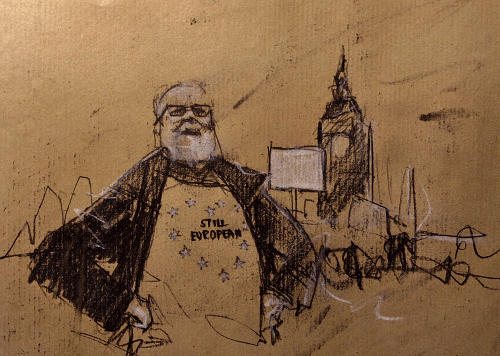
3173 march 13 20 x 25 cm march 2017
“Still European – March demonstrator, UK, 2017”

I don’t want to see or hear another comment on a news website stating that the result of the Brexit referendum was an indication of a clear majority of the UK population wanting the UK to leave European Union membership.
The occasional online moron, who clearly have no access to a dictionary, have even been declaring it a ‘unanimous decision’ in favour of Brexit. The fucking cretins… for their information here’s a dictionary definition of ‘unanimous’:

unanimous
/juːˈnænɪməs/
adjective
1. in complete or absolute agreement
2. characterized by complete agreement: a unanimous decision

Alright? So it wasn’t a unanimous decision. In fact it was 51.89% in favour of leaving and 48.11% in favour of remaining on a turnout of 72.21%. So in actual fact, and in terms of the numbers of the British electorate in total:

37.46% voted for Brexit
34.74% voted to remain
27.80% did not vote

So in actual fact a little over a third of the electorate actually chose to take the UK down the tumultuous political river we’re now paddling – with little sign of any active paddle work.
Brexiters… you’re NOT in the majority. Admittedly a third of the electorate didn’t bother to turn out, for whatever reasons, but that clearly shows that a UK Brexit wasn’t a major concern to that third if they couldn’t be bothered to make their mark on the ballot paper. They were contented enough to assume everything would stay as it is.
Some of the commentary I’ve suffered via the media and in person displays a level of idiocy that defies reason. Thick as pigshit reasons for leaving the EU I’ve encountered include, unbelievably:

“When we leave Europe they have to give us back all the money we’ve paid in since 1973.”
“I want Brexit because I don’t agree with all the money we give to corrupt African states.”
“Britain was great when it was an empire and I want Great Britain back.”
“Because the EU closed the coal mines.”
“We need to stop immigrants coming here to use the NHS for free.”
“We can get our own car industry back and stop being made to build Japanese cars.”
“I don’t like David Cameron.”

I understand the frustrations that some people have with the problems of the European Union. It is now, in essence, another neo-liberal political talking shop that has contributed to the problems ordinary people face today. But its origins were steeped in socially progressive communitarianism; controlling the excesses of unregulated capitalism and creating the cultural spaces for social and welfare reforms by levelling the playing fields of business between member states – primarily reinforcing the ongoing project to bring peace to a Europe that had warred for decades.
Following the increasing influence of Friedman free-market economics in the 1980s many of the interventionist policies have been reduced or destroyed and now we have an economic area that is essentially operating with the same predatory capitalist outlook as the United States of America.
These are the issues that effect the day to day lives of working people and these are the issues that need taking to task. The essence of working, and living, together as a borderless union of individually different states (with less overall integration than the USA) is a positive and not a negative thing. Despite having no customs borders, despite having the same money, despite having freedom of movement of people, nobody would say that the Spanish are the same as the French or the Greeks. All the states within the European Union have their own specific social and cultural identities. They have not been subsumed into a superstate of bureaucratic anonymity.
The idea of a greater over-arching community of individual states where each has its voice heard is a positive step away from the petty, divisive politics of narcissistic nationalism and it should be encouraged and returned to more fully.
The problems that this union has should be addressed, and I’m sure that they will be considering the still parlous state that the world is in economically (whatever politicians say we are NOT out of the financial crisis that hit the world initially in 2007/8); not to mention the impending problems of climate change that cannot be successfully approached without a united front. Leaving the union puts the UK in a position of weakness when it comes to these two most urgent issues; we cannot expect to be treated favourably by our nearest neighbours when we walk away from communal debate and action.
The European Union needs to instigate serious investigation, debate and action to address the issues that are fanning the fires of petty nationalist fractures and that can only happen from within by the members themselves who have a vested interest because of their membership.
If the UK is on the outside of the EU I think it will be the European politicians telling the British politicians ‘to whistle’ and not the other way around.

But what would I know – I’m just a bloody artist.

A Monument to Avarice


The horrific Grenfell Tower fire has hammered a hole through the political commentariat’s wall of belief that Britons live in a meritocratic society; that the old divisions of wealth and poverty have been consigned to the grave of history and that our current political order is, by its nature, egalitarian. The tragic outcome of this fire is just another symptom of social organisation that has maintained the same authority that stretches back to a supposed long distant and supposed disappeared feudal state.
Since the forty years that Margaret Thatcher came to power in the UK the public have been incessantly fed the line that she, her political class and their supporting articles of dogma were necessary to ‘save the country’ from the excesses of trade unionism. The media, and consequently a million bar-stool philosophers, have repeated this so frequently that it’s considered an unchallenged statement of fact and not clichéd, politicised opinion. This late seventies Thatcherite and Reaganite creed, underpinned by the supposed ‘scientific’ theorising and advice of the Chicago School economist Milton Friedman became the accepted credible, economical, political norm and has stayed with us since.

Over the last couple of days UK government ministers are watching the news coverage of the inferno and are wringing their hands and saying that such a thing should never happen in this day and age. But they have conveniently ignored that exactly the same ideological focus on the unchallenged rationalality of cost-cutting, efficiency-driven, free-market, trickle-down, laissez-faire political economy has inflicted exactly the same misery, death and grieving upon poor, voiceless communities elsewhere in the world. Well, for these professional politicians, now it’s on their doorstep and it’s now very unavoidable. To top that, it’s happened not just in the city of the place of government, but in the most affluent residential area of that city – The Royal Borough of Kensington and Chelsea. And to the new dawning awareness of the governing classes and established media the message is getting out and being widely circulated without their authority.
The tragic story of Grenfell Towers is not slowly unfolding through measured and authorised news releases via the television, radio and press, but spreading in an exponential explosion of angry, sad and chaotic personal stories created and delivered through mobile phones and home computers. We have seen citizen (social) media bringing a far more diverse range of not just critical opinion, but previously hidden facts to the table for the wider public to consider. It has not just been a sobering realisation of how forty years of Toryism (red and blue) has shredded any sense of broad social cohesion in the UK, but it has also been a very sobering realisation to the governing classes that they can no longer control the information that is reaching the governed.
Within hours of it happening the public are discovering that even in the midst of a crisis, as terrible as this, the machinations of state bureaucracy continue to manipulate the poor and powerless to the benefit of the powerful and wealthy. Stories are becoming common knowledge that survivors are being rehoused 200 miles away (despite official promises to the contrary) under threat of ‘making themselves homeless if they refuse the offer’. Others are being forced into residential elderly care against their will within hours of losing spouses. Survivors, who possess only the clothes on their backs, are being given derisory ten pound payments to buy food (and anything else they need), when public generosity has already donated hundreds of thousands of pounds. And particularly important for the residents in the area no civic official is releasing a credible estimation of the number of dead.
But the injustices in the treatment of the tenants of the block are not just as a result of the lamentable civic response to the fire. According to a senior government minister the cladding on the tower block that seemed so instrumental in accelerating the spread of the fire was banned for such use in the US, Europe and even the UK itself; and from other media reports, the decision on which cladding was chosen was made on the basis that it was £2 cheaper per panel than the top graded fire-resistant cladding required for such a building. For many years the residents of Grenfell Towers have been trying to bring the local council’s attention to their fears of the fire risks in their block. The council has not only ignored them but even threatened them with legal action if they did not desist in their campaign and demands. The residents were only stopped from taking further legal action against the borough council because the UK government has legislated away the previous entitlements to universal legal financial aid. As a tragic full-stop to that particular episode the two residents instrumental in leading that campaign are known to have died in the blaze; they won’t be making any more demands on the borough council.
The repeated demands made by professionals (coroners and firefighting experts) to retrofit existing social housing with sprinkler systems was watered down by government ministers and not pursued. This was primarily justified on the basis of the economics of such work. Recently government ministers have voted in favour of retrofitting a sprinkler system in their workplace the House of Commons. So it’s not just the economics that drive these decisions; it’s also the unstated consideration of who’s worthy of such expenditure. Clearly the working class, or poor, or ethnic minority residents, those considered reliant on social housing, are not considered economically significant enough to tip the scales in their favour.
I’m writing this three days after the fire was first reported; already there is enough information in the public domain to know that there must be a demand for a formal Inquest into the cause of this tragedy but again we witness the desperate scrabbling of the maintenance of the social order… The Prime Minister has declared that there must be a formal public enquiry into the fire at Grenfell Towers. This sounds very laudable, but what is really needed is a Coroner’s Inquest. Despite its title of public enquiry such an enquiry does not involve the public. If a public enquiry is held the survivors and other witnesses will not be entitled to speak, question, give evidence, or cross-examine those considered potentially responsible. A public enquiry is controlled by the government that instigates it; a Coroner’s Inquest is at least designed to be independent of government influence.
The political establishment, particularly those supportive of the neoliberal agenda (that’s the same one that drove the world to near economic collapse ten years ago) will not want their ideological sacred cows challenged. From their personal perspective they see the established order as beneficial to all because in general their personal perspective only takes in the view of others like themselves. The politicians will shy away from a fully open investigation and inquest because it will absolutely undermine their integrity, their philosophy, their ideology and their future authority.
This fire will be formally shown to be the combined result of failed housing policy (social and private), failed expectations of the benefits of public service privatisation, failure of adequate funding of the public sector at the expense of propping up a failed banking sector, failure in the belief of the benefits of deregulation in health and safety legislation etc etc… All central tenets of the dogmatic economic faith that is represented by neoliberalism. This doctrine has probably had the most damaging effect on the greater number of people on the planet, not to mention the planet itself, than any other previously discredited political philosophy; it’s time is up.
The formal end of feudalism in England is supposedly legally marked by the Tenures Abolition Act of 1660 but all this really did was to reinforce the power, wealth and landed status of the established aristocracy by removing their financial and military obligations to the monarch. It also laid the way for broader powers of tax collection levied against the general population. The current creed of neoliberalism is the modern maintenance of this system, The powerful rich entrench their privilege through their control of the media and its message to the public. It promotes their agenda as the only pragmatic political and economic solution to the problems that society is confronting – without realising that the problems society is confronting are generally of their ideology’s making.

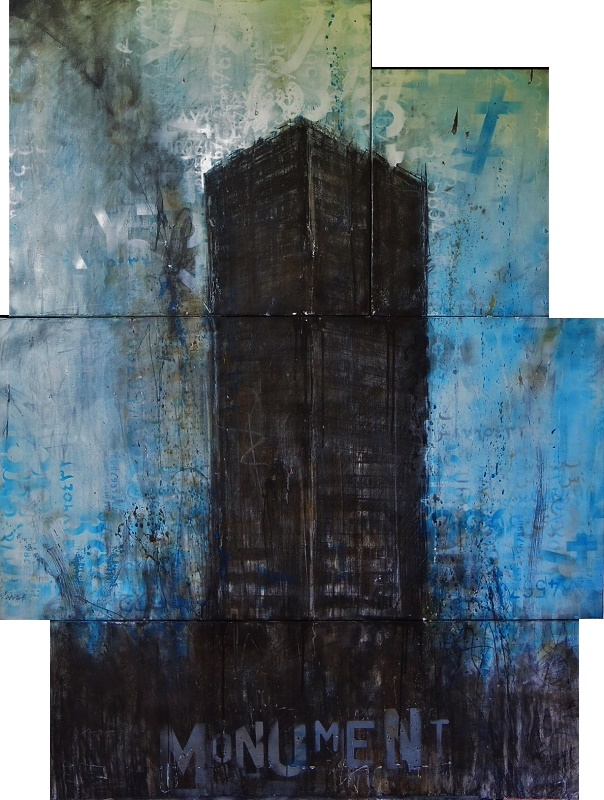
3240 monument 80 x 120 cm june 2017
“Monument”, conte and aerosol on canvas, 120 x 80 cm, 2017


back to blog menu