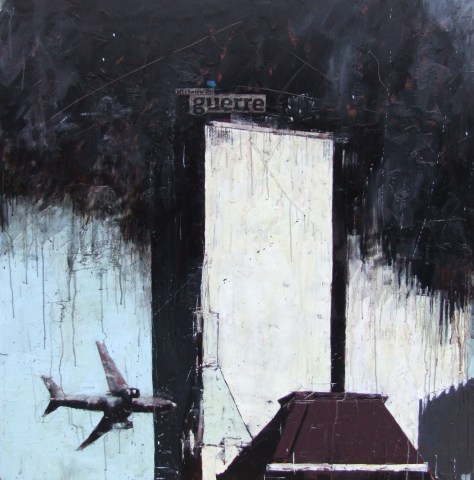
Viewing and meaning

When a painting is seen in the flesh (as opposed to in reproduction) it is invariably seen in whole and experienced as a complete and self-contained object. Personally my future appreciation of that work is tied to that initial viewing. I rarely come to love a previously un-regarded painting after repeated study. I may come to appreciate technical aspects of a painting I have never previously held any great affection for, but I cannot engender that same enthusiasm that a newly seen, exciting painting can create. This is an assumption based on the experience of talking to other collectors and gallerists so for convenience sake I am taking this as generally true for most, if not all, viewers of paintings.
On this basis I choose paintings that I would consider buying. I do not consider the title, the wall-note, the investment potential, the catalogue or any enthusiastic gallery sales pitch. I either want the piece or I do not. The next, and usually deciding, matter is affordability versus desire to own. I recently walked past a small gallery/shop in the Breton city of Quimper and was stopped by a small painting in the window. I went inside and found a small room piled floor to ceiling with paintings quite clearly of only two subjects: seaside views populated by picturesque rowing boats and floral still-life paintings. Clearly the painter was pandering to two markets – all bar this one, small painting of a young girl on a bed with a flute. And it stood out, in my mind, because of its honesty. I asked about it and all the artist could say was that it was a portrait of her daughter.
In my mind, the reason for this one painting taking my attention was because of its honesty; because of its refusal to pander to a perceived market. It is relatively crude in its technique, it will probably never be worth any more than the fifty euros I paid for it, but it is simply and honestly beautiful. I know that if another painter saw it then I would lose that opportunity to own it. That was my interpretation of the painting and my need to have it.
Where is this going?
Once again I have been asked by a collector to explain the meaning of a painting; the relationship between the exhibition theme, the painting itself and its title. I have always found this particularly difficult because so much informs my work at all times through its production and I do not keep a diary of all these influences. My first worry is that if I offer an interpretation, no matter how involved, well considered and clearly expressed, that challenges the collector’s initially held ideas about the work then I am not only doing them a disservice by questioning their own interpretation, but I am potentially ignoring aspects of the work that they have found more readily than me.
I do not have all the answers to my work. If I did then I probably wouldn’t have the obsessive need to progress it. Herbert Read stated that “A work of art is not present in thought, but in feeling; it is a symbol rather than a direct statement of truth.” It is that old cliché that painting is all about the external expression of the inner processes of art and the artist, which though currently unfashionable does seem to chime inside me as bearing some nugget of truth. More importantly he follows this with “That is why the deliberate analysis of a work of art… cannot in itself lead to the pleasure to be derived from that work of art. Such pleasure is a direct communication from the work of art as a whole.”
So in refusing to any more offer in-depth interpretations of my own work I am not playing the role of misunderstood, stroppy, prima-donna – I’m just quite honestly saying that I really cannot relate all of the informing influences. From the initial idea, through the related research of others’ intellectual ideas, to the preliminary sketches, the changing technical aspects of my own painting learnt over thirty years, the influence of lessons learnt from other painters (living and dead), the music I listen to while I paint, the news I hear and the books I read.
A friend (who is blessed with the abilities to both paint and write) recently helped me with this conundrum quite succinctly. I related this problem of defining my work to collectors seeking an explanation and he just replied that if I could thoroughly express the purpose or meaning of my work in words then I would do so. But I choose to do it visually because that is the language that I naturally default to. It sounds obvious when someone else says it doesn’t it? And if you don’t trust my friend down the road there’s always Barthes in his ‘Death of the Author’ where he states that a text’s unity lies not in its origin but in its destination. I’m not a philosopher. I might be a thinker and a reader, but primarily I’m a painter.
viewing-and-meaning

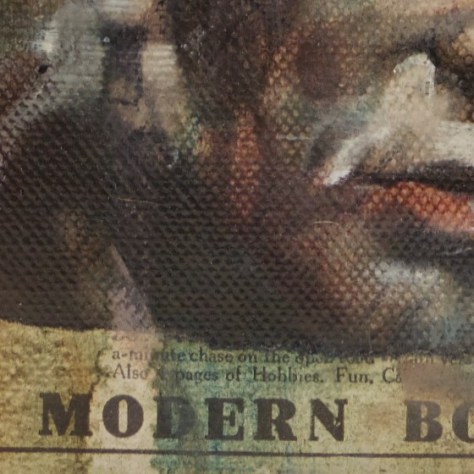
painting detail


back to blog menu

The beautiful people

I do not know for certain if the apparent contemporary public obsession with the idea of ‘celebrity’ is any more intrusive on our lives now than it ever was in the past – but I suspect it is. There clearly was a time when the notion of a celebrity was a more localised and small-scale phenomenon, but because of the nature of our modern globalised media it has mutated into an exaggerated cult of a rotating register of a few hyper-celebrities.
Undoubtedly I will be accused of being at best a curmudgeonly Jeremiah, or at worst a cultural elitist but personally I think this obsession is damaging not only to cultural growth but also to general social well-being and development. Also I would not place all the blame at the foot of all the individuals in question, who are inevitably (primarily because of the incessant media and corporate driven demand for novelty) also at risk of being victims to the machine. I would also like to clear up that I have no objection to individuals seeking recognition when working in any clearly very public arena; that is the nature of that beast.
My personal objections are reserved for the extremes of what I consider an industry that operates in an increasingly moral vacuum. The uber-celebrities that crave simultaneously absolute media attention and personal privacy; that see the idea of celebrity simultaneously as both the ends and means; that crave public sympathy for their plight as a celebrity; that have achieved and maintain recognition for no other reason than their capacity to spend unearned wealth; that expound to a general public on the morality of charitable donation whilst simultaneously doing their best to avoid paying taxes; that expect to be lauded and deified; that declare authority in arenas they are clearly unqualified for and most insidiously, the uber-celebrities that present their lives as a realistic aspirational goal that all should aim to emulate.
Digging for ideas and inspiration for the upcoming Hollywood show around the theme of these socially dysfunctional ‘beautiful people’ and the sometimes self-destructive nature of celebrity culture I half-remembered a line of a phrase in the last Shakespeare play I saw at Stratford. Looking it up properly I came across:
“O, wonder!
How many goodly creatures are there here!
How beauteous mankind is! O brave new world,
That has such people in’t! ”
They are the last words spoken by the character Miranda in Shakespeare’s ‘The Tempest’ – and seemed to have an ironic relevance to the modern notion of the eternally solipsistic uber-celebrity.
Then of course this (or my notoriously goldfish-esque attention span) led me to Aldous Huxley’s ‘Brave New World’ which I read nearly thirty years ago and have sadly more or less forgotten about.
I used to worry that the world (particularly Britain before we left) was slowly sinking into an Orwellian morass of state-surveillance and excessively prescriptive legislation. I can remember writing in the wet paint of one of my pieces (‘You’ll be wanting a happy ending then’) something along the lines of how, at school at the start of the nineteen-eighties, I used to laugh at the implausibility of 1984’s super-surveillance world – just as it seemed to be fulfilling itself as an increasingly accurate prophesy of twenty-first century Britain. All this time worrying about the potential of George Orwell’s novel to predict our future social and political course and I had forgotten Huxley…
In 1931 Huxley imagined a future world where the population are pacified through mental conditioning, state supplied drugs and, more relevantly now, through the encouragement and celebration of consumerism to the ends of eradicating personal dissatisfaction.
Huxley suggests that if a population is significantly distracted by a culture that obsesses over physical appearance and recreational, responsibility-free sex; is contented and free of unrealisable aspiration, then the state will not need to prepare to crush dissent in the manner Orwell predicted. There will be no need for the Thought Police if the population’s thoughts are permanently directed at nothing more than pursuing accomplishable, hedonistic, self-serving, ends.
And to my mind, the excesses of our celebrity obsessed media exemplify that corporate (replacing state) attempt to control through a culture of inanity and disposable distraction.
In terms of where we are now I think it is clear that Huxley was nearer the mark than Orwell – even if I do frequently consider the incessant celebrity onslaught to be the potential cast list in my own personal room 101.
And on the subject of room 101, there was one final little irony turned up whilst I was wandering around this thought from nowhere of little real significance (a novel is a novel – real life is real life).
Interestingly (for me at least) dates in Huxley’s future world are defined in their time from the first major instance of mass production for consumerist ends, using assembly line methods: the introduction, by Henry Ford in 1908, of the Model T Ford.
The novel is set in 2540 which in this consumerist driven dystopia translates as “The Year Of Our Ford 632”.
Well, I so liked the idea of incorporating that idea of the Year Of Our Ford into a painting that I had to calculate the current Anno Ford.
It’s 101.

the-beautiful-people

“fucked up celebrity #1” 2009


back to blog menu

Masters of my world

Because art has now become viewed as a progressive and loosely ‘intellectual’ practice, where new methods and media of expression are a pre-requisite to it being considered as serious, young student artists have tended to work in any medium except those that have a traditional craft base. This is not a new development and this ideology has become so ingrained into the art education/production/market system that it has further reinforced itself over the last forty or so years.
It has now been possible to produce art of critical acclaim that involves ideas as diverse as tinned shit (Piero Manzini), wrapping an existing canonical art object in string (Cornelia Parker), a gallery light repeatedly switching on and off (Martin Creed), accumulations and presentations of ‘found objects’ (Marcel Duchamp), textual descriptions about art (Art and Language); to the point now where it is fully accepted within the public mind that art can be, and now indeed is, absolutely anything. However, the key ingredient in successfully establishing these works as accredited ‘art’ is not the art work itself or its reception in the public sphere. Invariably the success is manufactured through either the intellectual theorising that underlies the work, or more commonly, the intellectual theorising that arises critically after the display of the work.
This critical response is the key manufacturer of the current stasis in the methodologies of contemporary art production and the important thing to understand is that this critical response is neither independent nor disinterested. Despite their protestations to the contrary the critical elite are feted and indulged to deliver a positive and exclusive account of contemporary art that matches an equally exclusive market controlling and feeding an art collecting oligarchy. This is maintained by an exclusive and limited core of galleries who are in the main just like any other wealthy businesses. It is this reality that is frequently displaced for an assumption that their owners must have a peculiarly prescient critical eye. As with any other business that is essentially a shop front for extremely exclusive and expensive luxury items they feed a market that is driven by an incessant necessity for the fashionably new as a substitute for absolute exclusivity.
A gallery with this peculiarly wealthy collecting base will trawl a few, safely established ‘radical’, colleges for any apparently new idea, regardless of its merit aesthetically or intellectually. To support this new find a critical treatise will be formulated that uses an intentionally obscure combination of ambiguous art clichés and references to previously established safe canonical artist’s work.
Then the art machine is initiated. First the artist is flattered with inclusion in commercial exhibitions with the established gallery artists to add critical weight by association. Then, after a while, the eventual ‘long-anticipated’ solo show, first displayed through a private exclusive show of the wealthiest and most predictably acquisitive collectors. If the work has not actually sold then it is not unknown for the mystical red dots to appear anyway, to create the impression of a potential lost opportunity to other buyers. At some point following this auction houses will also be manipulated (neither are the auction houses themselves innocently unaware) and will take bids, sometimes openly, from the gallery owners themselves – needless to say this is solely a purchase on behalf of a third party that was unable to attend (or mysteriously never bought directly from the gallery earlier) and it is only a side benefit that it raises the market value of the artist. One other key ingredient, at the most prestigious end of the market, is to arrange for the kindly donation of a significantly expensive piece of work to be donated to an equally significant national, public collection. This of course instantly raises the value of the remaining stock of that artist’s work still in gallery storage, including those pieces previously assigned red dots without an actual purchaser.
The artists are happy because they can afford to live and work without having to resort to that uncivilised dead-end of taking a ‘real’ job. The collectors are happy because they have not only acquired a degree of one-upmanship amongst their peers (who may still be collecting last year’s name), but they have work that will have a cultural stamp of quality and may even (should they be fortunate enough to repeat the exercise over a sustained period of time) have their name forever associated in history as a connoisseur of their time. The galleries are happy too, for not only are they making the money, they are instantly assigned a historical, cultural kudos that follows no other shop keeper.
Throughout the process, this select band of galleries will invite critics to the most exclusive opening nights, to meet the wealthiest patrons and arrange the introductions to those creating the most ‘relevant’ work. And unlike a thousand other exhibitions of unknown artists, in even adjacent galleries, those critics will attend; for fear they are struck from the list of those driving the cultural Zeitgeist. They can then take this air of being on the inside of an exclusive world to their commissioning editors, justifying their positions as the arbiters and reporters of national cultural taste.
This situation is not necessarily wrong, it’s just the way it is. Also it is not a new affliction or even particularly hidden. It is very likely the last legal unregulated market place left in the world, probably because, at this level, it deals with that strangely intoxicating and unreal notion of national cultural identity.
However, despite their own consideration of importance within this system, in general the art critics do not deem what is artistically worthwhile; why should they bite the hand that feeds the machine?
Neither do the artists; they just work at, and after, college in the hope that they will be ‘discovered’. Perhaps there will be the occasional student who will attempt to engineer their work to meet where they hope the future art market will be, and the lucky few who will naturally meet it by accident. But most will just be ignored. Very occasionally there will be an artist who can use the mechanics of the market, perhaps through a fortuitous meeting of a relevant contact, to launch themselves into this rarefied environment; they are the exception.
The general art buying audience has little input into who achieves artistic recognition in the high-art stakes. The small audience that constitutes the greater mass of significant spending are led to their trough. Clearly this is the safest route otherwise they would be risking not only their potential returns but perhaps even their capital (and at this level art is a most significant investment), not to mention their credentials of impeccable cultural taste.
The true taste-makers are the small circle of gallery owners that choose the new art at source, and they choose to primarily feed a market that, like all modern markets in non-essential goods, needs novelty.
I suspect that we cannot put this genie of novelty and shock-tactic art back into its bottle unless we change not only the art market, but the economic system that has brought such a wider buying public into the potential of affording non-essential, luxury items. When the luxury item exists and it is used by its purchaser as a supposed mark of exclusive superiority in taste amongst peers then there will always be a need by another collector to have the next, the better, the more expensive, the more exclusive, the stranger. The current elite-gallery system is the natural provider for that commodity in such a system.

masters-of-my-world

“Screaming head” 2006


back to blog menu

How painting works

Take a map from a foreign, and perhaps strange, country. Leave your house and navigate a local journey with that map. Either you can use the map and attempt to match your journey to it or you can follow your known routes of roads and paths and try to match the map to them.
That is the middle.
Opening the front door and leaving with that map…
That is the start.
It’s not as easy as the middle, but it’s easier than the end.
You won’t know how the journey ends but you will certainly, eventually arrive somewhere. And perhaps even after several false destinations on the way. You won’t even know when the journey is going to end, but after it has ended you will know for sure that it has.
That is the end.
That is how painting works for me.

how-painting-works

studio painting


back to blog menu

Cans festival

BANKSY’s ‘Cans Festival’ is the latest urban art show attracting the ire of the establishment art critics. Despite not being the first, but because he’s been the one with the most identifiable name, BANKSY has always been subject to lazy journalistic sniping.
I don’t have a problem when the criticism comes from quarters that just object to graffiti per se. When they view all graffiti, whether carefully planned and executed or just quick tagging, as an offence of aesthetic destruction upon our carefully built and lovingly maintained urban environments. That’s a choice that the individual is entitled to take, much in the same way that I object to all the oversized corporate street advertising that my senses are assailed with on a daily basis.
The criticism of today’s street artists that winds me up most is generally that coming from the establishment broadsheet art critics. It’s usually un-researched (probably because there hasn’t been a personal invite to a private view to schmooze and drink free wine), generally lazy (with no irony this is one of the main accusations they lay at the door of the artists) and, more often than not, demonstrably written from a position of ignorance of the urban art scene. Even if a criticism makes no direct reference to established contemporary ‘fine’ art, the critical definitions are couched in the same language so as to reinforce the authority of the ONE TRUE WAY of reading art; the contemporary broadsheet critic’s way.
It is easy to attack ‘urban’ work as ‘simplistic’ if you don’t agree with the message, but that’s because you can read the message so directly. The flip side of this tends to leave the critical quarter assigning depths of profundity to contemporary fine art that even the responsible artists fail to comprehend after the event, and this is because much contemporary conceptualism or installation work is not directly or easily accessible (and neither is much of it meant to be). This isn’t necessarily wrong; there isn’t one way to make art. But neither should there be one method of criticism – I don’t complain that Mahler’s music doesn’t make me want to dance.
For a lazy critic urban work is easier to read than much of the pseudo-philosophy wheeled out to assail the senses of the public-gallery audience usually held to be the apex of contemporary art. Because urban art is readily accessible to a public not readily versed in postmodernist or poststructuralist theory, because it undermines the critic’s position as interpreter (or original author) of meaning and (until recently) because it has been outside of the financial circus of contemporary art the critics have shied away.
It is this last point that is already changing the previous establishment disregard for graffiti and other urban art. Now that this once renegade art form has found an audience ready to pay establishment art prices, many private galleries can no longer afford to ignore it. They are catering to a growing audience who buy aerosol stencilled work on a brick wall as readily as oil paint on canvas. An audience that has a desire for art that doesn’t stand above them, like a naked emperor, with its air of supposed intellectual superiority. An audience that know (like the artists) that art will never change the world, but that can take comfort in the fact that someone feels the same way as them about current issues.
Today the people that look to graffiti and other politicised art are aspirational of change in the same way as the agitprop of the Paris art students of 1968; only in the eyes of a critic, scrabbling for an ‘angle’ for an article, could it ever be a competition.
Mark Wallinger appropriated BANKSY’s work for his Turner Prize victory in 2007 where he was praised for his ‘bold political statement’ – never an accolade given to BANKSY by the critical establishment.
Now that Damien Hirst is collecting British urban artists (where previously the audience was considered art-ignorant) I’m sure we’ll soon see a critical about turn.

cans-festival

Street work (Brest, France)


back to blog menu

The hours are worse

For the first time in my twenty years of borrowing, begging and blagging exhibition space I’m in the position of turning away galleries that are coming to me to show my work.
I’ve got group and solo shows booked pretty solidly for the next two years and other commitments stretching five years into the future; and they all came to me… How things have changed. Best not take the piss then. Best get on and ‘knuckle down’ as my mother would say.
I am also now able to sell all the preparatory drawings for paintings, which strangely adds a little more pressure. If people are paying for them I feel the obligation to work them a little more thoroughly and at least commit them to a decent paper. The disposal rate hasn’t dropped though; if I’m not satisfied with a drawing I’m not going to ask someone to part with money for it. Now that I’m logging all these drawings, and selling them, people might actually see how much work goes into a finished painting. Not to mention those drawings that never make it to canvas and the preparatory oil paintings too.
In some ways I’m glad that I lost all those years of old sketch books and experiments in the studio fire. They wouldn’t stand up to the work I’m doing now, and though I don’t think I would’ve ever sold them… well – you never know what’s around the corner do you.
I’m doing quite a lot of new paintings using just black and white (with very light oil glazes) and I seem to be getting some interesting results. How long this aesthetic and technical avenue will last is anyone’s guess. Something else will come along eventually…
It’s midnight here now. I’ll finish this entry and get on with some more drawing.
I wouldn’t change a thing in my life that has led me to where I am currently. I’ve now got one job; I’m a full-time painter. And after twenty years of supporting it with other jobs I’m prepared to treat it like a job, to work as hard as I can at it and produce the best work that I can. There is one difference between this job and others though. The hours. But at least I can smoke and drink at work…

the-hours-are-worse

Exhibition at Mauger Modern, Bath.


back to blog menu

Keep looking

Following the exhibition of my 9/11 World Trade Centre paintings, several viewers of the work questioned the dimensions of the plane in relation to the towers in the paintings. Though the paintings were taken directly from photographs and videos of the events it seems a common thing for viewers of the paintings not to realise how small the planes were (comparatively), and consequently how small the human scale is down from that. It’s as if we are so used to seeing television images of all horrors imaginable that we no longer really take in what the images are recording. The ubiquity of instant media imaging, and its rapid turnover, has almost made every image itself disposable as the next disaster takes its visual frame in our daily news.
Working on from replicating the images themselves I have now extended the modification of the finished paintings to the point where they no longer seem derived from the original source. I am now looking at creating contrived constructions of views that were never in the public eye because they were never actually recorded on film.
As well as these most memorable of recent news images I have been taking other press photographs and personally ‘processing’ them. Civilian and military war casualties, victims of social and political policy failures, drug addicts (legal and otherwise), the ever common celebrity excesses and all the other less than positive markers of twenty-first century human civilisation… I want to take the images that we no longer really look at and put them into a medium and location where slow and considered ‘looking’ is not ephemeral or secondary.

keep-looking

“Cashing the put options” 2007


back to blog menu

What a year

The Red Propeller 5/11 show seemed to pass off rather well. Actually, in comparison with my previous shows over the last twenty years, that has to rate as the understatement of my career. The private view was very well attended, despite the galleries relatively tucked away location. Work was being eyed up from the start of the night and by the end of the event more than half had been bought or reserved. Within a fortnight virtually all the work had sold – a new experience for me; hopefully one which I can repeat in the future. I also met up with a likeminded soul in the person of Mister Aitch, another artist who considers politics in art as being more or less a pre-requisite. I’ve been conversing over the electronic ether with him for a few months now and we’ve also been exchanging work. Hopefully sometime in 2008 we might get to put a joint show together celebrating the joys of the concept of state governance – I’ve just got to fit in with all of the other demands put on me following the new found interest in my work.
I’m not complaining. It would be disingenuous of me to whinge about the turn my life has taken since July this year. Admittedly as I’m typing this I’m looking out of a window at Brittany’s best horizontal rain, but I’m not preparing for a Monday trip to a hospital job. Following the damage to the studio I’m dressed to paint like an Eskimo, but I’m not worrying about union cases to represent for the following week. And though we’re separated from all our friends in the UK we’re making new creative contacts here. Only yesterday I was contacted by a local newspaper who were given my details by a local gallery owner who we’ve been getting on famously with – I’m not sure of the reasons yet!
There’s the ‘twelve days of xmas’ show that Motorboy has been putting together in Bristol coming up shortly. I would have liked to pop along but I’m too busy here at the moment. As well as sending some work his way I’ve been working on paintings for a January joint show at Signal Gallery in London. I really wanted to submit to this exhibition as Harry Simmonds is showing too and though it doesn’t really count as a ‘neomodern’ event it will be nice to have my work on a wall with his. A couple of people have expressed an interest in curating a specific neomodern group show and I’ll do my best to encourage their enthusiasm – we’ll see what happens.
I’ve also got to submit work for consideration by the auction house Bonhams for their impending urban art auction and though most of the die-hard supporters of ‘urban’ art probably wouldn’t consider my painting urban enough I have to be grateful to those that have broadened their buying from pure graffiti influenced work. It is this group of art buyers that have put me where I am now.
Even though I’m not a street artist I would like to be considered as working from a similar perspective as the more traditional (if there can be such a thing!) urban artists, even if my media and methods are different. We all seem to find a need to express ourselves politically through art and I think it is this that has generated so much interest in the genre of late. There is a generation that grew up through and after punk and see creativity as being intrinsically linked with social commentary. I think for most of these people the antics of the meticulously engineered and controlled contemporary art market, not to mention the deliberately obscurantist and pseudo-philosophical output of some of its most famous creators, is considered irrelevant to domestic scale art consumption. I’ve frequently associated BANKSY with an artistic identity not totally unrelated to the 18th century English painter and engraver Hogarth, and I think you can extend the comparison to many other contemporary ‘urban’ artists.
I’m still working full-time on the painting. One of the particularly good things about the move to rural France is the loss of distraction and the ease with which I can focus on painting literally full-time. The latest pieces are, I think, even more layered, worked and laboured over than those from the last half of 2007. I don’t know if the work is getting more intense in the viewing, but it’s certainly getting it in the production. I’m also still working on the few pieces that were not ready for the 5/11 show including more concerning the 9/11 attacks.
I’ve also received positive emails and comments regarding the paintings that deal overtly with the World Trade Center attacks, these were the paintings that I was most worried for about the feedback. One woman, an American, told me that she looked at my site after being told about them and was moved to tears by ‘Vanity Fair’. This was definitely the career highlight in terms of a viewer’s response to any of my painting.

what-a-year

“Vanity Fair” 2007


back to blog menu

A question for students

What took you so long?
Alright, so it’s not the fault of the existing generation; the blame should be laid at the feet of those that truly were the ‘children of Thatcher’. There have been a few raised voices over various issues since the maintenance grant, made compulsory in 1962, was formally undermined by the creation of the Student Loans Company in 1990. The problem with the protests of the last twenty years is that they have generally only been vocal enough to feature in the media when it is over issues of student finance. Even though these current protests relate directly again to the personal financial interests of the students there does seem to be a general change in the zeitgeist. The issue of education funding seems to be a convenient hanger for a deeper ideological malaise.
There has been a gradual increase in protesting student numbers as the anti-war movement grew, but they were always on the fringe. Now it seems they’re back. The noisy, angry, idealistic, unreasonable student. Thank god – if we can’t rely on the spirit of youth to have the energy to demand political change who else is there?
I listened to a BBC programme this morning attempting to pass itself off as a ‘debate’. The starting point being whether the students should even be allowed to protest or not. Apparently rather than popping into town of an evening and feeling some sort of solace through the expression of comradeship with a like-minded community they should be too busy studying towards making themselves correctly functioning production and/or consumption units in our broken neo-liberal economy.
The same people that celebrate the protests of the aggrieved elsewhere in the world see no contradiction in demanding their children and friends get off the streets. The same generation that to a greater degree have benefitted from post-war social policy giving them near full employment with employment rights, more secure housing entitlement, some degree of pension provision with a period at the end of their lives to use it and, ironically, free education.
So hats off to the students. Be reasonable – demand the impossible.

a-question-for-students

“The sound of free speech” 2010


back to blog menu

Lucky

We’ve had a sobering experience. A very sobering experience. Through some freakish accident that nobody can really work out we had a pretty serious fire in the studio last night. We were lucky that a passing kid saw the flames from the road and banged the brains out of the front door to alert us before it came to the point of no return; as well as having the foresight to telephone the fire brigade before he alerted us. As it was I had time, with the assistance of the mystery French youth Nicolas and my brother-in-law (who’s here on holiday) we managed to suppress the flames until the properly equipped blokes turned up. The heat, smoke and fumes were unbelievable but I’m so glad that we persevered. The heat left us with 300 melted favourite CDs, no working materials, a totally destroyed collection of over 20 years life drawings and other work, no studio doors, windows or electrics and the relief that the structure of the house was saved and none of us were hurt.
Most of the paintings for the impending 9-11 show at Red Propeller on the 5th November (no irony eh?!) were saved but I have lost virtually all the work on paper, 2 finished canvases and a couple of unfinished canvases.
I’ll be spending the next few weeks working on replacing the pieces on paper as I hoped these would be more affordable for people than some of the canvases. It’s also broadened the French vocabulary today. Déclaration de sinistre – insurance claim. Mètre fondu de l’électricité – melted electricity meter. Merci, merci, merci Nicolas – vous n’avez aucune idée comment reconnaissant nous tous sommes. I’ve probably buggered the grammar, but I hope you understand the sentiment.

lucky

“Refugee” – destroyed in studio fire


back to blog menu