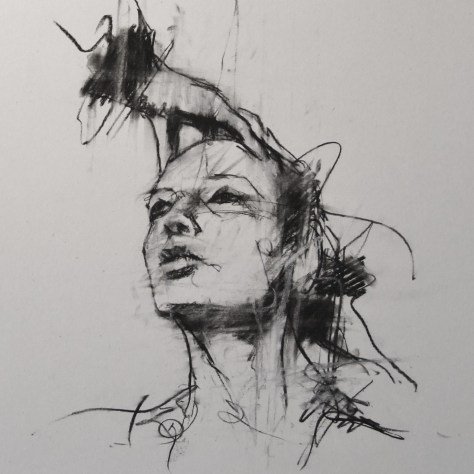
Ben Oakley Gallery (December 2016)

The work made for a mixed show at Ben Oakley Gallery, London, on aspects of youth culture in the 1980s.

back to work chronology menu

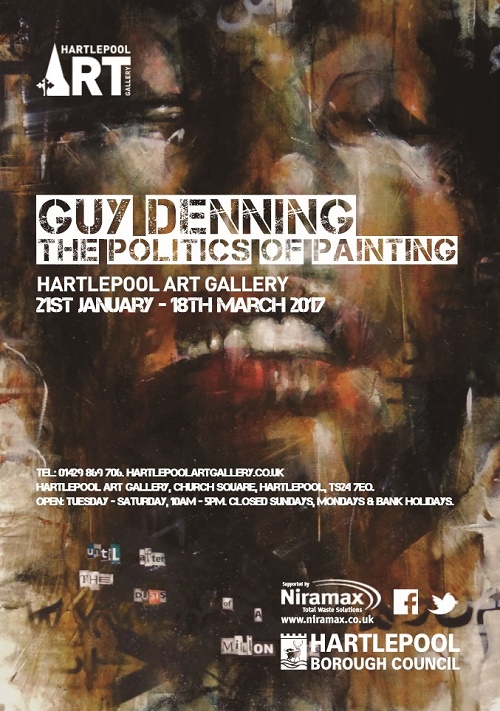
The Politics of Painting

This is the largest show of work that I’ve put together; there are eighty pieces dating back to the 70s to try to give an indication of how my work has changed over time. The main underlying theme though is the presence of politics in my work. A well-meaning friend (who happens to live in London) suggested that I was ‘too big’ for Hartlepool Gallery and I immediately challenged him. An offer to show in a public gallery space is an honour and I have been thinking long and hard about the best way to show something beyond a gallery exhibition of latest work available for sale. As well as some new paintings that have never been shown I have pulled together work from family, friends and collectors as well as rummaging through the studio for pieces from significant shows that I have kept. Unfortunately, due to a studio fire in 2007, the older work is a little sparse on the ground – but I hope the show gives some idea of how I got to where I am now. Previous visits to the North East have always been related to my old trade union activities so it will be great to visit again with my art.
A side benefit… A show of work that looks back over your career can be formally called a ‘retrospective’. If it’s mounted when you’re 51 it could be called ‘mid-career’ (just!). Which means I should have another thirty odd years doing this mad job. Excellent!

hartlepool
(a retrospective?)

GUY DENNING – The Politics of Painting
Hartlepool Art Gallery, 21st January – 18th March 2017

back to blog menu

Just because you say it doesn’t make it so.

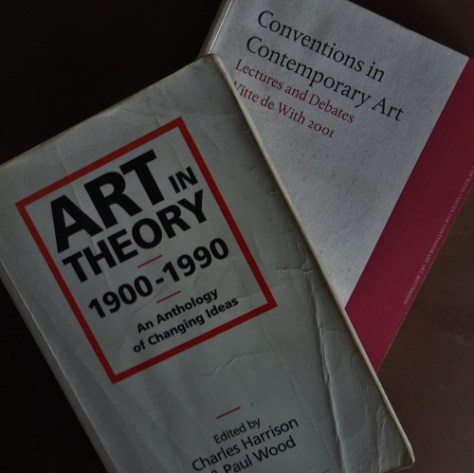
A couple of dictionary definitions…

ART: the quality, production, expression, or realm, according to aesthetic principles, of what is beautiful, appealing, or of more than ordinary significance.

THEORY: a proposed explanation whose status is still conjectural and subject to experimentation, in contrast to well-established propositions that are regarded as reporting matters of actual fact.


If a thing needs explanation of its reasons for being and its creation then the common assumption is that the thing’s purpose may be difficult to comprehend without the intervention of the appropriately qualified expert to elucidate the unqualified. The expert will explain the intricacies and complications of the specialist language that has been developed to support understanding of the functioning of the thing. The expert will translate the language of the specific into the language of the general – which begs the question as to why as simpler language wasn’t possible in the first place.
The rarefied world of contemporary art theory must rank equally with contemporary economic theory in being culpable of the crime of being intentionally opaque in its mechanisms and justifications. And since of course both can only be understood by the appropriately qualified language experts in their relative fields, we further qualify them by refusing to deny the unnecessary complications of each respective specialist language.
We falsely assign higher qualities of expertise (which in the arts translates as talent) to those that can express themselves fluently (no matter how incomprehensibly) in a given specialist field of endeavour. If we do not understand that expression then we quietly step down to a position of comparative inferiority in the scale of understanding of that field of endeavour. We back down in the face of the ‘expert’ who clearly knows more about the subject than we do. But we are not deferring to the authority of the subject. We are deferring to the expert’s familiarity of the language about the subject. And that is a very different thing.
Interestingly both recent economic and art theory are treated by some of its most highly regarded practitioners of being nearer to fact than theory. And their respective specialist languages keep the critical general public at bay and the informed critics side-lined as reactionary throwbacks to a bad and wrong history.

2764 that jokes not funny anymore 27 x 45 cm august 2016.JPG
“That joke’s not funny anymore” conte on newsprint, 2016


back to blog menu


Why did you paint/draw that?

Among the most frequent emails I receive are those with the phrase ‘What does this painting/drawing mean?’ with an attached image of something I’ve posted on facebook or this website. I’ve stated before that the reasons behind my work are various and that they frequently change during the process of the work being made. Informed by the news media, my previous work, the work of others in all creative fields, life in general and my imagination it is difficult to reply with any clarity – particularly if it is an older drawing or painting.
If I wanted to produce something with a singular clarity of interpretation then I would be very careful in its construction to enable that.
So I’m not being intentionally awkward when I’m intentionally silent on this subject. If I dish out the ‘official’ reading of any piece of my work I am potentially undermining other readings that are more pertinent to any individual viewer. I am doing my job in expressing myself and that expression is my business. The viewer’s job is to find within that work the elements that mean something to them and it’s an equally valid part of the relationship between artist and audience. Visual art with a clear and simply read message is either advertising or propaganda. All art should be rich enough to support a diversity of interpretations – all equally valid to its potentially socially and culturally diverse audience.

why-did-you-paint-draw-that


back to blog menu

To be continued part 1

From recent reading of newspapers, magazines and general conversations (both personally engaged and surreptitiously overheard) there seems to be, once again, various crises in that strange world that calls itself the art world. The arguments and the issues are the same as they’ve ever been over the years – the first is the perennial nugget that a greater number of the general public seem to be incapable of falling in line with the art establishment’s critical pronouncements on what constitutes ‘good’ art. The second is that, once again, the contemporary art market is supposedly heading for another financial crash. The two wouldn’t seem to be immediately connected but there are certain links where each has a degree of involvement with the other.
Firstly my main assessment of the problem regarding the public distrust of the critical acumen of today’s visual arts commentariat is that it is a problem of language and definitions.
To simplify and lower the arguments to its base level you have a majority of public opinion that has continued referring to much of the twentieth century’s and current art production (that which is critically celebrated) as being:

  • Capable of being made by my four year old niece
  • Nothing more than the ‘Emperor’s new clothes’

To which the usual arguments wheeled out by supporters of these assumed excesses of contemporary visual art are:

  • You don’t understand it so you are not qualified to comment on it
  • Art’s essential purpose is to ‘challenge’ the viewer

Before any of these (admittedly simplistic – but essentially accurate) arguments can be addressed there is a far simpler (or perhaps more complicated depending on your position) issue to be dealt with; that is of the language used in establishing what we are at least talking about – let alone the language of the debate itself.
For example… the word ‘contemporary’ with regards to art production… Initially you wouldn’t think this should be problematic. The word ‘contemporary’ sits in the English dictionary quite merrily. It’s been there now for a few years and there is a generally agreed consensus on its everyday use. However within the argot of the “contemporary art” critic (which is not necessarily the same thing as a “contemporary art critic”) “contemporary art” does not encompass the work of all art production currently being made by artists despite their being contemporaries. This use of the word “contemporary” refers to its definition as being at the forefront of recent or current artistic fashion. Thus Tracey Emin and Hughie O’Donoghue, though coming from different artistic perspectives would be happily considered by most critics as fulfilling their criteria of “contemporary artists”. However many of these same critics would not consider someone like Shepard Fairey or BANKSY “contemporary artists” as their work would be considered insufficiently intellectually engaging despite them both being contemporaries of the other two artists mentioned. The ‘contemporary art’ critic uses a professionally specific definition of a word that has a common everyday currency. The same problem lies with the term “modern art”. For those educated in art history and critical theory “modern art” is an historical term (of amorphous definition but obviously always preceding post-modernism) and does not refer to art of our, contemporary, modern day. For the general public not schooled in this tortuous world of art-world English ‘modern’ art generally means the same as ‘contemporary’ art… Perhaps for the sake of the clarity of all the experts in the field could relinquish their grip on the word “Modern” and replace it with “Modernist” or “Modernism”; I’m sure that would indicate to the public (not educated in ‘art-speak’) in much the same ways that the words “Cubist” or “Impressionist” do that the speaker is referring to specific usages of the words regarding a specific field of intellectual specialism. It should not be the responsibility of the listener to decode the meaning of the lecturer. Isn’t elucidation the raison d’être of exposition? If the lexicon of contemporary art criticism could limit its use of the everyday language being associated with everyday definitions, and art-specific definitions residing with language constructed specifically for such specific terms, then that might go a long way to at least smoothing the way for a debate that’s not weighted against the non-specialist from the start.
Cutting-edge science is presented for a popular audience through the media of television and print with its main thrust seeming to be to engage the audience with complex concepts reduced to a simple form.
Cutting-edge art however, is frequently presented as excessively complex ideas whose intellectual authority need to be taken as a given, by an audience incapable of comprehending because they have not studied the subject’s theory sufficiently. If a public audience has been witness to the critical declaration of ‘found’ object or ‘readymade’ as art for over a century now, and they still refuse to accept the validity of that argument then the critical and theoretical presenters need to up their game. They could start by talking in clear language as opposed to this recent gem of ‘critical discourse’:

“…As a consequence of the reductive parameters of these conservatisms, such as rigid canons, fixation on objects and absolute field demarcations, activist practices are not even included in the narratives and archives of political history and art theory, as long as they are not purged of their radical aspects, appropriated and co-opted into the machines of the spectacle.”

If your job is to provide comprehensible commentary in a specialised forum to specialists with a specialised language – and those specialists understand you – then you’re doing your job; if the non-specialist doesn’t understand you it’s not your fault.
If your job is to provide comprehensible commentary in a public forum – and the public think you’re talking bollocks – then you’re not doing your job; and it’s your fault.

To be continued dot dot dot

to-be-continued


back to blog menu

Coincidence and synchronicity

Another year done… this was my fiftieth on the planet. By the traditional reckoning of my grandparents day, with the “two score and ten” now down I’m left with another score to go if I’m lucky. My birthday was marked by Colleen with a surprise trip to Madrid to fulfil my long held wish to see Francisco Goya’s “Black Paintings”. Madrid was a wonderful city to visit. Seemingly very relaxed and very friendly to tourists with live flamenco dancing and plenty of unplanned art gallery visits as additional extras to Colleen’s plans. We waited for the weekend to pass to hopefully minimise the numbers of visitors at Museo del Prado when we visited; I know that a visit to any gallery will take us a while as we always take time to enjoy what’s on offer. The room in the Prado that held the Black Paintings, despite their damage and sometimes botched restorations, hoovered up an entire afternoon of my time – just looking at techniques of composition, painting, over-painting and glazing. It was some of the most rewarding looking at of paintings that I can remember; it left me feeling like a technical minnow in the face of a giant and it was an absolute, though mentally exhausting, joy.
As Madrid was a new city to us we also thought it would be a good opportunity to trail around some commercial galleries with an eye to contact those that seemed appropriate to contact when we’d returned home… (I’m always on the look-out for new exhibition venues!) Unfortunately we barely left the centre of town as there was so much to see so that remained undone.
When we were home I then had a few finishing bits and pieces to sort out for the December ‘Paradis est Ici’ show at my Paris gallery so thoughts of potentially annoying Madrid galleries again went filed under ‘P’ for procrastination.
So to the start of December, while at Galerie Brugier Rigail, Paris for the opening of my show and co-owner Laurent Rigail told me that they’d been contacted by a new contemporary art space offering me a two month long solo show at the start of 2016. It’s a new contemporary art space in Madrid called La Neomudéjar. Coincidence or synchronicity?

coincidence-and-synchronicity

Outside the Museo del Prado

back to blog menu

The party is over

(text of the talk given at UNESCO stand at COP21)

I was first made aware of the politics of global climate issues in my teens in the early 1980s. I have followed the debate for over thirty years with increasing disillusionment as the predictions have been shown to be correct and little has been realistically done to effect serious long-term change. We are now at a point where we have to change not only our attitude to our place in our environment but also the entire economic system that underpins our society.
As much as environmentalism has been part of my personal political life, art has been part of my cultural and social life. My art has always been fed by my politics and this year, the year of COP21 in my new home country of France, it was an easy decision to make, to focus on the pressing issue of global warming and the singular importance of the COP21 event. All of my work this year has centred on increasing awareness of COP21 and it will culminate in an exhibition with my Paris gallery, Brugier-Rigail. As well as this I was kindly invited to make an art piece, with relevance to this conference, for UNESCO.
Unfortunately, because of the terrible events on the streets of Paris recently, increased security concerns have meant that I am unable to bring the materials to make this possible. So I will explain a little on what I have been making this year and the images of the year’s supporting work will show here too.
I started with the idea that there is no ‘planet B’. That we have no option but to address the issues on the planet that we do live on. It isn’t an enormous intellectual leap, but judging from our continued mistreatment of this planet and our refusal to accept that we cannot live forever on resources that are finite, it seems too apparent that it needs saying loudly and repeatedly. We have one planet, we have one chance, we have one potential paradise and that paradise is here. So the phrase was born in my head ‘paradis est ici’.
For a large number of people, religious faith plays a great part in their lives. The notion of paradise is inextricably tied up with this faith and within this faith the idea of the angel is an omnipresent figure of judgment, strength and hope. I personally have no religious faith, however it is easy for me to see the judgment placed upon humanity by an imagined angel should the circumstances arise. Whether our planet is the gift of a god or the result of a succession of intergalactic accidents the need to protect this prize, our only potential paradise, is the same.
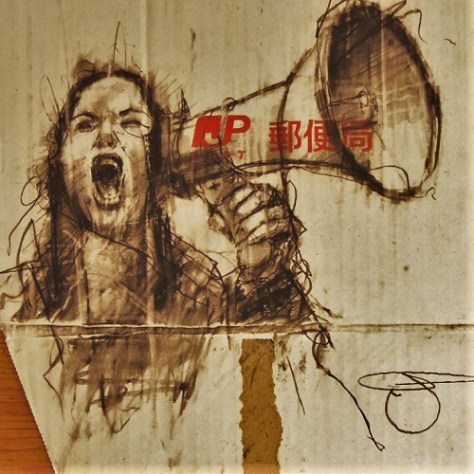
I have always used newspapers in my work. Besides being a good secondary use of a material that otherwise might go to landfill it acts as a personal comment on my dissatisfaction with the news media. The press rarely focus on the green agenda with the seriousness I consider it merits – so if I cannot find the headlines I am looking for I will make my own on their discarded media. Brown paper and packaging are another perfect medium suited to both my visual and political aesthetics.
The work is sometimes pasted up in the street. Hopefully it raises a thought, and perhaps a consideration of what it might mean, and hopefully an understanding of where my sympathies lie. I’m not trying to change the world. I cannot change the world but I can hopefully show others that may feel the same way as me about our situation, that they are not alone.
We cannot continue to live with the attitude that we are something different to the rest of the planet. Our fate is tied up with the manner in which we use the resources available to us. We cannot continue to warm the atmosphere and expect our lives to stay as they have. We cannot force extinctions on species and not expect further consequences in the chains that these organisms exist within.
We are living in an age of idiocy. An age when we convince ourselves that feeding beef-cattle for a small percentage of the world is more practical than feeding a global population on a vegetarian diet. An age when we continue to burn fossil fuels because the mantra of economic growth seems more important than a sustainable existence – despite alternatives being readily available. An age when water is taken from indigenous communities to be turned into tinned drinks for the so-called ’civilised’ world. An age when free public transport for all is seen as an unreasonable challenge to our individual freedom to sit in endless traffic jams in our own cars.
And humanity has a short memory. We have presided over an age of idiocy but the twentieth century will probably be remembered by some in the not too distant future as one of humanity’s ‘Golden Ages’. It was a time when, for the affluent west at least, fossil fuels were plentiful and other mineral resources allowed human imagination to realise the most fanciful dreams. Energy, like water, was more or less on tap. There was effortless potential for the common person to travel the globe. There has been plentiful food, available free of any seasonal restriction. We have benefited from social organisation that could provide the most exotic health care, retirement provision, general education, comfortable shelter and even support and care in the event of unexpected circumstances such as unemployment or disability. In 1957 the then UK Prime Minister Harold Macmillan said that “most of our people have never had it so good”. He was right, but he was unaware of the economic, cultural, social and ecological time bomb only half a century away.
Considering the profligacy of our time I doubt that future generations will look on our historical achievements with much sympathy. Our children will be paying for their parents’ and grandparents’ reckless waste. The modern world has been raised on an Enlightenment conviction that science and human capacity for reason could overcome any crisis thrown at it by nature’s inbuilt facility for chaos.
There is now a near unanimous scientific consensus that our planet is warming. There is also scientific consensus that human activity is responsible. There is also general agreement that this will have an impact on food production and fresh water availability leading to resource driven migration and conflict. The International Energy Agency stated in 2010 that oil production probably met its peak in 2006. The fuel might be running out but the fire is only just starting.
There is no credible justification for the crisis we are seeing develop in our ecosystem now.
The Swedish scientist Svante Arrhenius identified the potential of carbon dioxide to warm the world’s atmosphere over a century ago.
The US president was informed by credible scientific opinion of the reality of global warming in 1965.
In the 1980s my generation started to support environmental organisations that were predicting the issues we face now.
There is no denying that despite growing awareness of these problems we, as a species, have been too slow to seriously address them.
Global intergovernmental climate organisations have had their hands tied by powerful governments and these governments have had their hands tied by powerful business sectors. This issue is of an absolute existential importance to everybody on this planet. Up to now we have relied on our faith of governments to act in the interests of the people that put them into power; we have assumed that all the scientific opinion and information they receive is unbiased and based on evidence alone. This has clearly not been the case over the last century so now it is time for the people to stand up, to speak and to be heard.
We need, as individuals, to find and support the connections within our own families and our own communities that feel the same concerns. We have to look at our children, our grandchildren, our neighbours and their children. We need to recognise how the world has changed in just our small lifetimes and consider what changes face the future generations. Importantly we have to effect change in ourselves. We can make a difference. If the debate has to made within a capitalist framework then make the debate with your choices as a consumer. Re-use rather than discard, repair rather than replace.
We must not repeat the mistakes of previous generations. My grandparents saw in their lifetime a centuries old community centred economy replaced by a globalised economy that worked against the greater number of the population – in ONE lifetime. My parents were blinded by the drugs of convenience and apparent endless economic growth to seriously consider there was a need for any alternative. And my generation have been slaves to the false ideal of individualism and drugged with self-validation through consumption. We cannot wait and the world cannot wait. We must be the generation that finally addressed our own mistakes and the mistakes of our parents and grandparents.
That post-war, baby boomer generation were the most fortunate recipients of an apparent unbounded economic, social and technological golden era. They were born of a generation that had lived through two world wars but missed that insecurity themselves, they were the beneficiaries of fulfillable aspirations; they instigated various political, social and economic experiments in an attempt to create the perfect ‘Tomorrow’s World’ of their predecessors’ imagined science fictions.
But nature will not be beaten by hubris. The hard, physical reality of a limited resource of available minerals cannot be washed away with the expectation that technology will continue to fill our current, let alone future, material demands.
The party has been great for those that were invited but it’s all over now and we’ll soon be outside with the rest that never made it inside anyway.
We can make a paradise for everyone when we accept that we all share the only potential venue for paradise. Le paradis est ici.

the-party-is-over

paste up in Paris 2015


back to blog menu

Art, money and “Dear Mr Denning”s…

I recently received an offer from a French gallery asking if they could show and sell my work. As is normal in the gallery business the gallery expects me to pay to send the work to them and I would also have to fund the return of any work not sold. This is part and parcel of the gallery taking the work ‘on consignment’ – that’s posh art-shop speak for sale-or-return (i.e. they take no financial risk at all on stock they try to sell). I wasn’t surprised by this arrangement but it is a point I generally try to negotiate over; that the gallery pays for transport in at least one direction. What did surprise me was the commission on the selling price that this gallery expected – seventy percent… And to think that some artists’ eyes water when they’re asked for fifty percent (the norm). Needless to say that this gallery won’t be appearing on my Christmas card list in the near future. NEXT…
Dear Mr Denning… Would you like to make a piece of work that would be exhibited in a month long, capital city, public gallery exhibition? Well, of course I would. This will of course impact on my other work (commissions, future personal show work etc.) so what is the budget for this piece of work that this publicly funded gallery would like to show? There isn’t a budget? Ahh… so will the finished piece be purchased by this institution? No? Can I offer another piece of work that’s already made and available for display and you arrange for the shipping of that? No? It has to be specifically produced for this show alone… but you are willing to pay for the transport of the work – how generous. So you publicly paid, art professionals expect me to have to put off paid work and future commercial gallery show work so that I can make work that won’t be sold and won’t be paid for in materials? But it’ll be an excellent PR opportunity Mr Denning. And there are lots of other artists happy to be involved and they’re not being paid either Mr Denning. Splendid… and thank you. No doubt you museum-fellows go home at the end of your art-professional, paid working day to a plate of hot, tasty PR vindaloo. NEXT…
Dear Mr Denning… Why is your work so expensive? If I could paint and draw like you I would enjoy what I was doing and consider this part of the reward and (here it comes reader…) would sell my work much cheaper so that I could reach more people. Do you have anything cheaper available? NEXT…

art-money-and

“24 hours in the life of a madman 33” 2010


back to blog menu

A man with a plan

The end is approaching of my four year Dante project; the final part, Paradiso, should have its paintings drying within the next few weeks ready for the October exhibition in London. I’ve often turned to the writing of others for inspiration in my painting. Sometimes it’s clear, as with the Divine Comedy paintings or my occasional references to the poetry of Baudelaire. Sometimes it’ll be as simple as a lost lyric in the middle of song from some distant decade; I won’t be doing it again.
I’ve been working on a piece of my own writing for nearly twenty years. No publisher in their optimistically profitable mind would touch its profligate selfishness and lunacy. It’s very personal and generally autobiographical. But as in the best of all autobiographies it’s generally more fiction than fact. Actually it’s a completely bitter cocktail of lies, justifications, vindicated vendetta and saintly indulgences.
From this point I’ll be working further on the visual interpretation of it through my daily drawing under the ‘Madmen and English Dogs’ tag. The drawings serve as the starting point for proposed paintings and clearly there will always be more drawings than paintings as I’ve already put together about a hundred of them.
For my own records I’ll be keeping the drawings; the Madmen and English Dogs project is as much a personal project as an exhibitive one. I’ll be releasing small print runs of them though.
That’s the plan. Fewer, hopefully stronger, paintings – linked to my writing through my drawings and sharing a common theme of my fucked-up interpretation of what life and art’s about. Not particularly “innovative”, “transgressive” or very likely to “challenge the viewer’s preconceptions” but it will be an honest journey.
The destination will be the same as ever – worms and dirt. I hope it’ll interest a few of you out there, and with the internet technologies to show it off there’s no ticket price to pay. Don’t worry if you don’t like it – there are plenty of other faster, slicker, bigger and more expensive buses out there.

a-man-with-a-plan

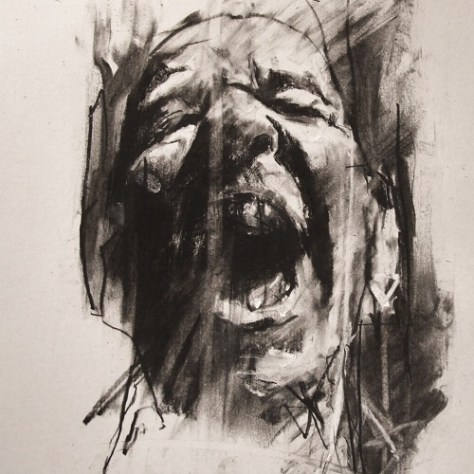
drawing from the “madmen and english dogs” work


back to blog menu

Duchampian rose among thorns

Currently in England for a quick visit and I accidentally stumbled on a self-funded, pop-up show in an out-of-business high street shop within the confines of the M25; names will be avoided to protect the guilty. What caught my attention was what appeared to be a minimalist approach to shop window display by a florist. Once I’d visually investigated a little further through the window into the unlit, dust mite sodden gloom I realised that I was having a close encounter of the contemporary art kind. There was nothing else happening at the time, the door was open, so I ambled inside. The artist was approachable enough, and initially quite enthusiastic, before I started asking questions on the subject of ‘why’.
The artworks consisted of various ‘contemporary investigations and re-interpretations of the folk-art of floristry’. This involved such presentations as a bunch of flowers in a decorative vase with the flower heads removed (Morticia Adams style), a bunch of flowers upside-down in a glass vase, a bunch of weeds in a decorative vase, a very traditional floral arrangement presented in a chopped-in-half and grubby plastic milk container. You get the picture…
It all seemed fairly obvious, but perhaps all art does seem obvious once someone else has gone to the effort of making it for the viewer to peruse.
I politely, and with genuine interest, asked for the reasons for the work and was informed that he (the artist) was challenging the gender stereotypes of floral arrangement, that he was challenging my assumptions of both what art can be and what its materials can be. Oh, and that he had studied at Central Saint Martins. It was also a celebration of the ‘fugitive’ in art and that I would be able to purchase ‘documentary photographic editions’ of the show. Apparently Marcel Duchamp was ‘almost in the room’, I looked briefly about us but I was sure there was no-one there but me and the artist; perhaps Mr. Artist was mistaken and Mr. Duchamp had popped out for bite to eat.
There was one piece that invited me to investigate further. A single yellow rose, on its own dais, next to an up-turned empty jam jar. I politely started with “Is there any significance to the colour of the rose?”
His response was clearly as unprepared as my question was unexpected. “Not really, but yellow does have associations with cowardice doesn’t it… unlike the colour red…” He didn’t pursue the chase beyond that.
“So, is that why you removed all the thorns from the rose?” I replied, not really cottoning on the fact that my first question was a surprise to him.
“Oh! No! I didn’t do that – I didn’t notice that!” His measured bubble of cool had inadvertently popped and his expression briefly transformed from ‘artist/philosopher at work’ to eyebrow wiggling, excited teenager. He sharply expelled the chirpy child with the low-keyed and calm, vocally expressed thought that this was ‘well weird’ and he wondered how such a strange thing could have happened.
I suggested that if he was not responsible then perhaps the flowers were purchased from a supermarket as sometimes they remove rose thorns to avoid being sued for customer injuries. Unfortunately he didn’t know for sure, so I presume he didn’t source his own art materials; there followed an awkward silence that was big enough to park a small car in. Foolishly I tried to fill the waiting, vacant and accommodating space.
“Perhaps you could replace the removed thorns with sewing pins or needles.” I ventured, “it could be symbolic of a violent human intervention on a violent natural world. Two wrongs not making a right, the cowardice of violence etc. …”
He liked this idea so much that he suggested even Mr. Duchamp (and his love of the strategy of chess) would’ve liked it too. Certainly. He also announced loudly, and as if the gentleman was within earshot, that there was someone at Central Saint Martins who would’ve liked this idea too. Sadly, the reputation and clearly obvious identity, of this individual was lost on me. Perhaps they, like Mr. Duchamp, were observing us surreptitiously through a crack in the wall.
The young artist liked the thorn/pin idea so much that he thought he might use it in the future and he thanked me for it, waiting as if for me to be equally and vocally grateful for his potential future use of my idea. My carefully manoeuvred, small mental car took on a life of its own and transformed, Optimus Prime fashion, into a fully articulated juggernaut. I shrugged, smiled kindly and reverse-parked, perhaps a little unkindly “Do you not think the art object should come from the artist’s conception as the physical manifestation of that concept for public contemplation, rather than the art object being the engine that generates an alternative and perhaps incorrect conceptual connection within the audience?” Reverse…
He wasn’t sure, “Perhaps.” And, after a pause rammed-full with pursed-lipped thought, suggested that perhaps it was ‘fluid’ and ‘dependent on context’. Not being a spiteful or rude person I nodded slowly. Kerb avoided.
I continued. “So the installation is as important as the concept and one does not necessarily have more authority than the other?” Parked.
He wasn’t going to be taking that one quietly…
“No, the artist as primary mediator between the conceptual and material is most important.” I was also informed that ‘they’ had looked at this issue repeatedly and thoroughly at CENTRAL Saint Martins.
I was tempted to ask him if he was always certain that the objects he presented were an accurate and effective representation of his ideas behind them. I wondered if he ever had doubts about his work or even his role as artist or ‘primary mediator’, but my preference for a quiet life without invoking conflict where conflict is unnecessary prevailed, and I left the Q and A where it was. I suspect there was little room for self-doubt here, from this graduate of… Did I mention that he went to Central Saint Martins? I know that this fine institution was mentioned by him at least four times in my brief, accidental visit.
I thanked him for his time and effort to speak to me, I congratulated him on self-funding a show and I left the small shop. As I stepped out of the door and into the street I just caught sight of the back of a hatted figure entering a pub across the road and fancied that perhaps it may have been the mysterious Mr. Duchamp; he certainly was not in the exhibition venue.
duchampian-rose-among-thorns

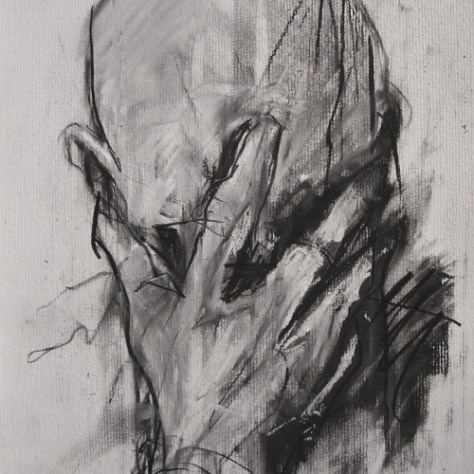
“24 hours in the life of a madman 23” (2010)


back to blog menu