So August 6, 2011 will go down in English history as the night when, once again, society seemed to disintegrate beneath the flames of street violence, anti-police sentiment, vandalism and looting.
The trouble continued into the following nights and I posted the piece of writing here. Now I’m not one for usually feeling the need to defend what I say or do to any great degree, but some of the emails I have received concerning my poem have been so vitriolic I feel I should write something in return…
I do not defend what has happened; anyone that knows me will know I am a pacifist and believe in the virtues of non-violent protest. But I have been thinking long and hard about why we have seen such an upsurge in violent protest coupled with organised looting.
I don’t think that what we’ve seen on our TV screens these last few nights is the important issue. We’re all familiar with violence and thieving in its many guises. I personally think that the issue of primary concern is that so many people were involved in what was clearly NOT a political protest. That so many people were so disconnected from a commonly accepted civic morality, to consider it acceptable to attempt to get away with whatever they thought they could get away with when an opportunity presented itself, is the important issue.
There was no single clear demographic identity to relate a cause to the symptom except age; the majority of the trouble felt was at the hands of the young. Whatever the reason is for the change in attitude to the idea of civil society, I think its core lies in generational differences.
What is it about the current cultural environment that has produced such a different personal outlook from, say, my generation?
Certainly something substantial drives individuals in such numbers to behave like pack looters. They clearly feel there is a selfish sense of acquisitiveness that needs fulfilling and they also clearly feel that this is perfectly reasonable; I’m sure it is justifiable and supported within their own peer group too. It is a sense of entitlement that the rest of us, particularly those who are older, do not consider right or excusable. What is so different about their circumstances?
I don’t know if they are contributory factors, but I do know that I did not grow up through the seventies and eighties a so thoroughly targeted recipient of consumer advertising. The era of disposable consumerism fed by incessant novelty product was far less intrusive than it has been for the last twenty years. Though there was always a childhood desire to be ‘grown up’ there was still a distinct separation in the mind of children between theirs and the adult world. That has disappeared and now children are just a different subset of consumer.
The celebrity culture that existed in my childhood was distant and tended more to an adult world than a child audience. It wasn’t all pervasive, it was considered trivial and it was never the focus of the news to the level it is now.
When I was a child was there a huge number of hidden children that suffered clinical depression? Or the varieties of eating disorders, suicide attempts or other psychiatric disorders that we generally consider to be (at their earliest) the concern of young adults but are increasingly creeping into the lives of primary-school aged children?
Was my childhood so unusual that until the 1980s the majority of my friend’s parents had stable work and affordable housing?
Was my childhood so unusual that the kids at my primary school only really aspired to occasional passing fashion fads? And is twenty-four hour, multi-channel TV creating a mental environment where everything (both on and off the screen) now has a life of a few weeks at best, creating a perpetual hunger for the next fashionable ‘must-have’?
Is there a more readily accepted culture of entitlement, fed by media pundits, than there was when I was a child?
Is there more common, general public acceptance that politicians are more corrupt, and corruptible, than there was when I was a child?
Are the disparities of wealth between the extremely rich and the rest of the public more apparent than when I was a child?
Is money more central to our ideas of cultural and social value now than when I was child?
I know it isn’t a simplistic case of cause and effect; I know of twins, born within minutes of each other and raised in identical environments from home through to secondary schools who, as adults, are absolutely different in their characters and moral outlook.
I don’t know the answers. I’m not a social scientist. I’m an artist and I just look at things.
I do know that the capacity for theft is a common human trait – driven by opportunity and a perceived personal need. Some of it is illegal and some of it is formalised into our society as being acceptable practise. The capacity for violence is equally reprehensible and justifiable for most people, dependant on circumstance. The responsibility for change is too important to be left to the politicians – we all have a duty to involve ourselves with our communities in a positive way.
But that’s another blog post.
“rest with their children, idealists and fools” 2011
I’m frequently being asked if I my work is stuckist, or neo-modernist, or expressionist or just urban art…
Post-modern irony or post-oddern morony. It’s all cheese as they say…
What is Stuckism? Well it’s certainly not a definitive style of painting. If you consider the origin of the term then it’s basically the opinion of one artist (Tracey Emin), concerning the work of another artist (Billy Childish), that any work not following the methodologies of a few lecturers at a few London colleges, informed by western art developments throughout the latter half of the twentieth century (conceptualism) were irrelevant at a certain time (late 1990s). This proposed insult was first taken as a badge of opposition and then of identity in challenging the mainstream art practice of the late twentieth century.
The group of artists I informally presented together online, under the banner of Neomodernism, was founded in much the same spirit. We, along with the Stuckists and Remodernists, felt that the visual arts were being led by critics, curators and theory. The visual had been replaced by the word, represented by the visual. The value of craft had been replaced by the value of ideas. I was certainly never opposed to all conceptualist installations as I was never an apologist for all and any painting.
Some say that we get the art we deserve; that the excesses of the last flush of the contemporary art market (2007) where increasingly abstract sums of money were being paid for (apparently) increasing un-art-like art objects was symptomatic of the crisis in the western capitalist neo-liberal world.
Perhaps…
Certainly art was not being treated as an object without utility. It was now being used, at this level, primarily as an investment vehicle.
Another label of the current art world (driven primarily by an enthusiastic collector base) that has now been safely absorbed into the mainstream art market is ‘urban’ art. It’s just another ‘ism’ (even though, to my knowledge, it hasn’t turned up yet as ‘Urbanism’) that I’ve been marketed under, despite the fact that a collector described my work as ‘urban’ about fifteen years ago…
It’s a strange name that seems to be waiting for a clear definition as it apparently covers any artist that a growing bundle of galleries want to push. So it stands in for graffiti (indoors and out), street art and performance, paintings that contain references to urban culture, paintings that don’t but are made by artists who have worked on walls, paintings on walls by artists that usually don’t, art interventions against advertising, graffiti being re-imagined on canvas, paste-ups of woodcut prints, mass produced subversive stickers, stencils, tags, tag wars… It’s all very amorphous and perhaps with a long life specifically because of that lack of a clear definition. The one thing that all the work under this umbrella does seem to benefit from is the democratic nature of its audience. It isn’t an exclusive art. It’s not an art that needs the knowledgeable, art-bollox spouting critic to validate it. It has a relevance to an audience that otherwise would have ignored art as being not for them. It’s an art for the modern world.
Things have changed. The distrust in the intrinsic value of postmodern conceptualism is becoming more widespread. Even the critics are starting to challenge their churches a little more freely.
There appears to be a growing return to the appreciation of the value of the small gesture and the quiet moment. There is a growing distrust of league tables of artistic quality being more or less identical to league tables of financial value.
Agents of Stuckism, Neomodernism, Remodernism and a million other artists not slave to the tyranny of the idea of word over art are now able to move forward without the automatic accusations of ‘reactionary’. And it is time to move on. We’ve had our say – so let’s just get on with the work. So I’ll declare my position now. I am no longer a Stuckist or a Neomodernist (I’m not sure I ever identified myself as that anyway). I’m not an Expressionist painter or an Urban Artist. I’m a painter, a visual artist, an artist. I paint for a hundred and one reasons. I paint to the demands of a commissioner, I paint for myself, I paint to make a political point, I paint as personal therapy, I paint to learn about painting, I paint to give away the work and I paint to sell the work, I paint because it’s an obsession and I paint because I’m selfish, I paint to make beautiful things, I paint to make ugly things and I paint for reasons I can’t even explain.
My focus on Dante’s poem as an inspiration was though its exploration of morality in politics. I grew up through the Reagan/Thatcher years and I feel that they have had a far greater influence than most today would care to think. Policies that were adopted through dogma rather than through necessity have had far reaching ramifications that are only now being questioned. The ideology of the supremacy of free-market capital at any cost have in some regards, with the assistance of other unforeseen contributory factors, created a far more politically uncertain world than that of the Cold War era.
Until 2001 the defining and conveniently heroic political moment of the post-war years had been the fall of Communism. In the western popular imagination, led by an increasingly accommodating media, the breaking of the Berlin wall became a convenient metaphor for a supposed end of ideologies. The events of September 11 2001 certainly put an end to that optimistic, simplistic and hubristic narrative. The attacks on America did not come out of a void; they were the latest chapter in a story that can be traced back through the machinations of generations of the world’s powerful elites. The sorry story of political and religious conflict rolls on and its crushing inevitability now falls heaviest on the lives of the ordinary citizen. Those with the least ability to affect political change are those that are subject to the most uncertainty and misery because of political change.
In terms of the outcome of that day in September the reasons underlying the attack remain academic. Ordinary people suffered extraordinarily – that should be the focus that develops a positive political difference. This suffering of the civilian is the constant in modern conflict that is dragging humanity back to the morality of the mediaeval. Conflict has developed from the ancient terrorizing of cities, to the formalised ‘civility’ of wars in distant fields to the World Wars fought firstly in fields and open seas, and then in and over cities. Now we have returned full circle to the notion of the urban civilian as legitimate target. This change has been a gradual evolution for most of the world, but for America it was a harsh and sudden return.
Those that instigated the attacks will defend it as being ‘deserved’ or ‘necessary’, and so again we return to a catalogue of blame, counter-blame, justified responses, outrages, conflicts, wars, civil-wars, terrorist outrages, political coups and violence. Always violence. Surely the perpetually preferred, political expedient of violence in response to violence is the negation of any enlightened sense of moral progress. With the instigators always secure and the powerless always the victim. Regardless of flag, faith or ideology the result is always the same and the attacks on New York exemplified this; as did the political response in the Middle East.
The Purgatorio is driven by the relationship between virtues and vice. Sin is not independent of love but directly dependant on it – through it being a product of a chaotic, perverted or misrepresented love. Whereas the Inferno seems to present an unremitting fall to a predictable and inevitable end, the Purgatorio presents the opportunity to the reader to believe in the ability to change an unfavourable fate. There is optimism within the poem, even at that simplest level of the journey being represented as an ascent rather than the Inferno’s descent.
I am not relating the Purgatorio to New York and September 11 through the deaths on that day. I am looking at the world’s perception of America as an imagined political and cultural entity and how the individual suffering was lost to the slogan of ‘America under attack’. A New Yorker reinforced my own thoughts when he stated that on that day, and for a short time after, he felt that America had the sympathy of the world; but all this was lost when the inevitable, predictable war machine started to roll.
The work, though specific to Dante’s writing will also feature elements of images found from the internet, particularly of people in New York that terrible day. Another aspect of my work in the past has featured significant press images as reference for my oil paintings. This is done intentionally (rather than creating fictitious characters) because I feel that it makes the viewer reassess their generally ambivalent attitude to such photographic images. People look at a painting with far more intensity than they do a photograph.
I am also constructing an assumed and complete narrative of the major elements of the day in New York on the basis of found video footage. One large landscape painting, in the fashion of the traditional ‘history’ genre, made from connected canvas panels. This, shown in Manhattan, relates the exhibition location as being in the considered centre of architectural and corporate ideological progress, but being brought low by one of the oldest human traits – it is the story of Modernism versus Medievalism. Optimism versus Nihilism.
This is a collection of work recognising the suffering of the American people on that day and I hope it will be seen as respectful to the memories of all those that died and suffered as a result – both in New York and beyond. William Blake wrote: “Can I see another’s woe, and not be in sorrow, too? Can I see another’s grief, and not seek for kind relief?” Despite the many cultural differences of the peoples of the world we are all essentially united by our humanity; our common desires, hopes and despairs.
Some people have tried to warn me away from taking 9/11 as subject matter. I do not feel I have to justify my position and I hope that the work demonstrates my belief that peace will only awaken when vengeance finally sleeps.
Today I have finished the first part of my work for the show that follows on from the Inferno show in Bologna. The new work is inspired by Dante’s Purgatory, the second part of his Divine Comedy; the first piece for it is a series of numbered, stencilled paintings that highlight my proposed focus for the Purgatory exhibition. The show is scheduled to open in New York around the tenth anniversary of the September 11 attacks. Whereas Inferno sites its residents depending on Dante’s consideration of their actions in life, Purgatory deals more with motivation and intent. As much of the work in my Inferno paintings relates to issues of current conflicts and it ends with a painting of the attack on the World Trade Center towers it seemed appropriate to relate Purgatory to the political decision-making made following the attack. Historically 9/11 is probably the most significant event since the end of the Second World War, not just because of the terrible loss of life that day, but out of consideration of the political events that both led to it and from it.
To echo the aftermath of the attacks I will be using a reduced colour palette with a predominance of greys and white and there will be a heavier use of collaged paper fragments and pencil work.
As in my Inferno work I will again be referring to other artists and writers that have also been informed by Dante in their own work. With this ‘edition’ of paintings I have tried to tie up a basic summation of where the Purgatory work will be going before I start it properly. Each complete set consists of two different portraits. There are 33 of each portrait (one for each canto of the Purgatory). One is of a New York resident and the other of a Fallujah resident. The two pieces take their titles from the first two lines of a poem by William Blake: Can I see another’s woe, And not be in sorrow too? Can I see another’s grief, And not seek for kind relief?
At first the plan was to release a limited print, however the only medium available to me in my own studio would have been a wood or lino cut and I did not feel that it suited the subject matter.
I wanted to incorporate text so stencilling seemed appropriate, particularly since I’ve been using stencilled text in my paintings for years now. My method of building an image by stencil also allows a high degree of variation between repeated versions of the same idea. This then became an exercise in personally further developing my competence in another paint media. I have now built for myself a method that allows me to produce a limited edition, that though bearing general similarities, hold an almost infinite capacity for individual experimentation.
Though each piece can take up to two hours painting time, it is still to some degree more dependent on a fixed, repeated method. I have arrived at something approaching serial paintings or repeat mono-prints and it’s a method I will develop further in the future.
I’m nearing the end of the Inferno exhibition work and I’ve started the preparatory work for the Purgatorio exhibition. I’ve never enjoyed painting as much as I am at the moment – I’m a lucky bastard. They reckon that purgatory is a temporary torment don’t they?
Perhaps I’m making indulgences for my salvation.
I think that painting is a focusing; a process of exaggeration and editing of a suggestion of reality. I can start with a skeleton, like a foundation illustration, perhaps taken from a life study or a photograph and then I start to manipulate that framework. All the time I am hoping for accidents with the paint as the accidents are usually the source of greatest productivity. Perhaps the accidents of paint give me a similar perspective as the viewer to the finished painting: the surprise at something fresh or something that is not immediately understood in its construction. This aspect of painting is like, perhaps, finding the uncontrolled intention.
I know when it’s right or, at least, tending towards right but I don’t know how to do it. If I knew how to do it, that there was a predetermined and guaranteed method, then it wouldn’t be the challenge that forces me to paint continually.
How can I explain to someone, and still sound rational, that I love the colour orange but cannot use it because I have never found the right orange for the right painting.
I’m not trying to be intentionally obscure but it is difficult trying to describe something in words that needs to be expressed in a visual language.
Some answers to questions I am frequently asked… (originally posted in 2010 – but occasionally added to since) Please bear in mind that these answers are to a mix of student questions raised to me over a thirty year period. If on occasion they contradict each other then that is the nature of my approach to the world. Nothing is set in stone – perhaps I’m a pragmatic dogmatic.
When did you begin to take a strong interest in art?
When I was in primary school I realised that I had a talent for it. Basically from that age on I more or less decided that it was something I wanted to do (I just wasn’t aware really of how you did it). My parents encouraged my interest in the subject by buying whatever books on art history I saw and wanted – they never considered buying art books a luxury – something I’m immensely grateful for, and in fact I’ve still got all the books now.
Tell me a little about your background. Are your past experiences reflected in the work you do today? If so, how?
My family owned a bakery in a small village in north Somerset. Consequently, certainly through the seventies until the ubiquitous supermarkets destroyed locally owned retailing, we were relatively well off. My father had a love of the arts (I think it probably developed from an unfulfilled desire to do something formally recognized as creative) and my natural ability was fully encouraged. Also my maternal grandmother was a retired local schoolteacher and she had a huge influence on my development in terms of appreciation of literature and the arts generally. I’ve always felt that I ‘belong’ to this area of the West Country which has an enormous historical tradition with the labour movement. From an agricultural origin it became increasingly politicised through mining and then the railways. Though these industries had faded away by the time I was an adult there was still a strong socialist, communist and anarchist base in the area. During the eighties, and the slash and burn politics of Thatcher, the area seemed to become a magnet for the traveller community and these people also informed me politically. You also have to bear in mind that I was probably on a permanent teenage guilt trip as many locals perceived my family as being particularly well-off (incorrectly – as the business was collapsing). Some of my earliest work that I felt happy with was fairly run of the mill politically informed stuff. I can remember general ecological issue paste-ups, anti-war pieces in opposition to the Falklands affair, another concerning the gassing of the Kurds at Halabja and a piece about the Union Carbide explosion in Bhopal. I can also remember various tutors and older artists wagging their fingers and advising me to move away from that kind of subject matter – but I think the die was cast!
When did you first discover that art would be an important part of your adult life?
I think I’d always had ideas that it would be around in my adult life, but it wasn’t until my rejection from art college when I was about twenty that I was determined to make it the foremost part of my career aspirations.
Where were you trained, (if you were trained that is) e.g. schools, colleges, clubs, etc. And was it helpful?
Over a period of about 7 years I made a total of about 6 applications to do fine art at Bath, Bristol and Weston (I think) – With the later applications I had a child of 2 so it had to be at a local college/university. On each occasion I was turned down. Basically I suppose I would be considered ‘self-taught’ but I got a huge amount of help through talking to other (older) painters when I was in my twenties, particularly the late Terry Plackitt.
Why do you think you were turned down?
I don’t know. Perhaps I was too cocky, perhaps they perceived me as a potential pain in the arse, perhaps the interviews were bad or the work I took along not good enough. Nobody would tell me. Admittedly I was only applying to local institutions and one of them obviously wanted applicants to wax lyrically about your choosing of them because of their reputation, but because of my personal circumstances at the time I was unable to travel away. I wouldn’t bullshit and tell them otherwise – fool that I was. The day of the first interview at Bath was odd in another way too. Despite being eight miles from home I was the only applicant and member present at that set of interviews blessed with a strong Somerset regional accent – an accent that was, even more so then, frequently subject to pejorative association with rural life. I did fancy that may have had some influence on some members that interviewed me. A few things I can remember was one panel member being distinctly unimpressed with my use of black and white photocopying as a medium, political subject matter (early 80s anti Falklands war work) and the pasting-up of work in the street (anonymous and illegal).
I understand that you were not accepted into art education at a younger age. Has this experience influenced your style of work?
It hasn’t influenced how I’ve made the work beyond the fact that I’ve chosen for myself which artists to draw technical lessons from. I’ve never been interested in whatever’s been fashionable – just what’s been interesting (to me). I think that in my early twenties I exposed my eye to far broader diversity of art production (and not just painting) than most of the students that were my contemporaries. In fact, many of the people that I know from that time who were successful in their applications to art college, were more interested in the social side than the academic side of it at that time of their lives.
What degrees did you get?
Art history through the Open University.
Which artists’ work inspires you?
Alive? Michael Borremans, Paula Rego, Ray Richardson, Gonzalo Borondo, Antony Micallef, Gregory Crewdson, Mathew Barney, Herakut, Ernest Pignon Ernest. Dead artists? The painters whose work I love the most are Goya, Kathe Kollwitz, Rembrandt and Franz Kline but also I admire the work of William Orpen, R.B. Kitaj, Freud, Jack Levine, Caravaggio, Bernini, Degas, Rauschenberg, Bacon, Whistler, Courbet, Delacroix, Gericault, Turner, Picasso – the list is endless!
Could you name some artworks which you like or dislike?
Degas’ Young Spartans in the National Gallery has been a huge influence on my work. Kollwitz never fails to move me emotionally. Goya’s ‘black paintings’ left me in awe. Certain aspects of Kahlo’s work are impressive in its autobiographic honesty. Donatello’s first bronze David is gorgeous and much better (I feel) than his next bronze David or Michelangelo’s famous marble equivalent. Most of Rodin’s sculpture is beautifully moving to me. Michelangelo’s ‘Pieta’ however was a piece that I saw in the flesh only recently (after knowing it for thirty years from my first ‘grown up’ art book!), and it moved me to tears. On the subject of just liking… Sargent and Whistler were good at inspired apparent ‘casual’ flicks of paint. I’ve always felt that Franz Kline has been unjustly sidelined at the expense of Pollock and de Kooning as the big hitter of the New York school. Any piece really where there is ‘good paint’ – if you don’t understand then ask a painter!
You state the piece ‘Object: Fur Breakfast’, is particularly powerful because of how it is perceived. How important is the viewer’s identity in terms of the art work?
The viewer is key to any individual interpretation of art. There’s a quote by Cindy Sherman (that in itself refers to French writer Barthes) – stating that an artwork’s meaning resides in its audience. The ‘death of the author’ – look it up!
Who were your early influences?
Franz Kline made a very distinct impression on me (in a book on American art I had in my early teens), as did Picasso though I was generally happy looking at anybody’s work. I’ve been reading on art since the age of eleven – I’ve forgotten the specific influences but I’m sure the greatest of the traditional canon of western art had passed before my eyes by the end of my mid teens.
What are your favourite ‘works’ of other creatives?
Musically there’s Ligeti, Radiohead, Michael Nyman, Phillip Glass, Michael Gira, Faure, Scott Walker, Swans, Leonard Cohen, Nick Cave, Coil, Godspeed You Black Emperor, CRASS, James, Schubert, Jarboe, Verdi, J S Bach, Mozart, Eels, The Cure, Mahler, Einsturzende Neubauten, Siouxsie and the Banshees, Placebo, Brian Eno, religious choral music (particularly that from Eastern Europe), North African singing. I’ve got an enormous music collection. The written word? Laurie Lee, Kurt Vonnegut, Hermann Hesse, Noam Chomsky, Naomi Klein, John Pilger, David Graeber and the like. I know it’s old hat, but I love Shakespeare’s plays, and also theatrically I think Sarah Kane’s work was incredible. One of the most moving plays I have seen was Warren Mitchell in Miller’s ‘Death of a Salesman’. Cinema – David Lynch is a great favourite as is Mike Leigh, Pasolini and Ingmar Bergman. I’m a huge fan of contemporary dance and modern ballet as I love to see the human body stretched to the limit in a way that only dancers can do.
Are you inspired by any of your peers in the contemporary art scene?
There are pieces of work by others that have given me a lot of ideas technically and subject wise but I can’t say that there are any contemporary artists whose work has consistently ‘inspired’. There are only four artists in history (and my history, because of my age, is invariably tied to the western canon of art) that I could say have stayed with me from my youth as being inspirational: Kathe Kollwitz, Francisco Goya, Franz Kline and RB Kitaj.
Did you pick up on other artist’s techniques or did you always have your own style?
I’m always accusing myself of stealing other people’s ideas – in all honesty everyone does it; I’ve always taken a great interest in Rembrandt, Turner, Goya and Kollwitz. It is both flattering and interesting though that you think I have my own style – though I do think that if you saw a bit more work you’d realize I’m not particularly original at all. It’s only paint on canvas after all. And originality for the sake of originality is an over-valued, misunderstood resource…
What materials / equipment do you use? What’s your favourite?
I think my strength is drawing – but painting in oils is my preferred drug – it’s a beautiful, sensual medium to work in. The feel of it, the smell of it… it feels like some kind of alchemical process sometimes.
Why did you choose the medium(s) that you use?
I was given my first set of oil paints when I was about ten or eleven. My father used to occasionally knock out little paintings of 1960’s sports cars but he obviously got bored and I ended up with all the kit. That was in the mid seventies and I’ve used them since. I’ve tried acrylics but didn’t like the feel of them and spent a few years in the nineties working with gouache which I quite enjoyed – but they were always coming a poor second place to oil paint.
Have the processes and materials you use and your equipment changed during your career?
I’m always messing around with different bits and pieces – but I usually come back to painting! Probably the only aspect of previous experimentation that I’ve incorporated in my present work is collage and aerosol sprayed text.
Do you try and produce some pieces whenever you have time or do you make sure to make time to do some?
I’m thinking of ideas all the time and I generally paint in the daytime now. I throw a huge amount of stuff away and can get quite frustrated and stroppy if nothing’s working. I’m painting or drawing most days.
What’s the longest time you’ve ever spent on a piece?
Some pieces hang around for ages waiting to be finished – there’s a piece that I started on September 12th 2001 that I didn’t finish until 2005. I’ve always got several paintings on the go at any given time. Perhaps from any given idea I might start a dozen pieces simultaneously, as slight variations fall by the way I’ll perhaps be left with two or three finished paintings. There was one occasion in the early 90s where I started and finished one large abstract in a day (this was when I was combining layers of gouache with finishing layers of oil glaze), but this has been the exception. I was so overjoyed at the outcome that I immediately took up another canvas and repeated the ‘formula’ to see if I could achieve the same buzz that the first painting gave me. Needless to say it didn’t – and I destroyed the second attempt. That’s the only time when I’ve had a feeling like that from my own work – a bizarre mix of elation and achievement.
What conditions do you like to work in?
Sat down indoors, with tea, nicotine, and listening to miserable music.
What genre of artwork do you work in?
I’ve had a go at most things over the years but I think I’m settled into figurative painting now. I still continue to fancy the idea of having a go at modelling the human figure in clay; perhaps I’ll find the time. No – I’ve changed my mind. I won’t attempt sculpture. I’ve seen too much good sculpture to even consider trying to think I could get near the degree of competency that I’d be with content with.
Could you explain the process you go through from initial idea or commission to the final product?
The ideas come from all everywhere and anywhere. The news, watching people in the street, music and their lyrics, other artists’ work, literature, dreams, magazine articles… I’ll plan ideas and rough sketches (most of these get destroyed after the painting is done) I’ve always got a stock of canvases, then I’ll just get on with it.
Would you be able to give me a rough guide on how you apply your paint?
All canvases start with a ground of (usually brown, turquoise or grey) thinned paint. I draw the piece onto the canvas with compressed charcoal or conté pastel and then generally work in sessions, dark to light. The key colours I use are black, naples yellow, cadmium red, burnt sienna, cobalt blue, yellow ochre, lemon yellow and white. I add further drawing, inscribe text and add collage elements as I paint. Don’t ask how I make the flesh tones (and I don’t understand people’s fixation with constructing skin tones), it’s not measured or remembered as a set formula! When this basic painting is done and it has dried I will add other layers of glaze (oil paint mixed with linseed oil, varnish or turpentine, depending on the effect I’m after – the oil takes longer to dry and holds the pigment more rigidly). Eventually I will get to a point when I can do no more with the piece, I’ll leave it for some time and keep visiting it (occasionally something needed will jump out). The last paint to go on is usually a very near pure (but never pure) white highlight. I rarely use pure white through the main of the painting – once you’ve used it, you’ve used it; and it’s usually your last chance of applying an accent highlight to a painting. Once dry I seal and varnish.
What does your typical day consist of?
I wake generally at 8am and about 9 I generally start painting. If it’s going well I can be painting until 9 at night (in the summer) but usually I finish at 6pm. If the painting isn’t working then I’ll turn to drawing. Any later than that isn’t practical for getting up in a vaguely sensible fashion for work the next day.
Do you work in a studio with other artists?
No, I couldn’t work in an environment like that. Artists are a pain in the arse to work with – I prefer to paint alone, with music, tea and nicotine and do so at my home studio.
How do you choose the colours you use to paint with?
I like to minimize my palette to strengthen my experience of how those colours work with each other. You’ll always see when I ‘discover’ a new colour that I like, as I’ll use it (probably to excess) over the next few months of painting. I find greys are a particular challenge. I love working with them but have enormous problems creating satisfactory mixes. That’s one of the reasons I admire Karl Weschke’s work – he was great with grey.
Why do you use words or sentences in some of your paintings? Do you think that it helps to express your emotion when paint?
I like the aesthetics of collaged text – I also like the additional meanings (asides from the obvious ones I put in) that viewers get from the text. I also occasionally write into the wet oil paint. The written word is far more intrusive on our lives than we realise and for that reason I like to refer to it.
What is your favourite object/person to paint?
I love painting people – particularly subjects that have an aura of androgyny about their character or appearance. Of any gender.
When painting, is it your emotion that you are painting or other peoples?
Even if the subject appears to be displaying an emotion – the emotional subject of the painting will be mine. My best work seems to occur when moods are more negative. If I’m painting someone that looks like they’re angry then it’s probably mirroring my state at that time, or I wouldn’t choose that subject. I’m not really sure as I don’t self-analyse my mental state before I work. Whatever comes out, comes out.
What percentage of the day do you think about or work on your art?
I know it sounds like a cliché – but more or less continually. When I’m painting I’m fully involved but when I’m not painting I’m thinking about how my current piece is, or should be, progressing. When I’m in the bath I’m thinking about my work, when I’m cooking or driving I’m thinking about my work, when I’m going to sleep I’m thinking about my work.
When you’re creating, is it difficult for you to switch over to the left side of your brain to handle everyday tasks?
I don’t know. I don’t think of making art in those analytical fashions. All I know is that other work is an impediment to me painting full time.
What do you enjoy most about the art you create?
I enjoy it when it seems to work and offer solutions for other pieces yet to be finished or when I come to the end of a piece – not a very precise answer I know, but that’s the only aspect of it that makes me carry on doing it.
Do you think art has helped you to become the person you are today?
Definitely – rejected, bitter, twisted, further depressed, paranoid, angry – then elated that I am capable of something people consider ‘special’ (whether I realize that challenge is another issue), fortunate in having something that has meant so much to me and determination to continue with it.
Can you describe your style of work in your own words?
No young artist likes to be defined in terms of ‘old’ work – but when the dawning realization comes that you’re no longer ‘young’ and that nothing is ever ‘original’ you don’t mind so much. Other people have called my work ‘expressionist’, ‘socially critical’… you can apply whatever label you like to more or less any piece of work by any artist these days. Even Turner gets described primarily in Modernist terms nowadays. Even though I’ve championed the artistic definition of ‘neomodernism’ if anything I’d like to think of my work generally following in the grand and nebulously defined and unfashionable tradition of Romanticism. Or Expressionism… there you are – I’ve changed my mind again.
What do you look for in artwork?
Heart and conviction to do the best you can. Honesty in the false and ugly face of fashion.
How important do you think gender is in artwork?
Not as important as the artwork itself.
Do you believe your identity is a result of nature or nurture (the necessity of culture), and how has either factor affected your work? (question refers to my blog writing)
If it helps I personally think that the simple male and female duality is more a social construct and convenience rather than being a specific genetic pre-determination. I think genders and sexualities are far more amorphous than ‘either/or’.
Do you feel your work is giving people something they can’t acquire anywhere else?
I’d like to hope so – but that’s probably wishful thinking and arrogance – anyway, the main reason for doing the work is for my own personal satisfaction. If I wanted to milk the market the formulae are fairly obvious and easy to play. I’d like to achieve the stature of the Kollwitzs, Turners and Goyas of the world – any artist that denies this is a bloody liar! I’m not lucky in the sense that someone like Jenny Saville has achieved it so young (and good luck to her) but I keep trying to push out honest work. That’s all I can do!
You speak of individuality and creative vision being difficult; do you express any frustration towards this through your work? i.e. Person x/ lecturer x (question refers to my blog writing)
Generally if the work isn’t up to scratch I’ll destroy it. Admittedly there’s 90% of the stuff that is online that I’d happily burn if I could get my hands back on it! A lot of people do consider me fairly prodigious in output but when you actually divide the number of finished pieces into the time period they were produced in I don’t consider it a great number. Bear in mind that I don’t do much else!
What trends do you see in the ‘art world’?
I don’t think the trend for endless novelty at the expense of content, will ever go away. Certainly not in the short term, there’s too much serious money tied up in too many corporate collections for that to happen. I’ve always maintained that there would be no ‘death of painting’ – something that was briefly and ludicrously touted around in the early to mid nineties. There will always be room for the traditional media in the minds of the general public and mainstream collector, a fact borne out by Saatchi’s ‘Triumph of Painting’ show on now. I’d like to think that there would be a move back to issues of craft, whether the medium is paint or video. If you could at least argue for a credible ability within the creator to actually ‘create’ competently it would remove a lot of the criticism that contemporary art attracts. I would also like to see a reduction in the amount of artists who contract out the actual labour of their work – particularly those that contract out tasks like painting and sculpture. It seems to defeat the point of calling yourself an artist if you’re going to employ someone else to actually do the work; those that defend this practice generally cite as a precedent the atelier system of renaissance but it’s not the same at all. There is rarely an apprentice/master relationship and in actual fact is frequently tantamount to labour exploitation. I’m also familiar with the alleged ‘intellectual’ arguments behind this but I don’t agree with them either. I couldn’t hire a top class racing driver to win grand prix events for me – and then claim the prize as my own because I came up with the concept of ‘winning’ the races. I’d like to think there would be more political engagement in the arts, especially with global warming becoming more apparent, but this seems to be of little interest to the art world. And raising any political issue in art has tended to be dismissed by these gate-keepers for decades. It’s left to the street artists, left-field writers and musicians to bring these important issues into the greater public cultural arena. It might change – but I’m known for my optimism…
Has your work ever been censored? If so, how did you deal with it?
There was an occasion where I hired a gallery to take some publicity shots of myself and my work. Because the minimum period of hire was 2 weeks it eventually turned into an exhibition. As the date of the show approached many of the paintings were still in need of some slight finishing and none had seen the light of day outside of my studio, but despite this the manager of the gallery telephoned me to enquire about the subject matter of the work. She had been forewarned by another public gallery manager that my work at that time could potentially be considered offensive or pornographic. Basically I just faced it out, ignored her requests to see the work in advance, took the work on the day of the hanging and showed them anyway. The gallery insisted on putting up an A-board outside on the street to warn passing public that they might find some of the work offensive – accordingly I had more interest than I may otherwise have had. There seemed to be a problem with a male artist painting explicitly sexualized female nudes, particularly in the obsessed mindset of the manager involved. Ironically the equally sexualized male nudes (some were even masturbating) did not present the same problem. I did attempt to instigate a debate about her patronizing approach to the work which in her terms was either ‘misogynistic’ or ‘homoerotic’ depending on whether the work’s subject was male or female. The transgender and bisexual issues in some work were conveniently ignored and she hadn’t even heard of Camille Paglia, who at that time was a regular cultural comentator, so I walked away from the argument before I lost my temper.
What was the toughest point in your career as an artist? Have you ever hit rock-bottom?
Any rejection from a gallery, public or private, is hard – but more so when they won’t even take the time to see the work. I can honestly say that I wouldn’t care about not selling my work – provided that I had the opportunity to at least show it. There was a period (mid 90s) when I was struggling (and failing) to get through the hoops put in your way to obtain public arts funding for a show in disused shop space. This tied up with the usual patronizing rejections from commercial galleries led me to destroy a huge amount of work in a bonfire one night. Another pointless gesture!
Your writing is very honest and I empathize with much of it. Do you find this helps to express yourself in art?
When I get talking about art I tend not to shut up – writing it down is a way of having a rant without peoples’ eyes glazing over! I think the art should stand on its own without verbiage. I have a desire to write but I find it hard work.
I noticed a dislike of the pretentious upper class attitude in art (Turner Prize); do you find the general public is as involved with the arts as much as they should be?
The general public, sad to say, generally couldn’t give a toss about much contemporary ‘avant-garde’ art. To most people it’s about as important to them as football is to me. The singular difference is though, if I was sat down in front of a strange football game for the first time in my life, I could probably figure out what the bloody hell was going on and perhaps even the main stay of the rules. Sometimes even I have a job to figure out what’s going on in the art world – and I try and keep ahead of it. What chance do the public have? The art world isn’t helping itself in this respect – but the establishment is quite happy to maintain their supposed authority of the ‘informed’ elite. Incidentally, I don’t consider it an ‘upper’ class attitude, though it is certainly pretentious. I just consider it a deliberately exclusive attitude – and it tends to be more related to public art establishments and blue-chip private galleries.
You seem to enjoy challenging controversial issues such as pornography, what is your take on a milder subject such as landscapes? (question refers to my blog writing)
I’ll take on any subject if it interests me. One landscape piece that I finished was of Brunel’s suspension bridge in Bristol. This wasn’t done out of a sense of valuing the potential of a picturesque view but in opposition to this kind of idealizing of our industrial heritage. Usually the standard suspension bridge portrait involves the bridge nestled within a comfortable view stuffed with colourful trees and skies. It’s as if the artist is saying that this view of the bridge is beautiful because of its involvement with the nature around it – my argument is that the bridge is beautiful despite the nature around it. The bridge represents cultural achievement and the temporary conquest of nature, that’s specifically what my work celebrates. Nature is not pretty and nature is not fair. It would have us off the planet and not worry one whit about what took our place. The bridge is a beautiful piece of engineering, a cultural achievement in its own right and should be celebrated accordingly.
You mention Mapplethorpe’s work. I have researched some of his pieces and would be interested in a more specific analysis of what you admire in it, be it the composition or the subject matter? (question refers to my blog writing)
Though the subject matter is my favourite (the human body) what I particularly value in his work is his command of the photographic medium. His work is more than just eroticism or human documentary.
Your work despite being hugely involved with identity seems more concerned with your view of the world rather than an introspective view on what makes ‘you’. Is there a reason behind this?
I don’t know! All painting is arguably referential to the self of the painter – if it wasn’t able to be related to the artist then we would generally celebrate individual artworks more than the artists. I’m interested that you think my work is hugely involved with identity! Personally I’d have said that the underlying theme was personal isolation – then perhaps that’s an identity of sorts! It’s certainly an identity with a relationship to my view of the world.
Making a mess: speaking out, do you feel art displays the truth? (question refers to my blog writing)
Art only displays a combination of what the artist sees as truth and what the audience agrees as truth. Didactic art generally doesn’t work – it usually preaches to the converted or further pisses off those that didn’t agree with the argument anyway. It’s like a friend coming to you for advice – they don’t want advice, they want you to confirm the decision they’ve already made in their own mind.
How has society influenced your art? Are there any social implications in your art?
My subject matter does take heavily from my opinions on current affairs; I just wish that what goes on in the world affected the greater number of the population in a similar way. I don’t think art can change the world – but I do think it can record a position that honestly reports on an individual’s challenge to the official line. It is sometimes difficult to not produce directly referential work, particularly with regards to a war you disagree with, but I have tried to avoid it – even if the method is clumsy (using allegory).
Do you enjoy doing political paintings?
I don’t see them as political paintings – they’re more individual expressions of opinion or feeling. If that’s perceived as political then I suppose yes I must do – I paint what I paint!
Is art a reaction (the process of erasure paintings) or a provocation?
It can be either. Hopefully it’s both at the same time – that way it maintains relevance beyond its own time. Is a protest piece more important than any other? No – a protest piece is just temporarily more important. BANKSY realizes this – he’s the finest exponent of political art we’ve had for a long time. Unfortunately he’s generally considered an anonymous clown – he’s much more. And in my opinion he’ll be remembered in the same sense that William Hogarth and John Heartfield are. I’ve noticed that he’s just started selling prints and he’s getting the usual accusations that anyone who puts themselves in that position gets. Namely that he’s ‘selling out’ – what a ludicrous position to take. The man has to eat – and the prints were affordable enough, though what will happen with their secondary sale value should he become popular, is anyone’s guess.
You express distaste of anarchy however I still detect a desire to hit out, (‘make a noise’), is this purely in reaction to, for example, the government or do we as people need to protest or complain about certain aspects of life? Without this cause would you have the same desire to paint? (question refers to my blog writing)
Politically I’d consider myself an anarchist, I don’t know where you think I’ve expressed a distaste of it! – It’s the ultimate state of responsible democracy – of course it wouldn’t work on a large scale because humanity is intrinsically selfish and greedy. But then has any other political system worked? Has there ever been equitable state communism? Is there any demonstration of inclusive and socially beneficent capitalism? Anarchism as an ideology has a set of stated aims that it, as a political system of organization, would like to achieve. I agree with those aims. I object to the vilification of ‘anarchy’ by ignorant (or politically prejudiced) commentators that use it when they mean ‘chaos’ or ‘disorder’. I’d paint without politics – indeed I did when I was a child! The only reason that politics sometimes enters my work is because it’s a subject that impacts on my considerations of organising a responsible sense of community and art, as a medium I operate in, means some people seem to take notice of what I say (or paint).
Could you describe in artistic terms the process in creating your work such as ‘Media whores and roosting chickens’ and the particular techniques to which help you convey your message?
I have a huge internal bank of ideas, titles, techniques, drafts of ideas, inspiration… I can never retrospectively give a full and honest account of why a painting turns out the way it does. If it’s of any interest – that painting has a self-portrait underneath that went wrong! That’s how it started! The news, reading, music – they all play their place! Not a lot of help I know – but at least I’m not bullshitting you! The title is a reference to the hypocrisy of the mainstream media in their dealings of all events since 9/11.
Do you think that as a painter you views are taken seriously?
On the subject of art I hope so – on anything else, I hope not. I’m only expressing opinions and I’m no expert in the other fields that I have an interest in. Hopefully I can generate an interest in those other subjects.
How long can you go without creating before it starts to affect you physically or mentally?
I try to paint, or plan towards painting every day. If I don’t do something related, even if it’s only reading about art, I get uneasy after a day or so. I consider that I don’t have any time to waste. It’s a perverse and dysfunctional obsession.
Do you smoke, drink or take any drugs?
Ha ha – you naughty student… Yes thank you. Alcohol and nicotine are probably two of my most endearing habits – at home I drink red wine and port. Drugs? Well I’ll happily admit to an unhealthy obsession with good quality, strong, black coffee.
Is there any limitation to the creativity of art and do you believe there is a point where it stops being art?
I don’t think art will ever stop changing – but I don’t think novelty for the sake of novelty is a particularly useful avenue – which is where we seem to be now. A little more thought and application of effort is needed. And a large pricking of the pompous balloons of the London-centred UK art scene. I’m not averse to change – if you keep an eye on my blog you’ll see that good conceptual installation is appreciated! You’ll also see that crap painting is not! I’m not a reactionary old fart. I just don’t agree with the art-sheep that assume the new ‘whacky’ artists know what they’re doing – as if they’re on some quest to improve art. That’s the assumption – that there can be ‘progress’. How can you progress towards something if you don’t even know what that end point is? I think you’ll find that we’re all just going round in circles – or spreading increasingly outward like a pool of liquid paint that occasionally gets stirred about differently!
Have you ever received criticism about your work? How do you deal with it?
I love criticism. And vindictive negative criticism just makes me laugh because it shows the critic to be incapable of knocking together a valid argument. It’s the best type of criticism to get because you get to vent some spleen and wield a sword of argumentative authority! If I’m getting constructive criticism, even if it’s negative, I enjoy it – it means someone is looking at the work. And I might learn something that I missed myself… I might learn something – that’s important.
What advice would you give anyone wishing to become an artist?
Follow your own heart – that’s advice I got from R B Kitaj just before he died – and I can’t say any finer than that. It might not sound very useful at the age when you’re still at college – but if you’re still painting when you’re 40 you’ll get the drift!
What does it take to become a success?
I don’t know! If I knew I’d buy some! It depends on how you judge success I suppose. I’ve not had much in the way of critical success, but I’ve sold more work than a lot, I’m still doing it, students take an interest (which is always a good sign that I’m not totally irrelevant!). In terms of the ‘art world’ – to succeed you need to at the very least make sure you’ve gone to one of the big London colleges (not guaranteed but it does help!) or have contacts (nepotism is still a valid qualification in the art world).
In terms of your total career, what would you do differently if you were starting out again?
Looking back now – if I could combine my general bolshiness and refusal to listen to tutors – then 3 years at a serious college would probably be the only thing I’d hanker after. But you can’t go back – so there’s no real point in thinking about it. I used to be bitter about being excluded – now I can’t be arsed (plus the fact I’m too busy painting). What happened in the past made me what I am now – and I’m fairly contented on that front. The only reason I’d want to go back in time would be to constructively use the time I wasted. I’ve wasted a huge amount of time.
Is art an escape from the world for you?
Yes – I hate the modern world and the way in which ordinary people are dragged through it by those in power. I can’t stand the western obsession with acquiring stuff just for the sake of keeping up with a corporate vision of consumer fashion. I hate the profligate waste that’s all around us, and the way that responsibility for environmental damage is placed upon the consumer rather than the producer. I hate the way that we’re watched, monitored, controlled, told what to do and where not to go. I hate the insidious, mind-numbing inanity of a popular media that celebrates idiocy and image over content and quality. I hate the increasing cultural homogeneity that’s being forced upon the world by unaccountable corporate monsters.
I detest all the politicians that view their public service as a lifetime career rather than a short term opportunity to make a positive difference (they should be subject to an eight year maximum fixed term of public office). I hate that the moneyed elite are still able to divide and rule by deliberately maintaining an obscene global differential of wealth.
Do you go for spans of not creating at all?
Yes – but not by design – and it will only last days. If there’s no work appearing that just means I’m not happy with what I’m doing. I destroy all work that I’m not happy with.
What other ventures are in your future?
No fixed plans ever – I’ll keep my options open to progress whatever ideas and opportunities might pop up.
When people first meet you, how do you come across?
I haven’t got a clue – hopefully as an artist that looks on art as work and someone who doesn’t bullshit. Though my enthusiasm for art might frighten some and be perceived as obsessive.
What kind of people do you see as an artist?
I have so little time that’s distinctly mine that I rarely go out to socialize with other creative people – and I do regret this. When I lived there Bristol has a vibrant creative community and I keep in contact with other artists around the world – but if I spent time socializing with them all I’d never get my painting done. I’d spend more time talking about collaborative projects than actually getting anything started! There have been those odd peculiar occasions when people have come up to me to say ‘Are you Guy Denning?’ and to comment on my work. I am flattered that people take the time to take notice of what I do; I would like to think that I would never abuse that position and it’s one of the reasons that I’m more than happy to do this kind of thing for students. It is bloody strange though. And I must be memorably moose-like or something – great…
What makes you tick? What makes you, you? In one sentence… why do you create art?
It sounds like a sad old cliché, but art and my painting… well I can’t imagine life without it – which is probably a bit sad and obsessive. I have to do it – I don’t choose to do it. That’s two sentences!
How has creating art shaped you professionally and personally?
Every day that I had to go to another day job made me more determined to aim towards working at painting full time. On a personal basis it gave me a huge sense of hope in aspiring to achieve this, but it can also work the other way. I do have a past medical history of depression – and the art doesn’t always help. My wife helped get me off a substantial volume of medication in the 90s and that was extremely positive for me. I now realize that the negative aspects of my personality are not a fault; they’re just part of what makes me who I am. There’s also the strange situation of the positive responses an artist’s work gets from people that can lull the artist softly into a sense of perpetual un-fulfilment – well, it will if the artist is honest about their work. I don’t think any of my work is a fair account of what I think I set out to achieve, which is probably difficult for people to understand – but that’s the way it is.
Do you do your art as a hobby or full time?
It’s not a hobby – it’s work. It’s just a crap wage. I take some solace from the fact that Hans Hoffman wasn’t able to give up teaching until he was 78.
How did you earn a living?
Seeing that it was so difficult to maintain consistent earnings from painting I’ve also been a builder’s labourer, had a pop at roofing, some shop work, medical lab assistant in a hospital’s pathology department, scenery painter, web designer, worked in my father’s bakery, hotel night work, emergency radio operator, telephone switchboard bloke, advertising artist, board game tester… I wish the list was shorter!
Would you feel fulfilled if you didn’t have art in your life?
Absolutely not. I’ve always maintained that an artist is probably the most selfish person on the planet.
Do you get that feeling from anything else?
No.
Do you feel that choosing the artist’s life has been a sacrifice?
No, because nothing else is as important to me.
Have you given up certain luxuries?
Probably – but only in the sense of what others, those that don’t “have” art, consider luxuries. I don’t feel that I’m missing out on anything – all I want is to be making my art.
Do you feel like you have a choice in the matter?
No, and I wouldn’t want the choice if I did have it.
If you had to choose another profession to pursue, rather than artist, what would it be?
If I had the talent, and I couldn’t paint, then I would love to have the ability to compose orchestral music. I mess around with electronic music but I don’t consider it in the same field.
If you could pinpoint the characteristics of people who collect your art, what would they be?
My collectors come from all backgrounds. Accountants, anarchists, politicians, the unemployed, doctors, builders, business owners, other artists (which is always the highest compliment), students, royalty and aristocrats too… we all sit at the steps of the rich.
Any future plans for you art work?
Just to keep doing it until I topple over.
Do you think that it is because of Post-Modernist values that a lot of the art we see today is over-intellectualised and alienated?
I do find it increasingly bizarre that a concept like ‘post-modernism’ which for so many philosophical commentators has proved so difficult to define (except in its obvious literal potential opposition to modernism) has led to the situation we are now in. That is – a state where the lack of a credibly precise tool allegedly measures cultural critical values. What the critics, who hold up as post-modernism’s acceptance of ‘anything‘ as art, are actually analysing is the tool itself in relation to cultural output. Initially this was fine as it has indeed raised some interesting questions concerning authenticity, authorship and the notion of ‘genius’. However the second generation analysers, particularly those involved in the creative industries themselves, who in general have neither the intellectual rigour, time or patience to approach the questions with the same degree of application, take aspects of post-modern theory in a ‘pick and mix’ fashion as a start point for their work. So in short – yes!
What is the difference between Neo-Modernism and Re-Modernism?
I don’t know! Is there a difference? Certainly I’d agree with much of what is stated in the manifestos. Bear in mind that we are painters first and theorists second. I’m no believer in art dogma and I frequently change positions but I certainly think I would hold with the ideas of valuing spirituality (in a non-theistic fashion) in art.
Where did you come up with the title ‘Monument to the Unknown Celebrity’?
The title is my invention. I think…
Who is the painting of?
It is of no specific person. It is about the idea of celebrity which is made clear in the text in the piece so there is no need to relate it specifically to an individual. The whole exhibition set was titled ‘Celebrity Will Eat Itself’ and referred to my ongoing distrust of our current cultural obsession with the notion of celebrity.
What sort of media did you use? And did you use any unusual techniques to create your final outcome (by this I mean in some of your works it looks as though you have used turps to make a semi translucent final layer but I can’t find anything confirming this!)
The main medium for all my painting is oil on canvas. However I do also use aerosol paint (originally I was using automotive paints (cellulose) but most of these are acrylic based nowadays). I do use glazes – generally with a glaze-medium, but I also mix up different glazes in different supports (different oils, turps etc) depending on the finish I’m trying to achieve.
As an international artist having exhibited in Italy, Germany, France & United States what comparisons have you made from the wider art scene?
It’s interesting to see how insular each country’s respective art world seems to be. Wherever I go I am asked if I know the work of various celebrity artists, but with only a few exceptions they are generally unknown to me. If I raise the names of the UK’s supposed top artists they too are frequently unknown outside of the UK. I suspect that this is a phenomenon that will disappear with the advent, and increasing use, of social media like Facebook spreading any given name, message or image far more liberally than traditional nation-bound media. Even language is not the barrier that it once was with freely available, and instantly working, translation tools for anything viewed online. I think that any distinctive national characteristics, or fashions, of a community’s art will slowly start to dissolve away as culture increasingly becomes homogenised. Though the greater spread of a potential audience is appreciated by those showing their work this way I think the enthusiasm has to be tempered with an awareness of this potential problem. As soon as we have a single global culture we will be back in the same space where variety is lost at the expense of the uber-celebrity artist.
Evocative work, what would you say is the overriding emotion in the creation of your work?
I make each piece of work independently. Personally I do not feel that there is an overriding emotion in my work beyond the aspiration to affect people. I can only paint from my own experience; I can’t predict the response of an audience as their interpretation will be driven by their personal issues and cultural identities.
Do you embrace modern technologies in your preparations?
Certainly. I can research the written references in my painted work now far much easier than I could before the internet. If a political subject needed thorough research in the 80s and early 90s it would take a great deal of time and patience at local libraries whereas now it’s instant – and quite literally at the tips of my fingers. I can also capture news images from video available online whereas before the internet I would be stood in front of a TV screen with a manual camera – and a large bag of luck…
How do you see your work developing in the future?
I don’t know. If I had certainty about where my work was going I’d cut out the journey in the middle and just do whatever the end result was meant to be. All I can hope to do is to make increasingly stronger paintings that mean as much to an audience viewing as they do to me painting…
What advice would you give to an aspiring artist at this time?
Don’t expect miracles. Just put the work in and treat it like it’s a job. If you have to do it then nothing will stop you. It might mean painting at night and supporting the obsession with crap jobs in the day – but that’s the price of the need to make whatever you have to make. If you can walk away and not do it then it’s probably not that important to you – find something else to do other than art. Be true to yourself.
What do you do when you are not painting?
I worry about wasting time that I should be spending painting.
What’s your take on sexuality, exploitation and temptation? Why did you decide on the theme of sexual politics, integrity and desire? Sexual politics have always been an underlying thread in my work. Every painting and drawing is a self-portrait. Art is thinking out loud and the viewer gets to see it. I might try and subdue the potential excesses of my thoughts sometimes – there’s a compromise for you… made for the benefit of the sensibilities of an audience. I can’t escape sexual politics, temptation and exploitation. Can you? Who has suffered in the chain of supply that feed your choice of what you consume? Who do you look at and desire but stay respectfully silent about while your head simultaneously constructs the bizarrest fantasy? Are you tempted? Who do you watch?
Would you call yourself a contemporary painter, a traditional painter, or something else?
Because of my general preference for oil paint, a medium that by some would be considered ‘traditional’, many people consider me a card-carrying art-reactionary. That tends to be the usual pejorative association of the term ‘traditional painter’. By definition of still bearing a pulse and consuming the planet’s air I must also be a ‘contemporary painter’ – a description I don’t mind. If I’m dealing with the art world, and it’s already assumed I’m a visual artist of some sort then I don’t mind calling myself a painter. But I wouldn’t say this to a stranger who just asks what I do for a living. In that situation, if you answer ‘painter’, people then sometimes ask me to quote for decorating their bathroom or kitchen. Generally, for the sake of not having to turn down unwanted decorating jobs, if someone asks I tell them I am an artist. In France it’s easier – even the state considers me an ‘artiste-peintre’. There is, among some artists when faced with the same question, a preference of calling themselves ‘painter’ rather than ‘artist’. This is sometimes done to give the impression that they consider themselves a ‘worker’ and not a pretentious aesthete; they will then qualify the statement with something along the lines of “it’s up to others (or history) to decide if I am an artist”. I used to do it before I knew better and generally consider this more pretentious than calling yourself an artist. It plays on pandering to the snobbery and pretentions of the intellectualism and connoisseurial credentials of the questioner; it’s almost fishing for compliments.
Where do you think the traditional easel painter stands in the art world today?
Once again, who would we consider a ‘traditional’ easel painter? It all generally comes down to the critical acceptance and celebration of individual artists. Currently, the likes of Lucien Freud and Paula Rego can generally do no wrong as far as critical acclaim is concerned so ‘traditional’ figurative painting is as valid as ever. Admittedly they are probably considered by some as the last of a certain generation of painters but then painters like Antony Micallef and Jenny Saville has shown how the medium moves on without losing its relevance to a younger audience.
Is beauty and aesthetics important in your painting?
The aesthetic of the medium certainly is important. I was always influenced by a potential visual punch delivered by interesting paint effects, generally best exemplified through abstraction. This is why I am so impressed by the work of Franz Kline, Robert Rauschenberg, Francis Bacon, Joseph Turner and Gerhard Richter – I love the way they manipulated their media. As to an idea of a general aesthetic, or beauty, in my painting I’m not sure. I don’t set out to make something that is either ‘ugly’ or ‘beautiful’. Each piece of work is generally established though its subject and not its depiction. During its painting it will present different problems that have to be addressed with different painting solutions that are learnt as you progress as a painter. Personally I think that painting can never be totally autonomous or separated from its social function; certainly not if the work is planned for public exhibition. I used to think it was very important and disappeared into painterly abstraction for about five years before I realised that I was disappearing up a formalist dead-end. There was nothing I was doing that hadn’t been done by abstract painters before me.
What is your opinion on the art market and the value of a painting?
The art market is a necessary evil that allows me to paint full-time and exhibit to the public. I am not independently wealthy; I have no state or independent private patronage so I have to accept that I am at the mercy of the market. If the success I have recently benefited from stopped tomorrow I would be grateful for the last years of very good sales and go back to supplementing my painting income with another job as I did for the twenty odd years before I moved to France. As to the value of a painting I am permanently puzzled. I have bought other people’s work and clearly the value is no more and no less than that which the market will accept. I do not put the prices on my work as I cannot begin to relate a financial value to my work that a selling gallery will agree with.
Where do you think painting is at today in relation to contemporary art and the advent of new media such as film, photography, digital art, installation etc.?
This is an enormous question and vast tracts have been expounded on it. Western visual art history is centred on painting, particularly since Vasari wrote his ‘Lives of the Artists’. I think too much has been invested, financially and philosophically, for painting to ever be sidelined at the expense of newer media. I do think though that over the last forty years painting has suffered through deluded intellectualised debates over its ‘death’ through irrelevance. Certainly the choice of potential media has broadened for artists and that is a good thing however there is something urgent, primal and immediate about mark-making that will always allow painting and drawing to be relevant media. I have used photography and I have dabbled with film and digital art but personally painting has an authenticity of personal expression that has not been matched by other media.
We live in an age where anything goes in art. What is your opinion with this regarding painting?
My main objection to the ‘anything goes’ approach to painting is when technically deficient work is being critically defended as ‘intentionally’ bad. This is lazy both in terms of the work’s creation and in its critical interpretation. If a critic cannot assess the capacity of an artist to competently make the right mark in the right place they need only ask another artist who can. There is a vast difference between a skilled artist attempting to make work that displays an attitude of creative naivety and an art school graduate of limited technical ability, disguising this inability with hackneyed, half-considered and half understood intellectual defences of irony and self-regard.
When did you first create something from nothing?
I’ve never created something from nothing. Everything I make is informed by the world around me. Even as a child I would paint or draw according to what was either in the popular culture (TV cartoons etc) or what generally interested me.
Your work is like a scream. When I see it, I immediately feel compelled to look at it. How do you capture suspended emotion? It’s as if the observer is witnessing the explosion of emotion.
I don’t know how I do what I do – I just do it. I paint and draw every day and it’s come to the point (I’m nearly 50) where it’s just another normal function of my life.
Your canvas is sometimes newspapers or yellow envelopes. What is the significance? To me, they add truth to an already honest portrait. Sort of like taking the elitism out of art by using something common as a canvas. I believe I even saw a Smiths album.
I originally started using newspaper out of necessity – it was cheaper (free) than drawing paper and I was drawing on a daily basis. For preparatory work, in the times when my work was not being exhibited or selling, it was simply impossible to entertain the idea of spending money on drawing paper when there were more important things to buy to live.
How do you find subjects for your work? Are they people that you pass on the street? Do you know any of the subjects in your work?
My subjects come from all over. Some of them are paid models and occasionally I will ask strangers if I can photograph, draw or paint them. Mostly it is friends and family that pose for me and I pay them in paintings and drawings – we all seem happy with that arrangement. I also take video captures from current affairs programmes on the TV if I’m taking on a subject like political protests. I can also work quite happily from my imagination.
There is a political aspect to your art. Even perhaps an anti- war message hidden in the images. What are you trying to say without words?
Politically I consider myself a green anarchist/pacifist and sometimes that expresses itself through my work. Sometimes it’s direct and clearly expressed and sometimes perhaps it’s just there in the background. I don’t make my work to ‘talk’ to people. I make it for myself but I’m fortunate to be living in a time when I can share it with the world at virtually no cost through social media.
Where are your beliefs about war etc., rooted?
On a family holiday to Switzerland in the late 1970s, when I was still a child, we visited the first world war cemetery at Verdun in France. Until that moment my only understanding of war was mediated via Hollywood films, children’s war comics and plastic toy soldiers. That visit changed my life; it formed many of my later political and moral opinions.
The emotions in the faces of your subjects is so profound. I see anger. Despair. Pain. Loneliness. Madness. All sort of caught in midstride. Do you use your subjects as sort of a release for your own emotions? As if you are living through your art?
I don’t know, I don’t analyse it – I just make the work and in so doing paint what I choose to paint. I’ve had a history of depressive episodes that I was heavily medicated for but I eventually and with the help of family, meditation and yoga I made the decision to live without the medication. Perhaps my work is a kind of cheap personal therapy.
I see drug addicts, prostitutes, the mentally ill, and the destitute all over your art. Do you feel an empathy for those who struggle? Is that where a lot of your art is born…through feeling deeply for those in pain.
I think everybody feels empathy for those that are suffering (or they should). Sometimes it may not stretch beyond concerns for the immediate family (perhaps out of a sense of realising that an individual can’t fix the world) but it’s the natural human condition. We are social animals and that sense of community is built into us. I used to be very involved in trade union work and other social support networks. Perhaps there’s an aspect of my work that has taken over that hole in my working life because I do miss it.
What do you want others to feel when they look at your work? Do you want them to connect with the people in your paintings?
I don’t think a viewer can truly ‘connect’ with a figure in a painting, but perhaps I can present something that they feel relates a narrative or emotional sense that’s relevant to their experience. Like I said before – the ideas, narratives, inspirations and texts that go into any piece of work are mine; for my benefit.
Do you connect with the people in your paintings? If so, do you disconnect after you finish a piece?
When the painting leaves the studio I have decided that there I have no further interest in working on it. I have only two pieces of my work that I have decided to keep – and that is for the technical reasons of their painting rather than their subject matter. I don’t attach to my work once it’s done with. I’ve heard some artists describe their work as ‘children. I don’t feel that – I’ve got real children and I don’t need to paint surrogates.
What do you want people to feel when they look at your art?
The only thing I want them to understand with each piece is that I have tried my hardest to resolve the personal issues that led to its making. I don’t demand that everybody understands or likes my work – but I’d hope they’d understand that I’d tried my best to make the strongest work with any particular idea and my capabilities at that time.
What materials and equipment do you use? What is your favourite medium?
I think my strength is drawing and my first choices of materials are Jakar compressed charcoal sticks (black and their white pastel), Conté a Paris compressed charcoal pencils and plastic erasers which I can cut to get a clean and sharp line when I erase to make a mark. I also like Sennelier’s dry pastels for muted colours. To fix the work I use Molotow’s Belton acrylic clear coat aerosol which also gives sufficient protection to the work I paste up on the street. But painting in oils is my preferred drug -it’s a beautiful, sensual medium to work in. The feel of it, the smell of it… it feels like some kind of alchemical process sometimes.
I use a lot of Sennelier’s paints and Jacksons’ glazing medium. Specific transparent colours like Indian Yellow or Phthalo Blue I am happy to buy from any established maker.
Why have you chosen these particular techniques to shape materials? What else could you have used?
I’ve chosen them because I experimented with them and found them to be the most appropriate for the kind of work I’m making at the time. I will experiment with any material and technical process – but if it doesn’t seem that it will deliver what I want it to then I will either drop that process or find a creative avenue that will suit it. The love of the medium and process is not the prime reason I make art.
What is your favourite paper for drawing?
I don’t have a favourite paper; I am happy to draw on any surface. I choose the paper depending on the drawing medium, the nature of the drawing method (vigorous or gentle) and the ideas in my head of the proposed outcome. In the 1980s, because I was drawing so often I would use old newspapers as a surface for rough sketching because it was affordable. It is only since about 2000 that I have used newspapers and packaging as a surface for finished work – and that was an aesthetic choice.
Name a poet, song, and piece of art that describes your view of the world?
T.S.Eliot “The Hollow Men”, Swans “Failure”, Kathe Kollwitz “Woman With Dead Child”
We’ve just had a visit from Sarah and Dave of Red Propeller and they’ve basically given us a thorough de-brief of the London ‘Behemoth’ exhibition. All in all it looks like it was a success, both in terms of feedback and sales. Considering the tough financial times we’re in, a near sell out show of 34 paintings with no variety in theme has to be something to be pleased about. I have never so thoroughly worked through an idea before and I’d like to think that this degree of application has had some part in the success of the show.
When I saw the show at the opening I was also relieved that there wasn’t a painting screaming at me to be taken down and thrown to the Trafalgar Square traffic. Because I’m taking so much more time to put a set of paintings together, and they’re sat on the studio walls for that much longer, their problems are clearly apparent and hopefully resolvable in good time.
There was only one problem (in the mind of Red Propeller) concerning the exhibition. Apparently, on the second day of the show, someone came in and stole one of the smaller paintings. Unfortunately it had sold on the opening night so the buyer had to be refunded. Red Propeller were extremely upset about it and they’ve taken the financial hit on it – which is very good of them. They said that it’s not my fault so I shouldn’t be out of pocket. I said that it wasn’t their fault either – it was the fault of the thief!
Anyway, thinking about the theft of one of my paintings, in all honesty, I consider it a sort of strange compliment – to think that someone wanted a painting so badly that they had to steal it. I must admit that I have in the past occasionally seen other people’s art on a museum wall and thought to myself ‘looking at that – I can see why a person would want to steal art’.
If they took it because they had to have it then I’m not as hacked off as I would be if someone stole it to shift on the secondary market. So if anyone out there is offered a small canvas of mine, wonderfully framed by Tunnadine Fine Art Framing (marked on the back), by the title of ‘des paillotes’, (the title is collaged on the canvas) about 20 cm square…
The response to the Behemoth work was constructive and useful. It was well hung by Red Propeller and all in all I’m fairly happy how it all turned out. Now I’m back home it’s time to get on with the next project that already has about ten paintings started. Much like the last show’s work, based on Dreyer’s film about Joan of Arc, the next project is something I’ve been loosely tumbling over in my head for a fair old time – Dante’s Divine Comedy.
I started the work earlier this year as I was coming to the end of the Behemoth paintings but the original inspiration to actually approach the subject came from Tom Phillip’s interpretation (the book was a birthday gift over twenty five years ago), this then led to me getting the Dore illustrations of the text, and then the poem itself. I have attempted to start the project a couple of times since then but I didn’t have the available time to disappear into it fully, consequently the efforts were only useful in identifying how I didn’t want to progress the work.
After various email conversations with far more informed people than me (in particular an English arts journalist and an Italian arts academic) I’ve been directed to some really useful research on the subject.
I certainly will not be illustrating the poem as I feel that has not only been done far more effectively than I could do (or would even want to do), but there will be little room to work in a manner where I can interpret and evolve the work to reflect the current political and moral issues that I feel deeply about.
The work is more likely to be a blend of Dante’s and Denning’s journey. Clearly I will be led by the inspiration I’ve always found in the original text but I want to explore my own personal prejudices along the way. This is going to be a very busy year in terms of actual painting work – I will be exhibiting The Inferno in Bologna next January, Purgatory will be shown in New York in September and then there’s Paradise. We don’t have a venue for that yet but we’ll have at least a year to find one. Assuming I can actually deal with painting Paradise…
A crypt is a good place for an exhibition of paintings that reach back into the sorrow and pity of the middle ages for their subject matter. Guy Denning’s new works meditate on the suffering of Joan of Arc, as depicted in a 1928 film. Indeed, while paintings of this medieval woman warrior have been rare since historical art faded from fashion in the early 1900s, the decline of history painting left the way open to filmmakers. In the last century there have been many films about Jeanne, the Maid of Orleans. One of the most self-consciously accurate is also one of the most recent, Jaques Rivette’s two-part Jeanne la Pucelle, whose low-key, almost amateurish scenes exploit a deep feel for the French landscape, Rivette’s film makes an interesting comparison with Denning’s pictures for it explores the historical reality of the story, insisting on verisimilitude and context, while in Denning’s pictures the death of Joan of Arc is isolated and intensified to reveal in her scarred ageless visage a universally telling face of martyrdom. Paintings for our time then, rooted in one of the great folkloric tales of European history. Joan of Arc, to stick with the usual English spelling of her name, lived during the Hundred Years War at a time of crisis for France. Voices told her she was destined to save the besieged city of Orleans and crown the Dauphin. She somehow persuaded the male military and political establishment to let her do both. In battle at Orleans she triumphed; but once she saw the Dauphin properly crowned her miraculous prestige began to crumble. Treachery put her in English hands, a prejudiced trial led to death by fire. Does the interest of Joan’s story lie in her life, or her death? It seems that for most filmmakers and artists, it lies in her death, whose cruelty has blazed down the ages. Guy Denning’s paintings find in her martyrdom a gory drama for our time. We may not be able to imagine a world in which Christ commands a maid to take up arms and knights kneel before her. But we can imagine a world of treachery and rigged trials and torture and murder. Medieval art and literature, medieval life, offers many icons of suffering, of which Joan is perhaps the most universal. No one has ever made a tv series called “What did the middle ages do for us?”, but one thing they gave us was an imagery of pain. The most frightening book in the world, Dante’s Inferno, was written in the same age that made and broke the Maid of Orleans. From Beckett slain at the altar to the burned religious martyrs of Smithfield, the age from 1100 to 1650 bequeathed grisly, grotesque icons of charred and bleeding, unjustly tormented flesh to the modern imagination. The colours of that legacy – fiery reds, bloody browns, charred blacks – are matted into Denning’s dark portraits. Yet the titles of his paintings allude to modern martyrdoms and betrayals: Somme, September dossier, Dreyfus, Verdun, Hutton. History as a mad landscape of lies, the face of dignified suffering the last human heroism in a dishonest age – appropriate thoughts for the crypt of a London church beneath a world rapidly returning to the middle ages.
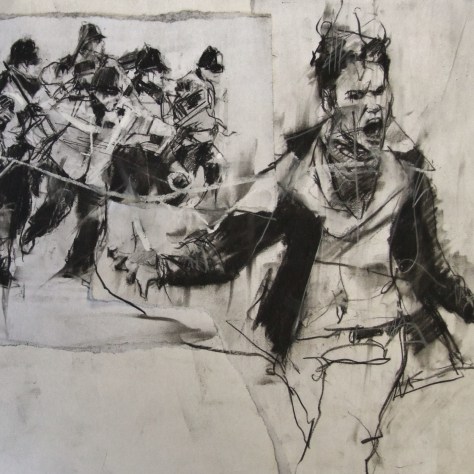

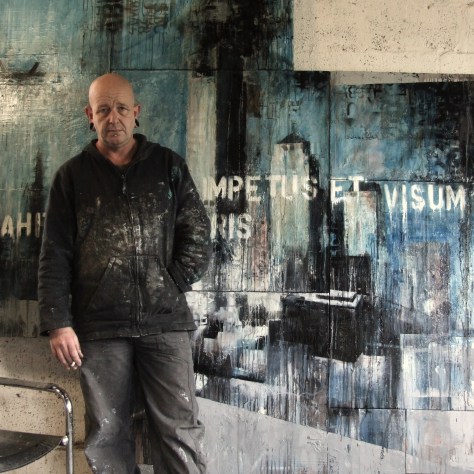


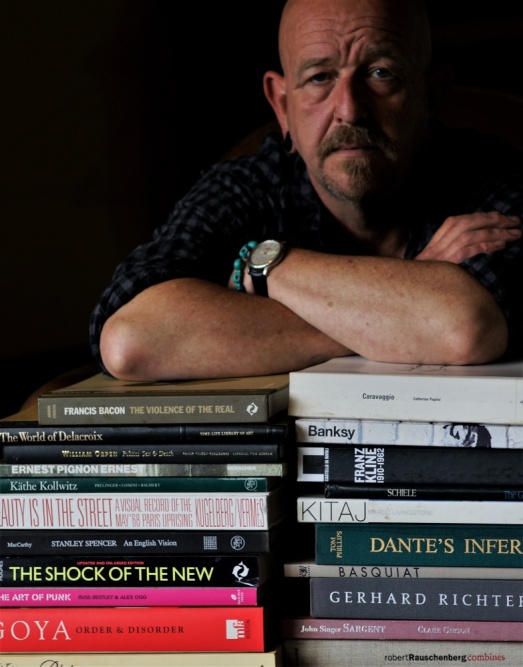


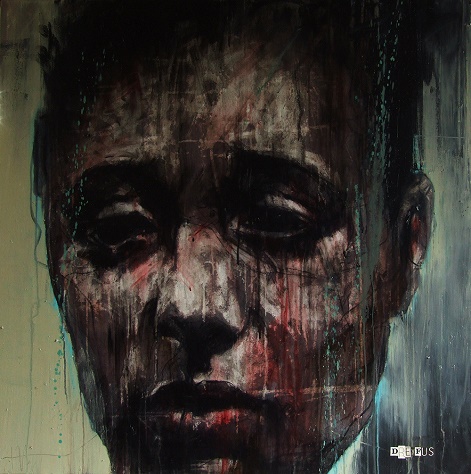
 guydenning.org