Copy shop art

For too long the photocopy has been side-lined by the art establishment as either a business tool – unrelated to the craft conscious gallery environment, or if taken on board as a pseudo avant-garde tool for the conceptual arena. It is time that the photocopy as a reproductive art tool was brought alongside other established ‘fine’ art tools.
The celebration of the woodcut and the etching was their opening of the art marketplace’s affordability; but the market stall holders have closed ranks again. A limited edition, in any one of the many accepted fine art formats, particularly if produced by a resident of the accepted art canon, can far outstrip in price a single piece painting or drawing by a ‘lesser’ artist.
The engraving was originally a reproductive tool of commercial use so it has no reason to rate hierarchically above the photocopy.
Accusations of the crudity of black and white photocopying are elsewhere held up as the singularly aesthetic beauty and reason of the woodcut print.
And when Polaroid photography has entered the commercial gallery streets how can we accuse photocopying of the impersonality of its mechanistic detachment from its creator.
The reason why the photocopy has not been accepted as these and other forms of reproduction is because of its absolute opposition to the elitism of the fine art gallery world.
If I can sell a limited edition print, using a photocopier, for less than the price of a pint of beer then that’s progress.

copy-shop-art

“Bristol Life” photocopy print edition


back to blog menu

Make a difference – make a mess

Our glorious leaders have found the world not to be of their liking and are on a mission to ‘tidy’ the ‘mess’.
Meanwhile the art world – the world that claims to want to make people think, contemplates its navel – as ever.
Forget your art ‘career’. Do something to make art relevant again. It needn’t interfere with your ‘mode of production’ for any more than one piece. If you claim to stand for art, then you stand for culture, you stand for reason and rationality against the natural order of violence and barbarity.
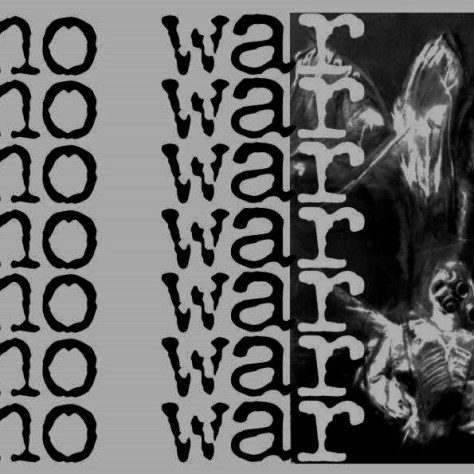
Make an A4 piece of work with the words ‘no war’ somewhere in it – PLAINLY. Photocopy as many as you can afford and make your town your gallery.
Fight the order and make a mess.
This isn’t about art theory.
If you want irony, consider the fact that world leaders consider it morally inexcusable to assassinate a world leader but wholly acceptable to bomb civilians for their greater freedom. Stop ‘deconstructing’ their world before they absolutely deconstruct ours.
It’s not about changing the world because they’re not going to let us.
The mass media want a war because they want the ratings; the politicians want a war because it’s about markets.
If they put a tenth of the military budget into peaceful solutions they could eliminate the inequities that foster the extremists – but they wouldn’t control the prizes of conflict, the oil markets.
A war has an economic dividend for the victor. It’s not about democracy, it’s not about revenge, it’s not about justice and it’s not about freedom.
It’s about cleaning up, ideologically and financially.
Don’t let them clean up without at least making a noise – or they think they’ve got a mandate for murder.
Because you were too busy to make a mess.

make-a-difference-make-a-mess

“Make a mess”, 2003


back to blog menu

Scapegoat for an atrocity

Following the initial idea for this painting, the process for the continuation of the work develops from a natural mechanics of the convolution of thought. Producing a piece specifically to be shown in such an art historically rich location as Florence with all the accumulated associations of history painting led to this work being loosely associated with the mythology of antiquity. However, I have always felt that artists bear a responsibility to social concerns and it would have been an abdication of this responsibility not to refer to the current conflicts outside of the rarefied environment of ‘Art’ which still too often claims an autonomous relationship with society at large.
Icarus flew too close to the sun, the wax of his wings melted, and he perished for his pride. In this respect my depiction of Icarus represents many things. The black and the gold are a symbol of the global political greed for oil – and my response is summed up with the cut-up newspaper text.
There are further combinations of references to contemporary life and art-historical tradition. The old colonial notion of ‘the noble savage’, still pushed to the consumers of news and represented in the painting by the black warrior, is a commentary on the current political and media community’s obsession with identifying a common ‘popular’ enemy. A symptom of controlling dissent well demonstrated by Orwell’s INGSOC of ‘1984’. In the linguistic currency of modern news-casting the ‘civilised’ Western world is fractured by political difference whereas the ‘uncivilised’ Middle East is split by religious or ‘tribal’ difference with all the semantic associations of a backwards looking society yet to reach our levels of ‘sophistication’.
The Middle East was the birthplace of modern mathematics, astronomy and medicine – and this is ignored as foreign armies roll in under the guise of civilising an un-modernised culture.
Icarus represents the collapse of western political morality, the impotence of the idealism of the United Nations in the face of global capitalism and the callous indifference of the majority of western peoples whose only interpretation of the events is as television spectacle.
Icarus represents the tragedy of the events of September 11th 2001 – particularly its political manipulation into being the scapegoat for an act of military aggression that had been planned years before this horrendous terrorist act.
In the painting none of the figures take notice or is even aware of the unfolding tragedy as it is carefully and erroneously mediated by the politically and economically controlled news media, here represented by the illegible jumble of stencilled texts.
The quotation is from the Roman poet Marcus Annæus Lucan:
‘Trahit ipse furoris  Impetus, et visum est lenti quæsisse nocentem.’
‘They are borne along by the violence of their rage, and think it is a waste of time to ask who are guilty.’

scapegoat-for-an-atrocity

“Icarus (scapegoat for an atrocity)” 2003


back to blog menu

Waiting for a gap in the traffic…

Modernism never went away. I’ll rephrase that. The Modernism of Fry, Bell, Greenberg et al may certainly have fluctuated in its importance as a canonical term in recent art theory, but the notions of modernism or modernity have not. The view of high Modernism as a stripping away of the ‘non-art’ aspects of artistic practice, ‘the use of the characteristic methods of a discipline to criticize the discipline itself.’ From the late 1960s the representation of ‘other’ or excluded art histories became prevalent and Modernism, despite protestations from its opponents, subsumed movements with a less overtly political element (Pop, Minimalism). Because of the nature of these movements (defined more as intellectual than political) and the current movements in criticism outside of Art, Modernism almost morphed into Post-modernism.
As before in art history, the avant-garde slip into the comfort of becoming the vanguard and the new avant-garde can only define itself in oppositional terms to the established hegemony. With Marxist and Feminist art practice coming to the fore during the 1960s and the Modernist ‘top league’ being almost exclusively white, male and American this critically driven art movement led to its own, self-predicted end.
Greenberg understood that the seeds of Modernist criticism and practice’s downfall would have been sown by Modernist criticism itself. ‘I identify Modernism with the intensification, almost the exacerbation, of this self-critical tendency that began with the philosopher Kant. Because he was the first to criticize the means itself of criticism.’
Since the very finely tuned definitions of what actually constituted Modernist practice were contemporary with the paintings of the Abstract Expressionists (and they both fed off each other) the two terms have become almost synonymous. Defenders and critical supporters of Pop, Feminist, Marxist and Minimalist work frequently defined themselves oppositionally to Modernism, primarily because its chief promoter and protagonist, Greenberg, allied it to the Abstract Expressionists.
Modernism is not an artistic doctrine as such; though the following was written in 1972 and could be considered revisionist I feel it is an honest account and defence of Modernism – then and now. Rosalind Krauss wrote ‘…it was precisely its methodology that was important to a lot of us who began to write about art in the early 1960s. That method demanded lucidity. It demanded that one not talk about anything in a work of art that one could not point to.’
The attacks levelled at Modernism should really have been directed at Greenberg and his very narrow perception of how Modernism should be applied if used as a prescription for art production. I think most would agree that didactic work produced in this manner does not stand the test of time, and it applies to even supposed Modernist work, especially that not produced in its own, relevant, time. That’s probably a very long winded way of defining ‘old hat’.
You cannot stop progress in Art – even if the progression seems initially retrograde. The most astounding work is always the reactionary. You might not like it – but that is not why it has been done. The best new work is done because it hasn’t been done before. It’s the journey of a succession of artists trying their hand at a brand of shamanism. The popular tabloid interpretation of this places the artist somewhere between being ‘difficult’ and ‘downright mad’. This consideration, of the artist as ‘madman’ is also played up to by practitioners and supporters of the arts. Some of the more esoteric art movements: minimalism, conceptualism, arte povera etc through the actions of both supporters and opponents (not to mention egotistical creators) have made the artist/mad association easy to support – but look at this from another angle. Admittedly this requires a definition of Art that is not particularly popular, critically, at the moment – art as the search for spiritual significance.
I do not define this spirituality in any formal religious sense, rather as a base spirituality of humanity. The same base that leads various individuals to form religious sects for others to follow. Personally I would define myself as an ‘unholier than thou atheist’ and in its own way this humanism is my spiritual faith. It’s a little like understanding an Anarchist society as having more organisation than any supposed ‘beneficent’ government system. I look on artists as being those who, on behalf of society, attempt to manufacture objects of totemic significance, with no function beyond that significance. The theorising of Modernism came very close to establishing this but realised that definitions of aesthetic ‘quality’ were essentially impossible to quantify. The attempt to deconstruct the eternally un-deconstructable was at an end – and criticism turned in on itself as if to establish whether the questions were being asked correctly. I think we can be pretty sure that if artists are still able to outrage and offend (even if it is sometimes obvious and formulaic) that perhaps the theorist’s game is up!
There is a critical assumption that art cannot exist without corporate or public support; even more specifically without critical reference. On looking at certain African Art, curator Jan Hoet stated in 1992 ‘I did not find any houses of the well-to-do containing contemporary art. Nor any press providing artistic and cultural information… And in spite of everything there is art.” Art has always existed outside of the critical idiom – particularly in the last 200 years where its very nature, in being progressive, was to be transgressive. This idea of critical reinforcement of any art production was brought about by the methodologies of Modernist criticism and widely available, but prescriptive art education. Perhaps being given the benefit of the doubt by a fellow art historian, Edward Lucie-Smith describes Hoet’s words as ‘slightly naïve’. I would describe it, being a painter, as strikingly arrogant. It is Greenberg’s notion of the relevance of Kant taken to the extreme, abetted by, certainly in this country, the idea of the curator/critic knowing more about art than the artist.
We have arrived at a point where public art funding is determined increasingly by ideals of ‘social inclusivity’. This agenda driven exhibition programme, that controls the majority of good public exhibition space, in its obsessive zeal to promote political correctness still alienates certain artistic agendas. Admittedly this is only based on personal and anecdotal experience, but most of the curators, gallery managers and directors that I have dealt with have been white, middle class and degree educated. The degree education being, for most, their only experience of adulthood outside of the rarefied atmosphere of professional arts administration. They have followed and swallowed the party line and can spit out the political correctness handbook verbatim – but sadly they have little real idea of both its increasing relevance and occasional irrelevance. Many are from the odious school of ‘…some of my best friends are … black/ gay/ disabled’
Because of the insular nature of their upbringing, education and work life they look on pc as a convenient label system and ideological blame generator. Anything that they cannot fit rigidly into this liberal censorship system will not be accommodated, because in their ‘finding it difficult to read’ they assume the rules must be being broken. A male artist painting the female nude is assumed heterosexual therefore the work must be exploitative and consequently not ‘good art’. The gay artist painting the male nude is often side-lined as producing ‘homoerotic wall decoration’ (initial presentations of the work of Caillebotte for example). The female artist dealing with the male nude is either producing pornography or wall decoration – in either case she is undermining the Feminist Struggle. This situation has continued for too long. Since when did administrative officials decide, to any great critical acclaim, what should or shouldn’t be the subject matters of artist’s working practice.
With the increase in widely available art and art history education came an increased number of potential critics, historians and curators. Now we find that formal study in curating is almost essential to secure a post in this field. Though the increased general knowledge that this has permitted in the public perception of the arts is to be lauded, the control and restrictions that the establishment put on artists is not. Since the early 1980s the general perception of many Fine Art students is that they are being forced to work within a critical frame set by knowledgeable but tunnel-visioned tutors, who seem more obsessed with being ‘there’ at the start of some ground breaking new art movement. Tutor as guru, and students as acolytes of the latest critical sensibility. Those students that refuse to comply will be side-lined and regardless of commitment or quality of work find their grades suffering at the end of this three year farce. Those that don’t fight, and who can blame then when they’re essentially funding their own grades, and submit (essentially opposing all progressive art movements in history) will arrive from their ‘educations’ with the grades that will be recognised by their tutor’s contemporaries in the art world outside of education.
This glut of intellectualism in art criticism began to feed directly into art production, partly with minimalism, but most surely with conceptualism. Summed up beautifully by Alison Green ‘The canonisation of Conceptual Art hinged on essentialising arguments about its difference from the expressionism and/or phenomenology of the art that preceded it.’ In other words Conceptual Art is the idea of the creator and the intellectual response of the consumer – the replacement of the perceived art object by ideas and thought. The concept of Conceptual Art verges on the sublime. If it could work as cleanly as its proponents hoped, it would assign to Art the kind of power that exists in music. The disembodied aesthetic. Unfortunately by its own definitions Conceptual Art is tied to language; signifier and signified. Any associations made cannot be controlled in the manner that some conceptual artists claimed, and how could the consumer of the idea disassociate themselves from the media, process and environment of delivery. Not only will the ‘uninformed’ art public make these qualitative judgements but the critics and historians do, and have done.
Because of our common held assumptions of what Art ‘is’ (despite its difficulty to define) I don’t feel conceptualism is the end point that so many others feel it is. That is a positive step – if we ever establish what Art is in a quantitative measure we will no longer have what it really is in its deeper sense.
Art criticism is useful, but it is neither science nor art. Art criticism, history and theory are only selective opinionation – hopefully considered, informed and respectful of differing opinions. Modernism gives us a way to interpret certain aspects of certain sorts of art. As does Feminism, Marxism, Queer theory etc. If you want to know why artists do what they do then listen to what they’ve been saying.
‘…the modern artist tends to become the last active spiritual being in the great world.’ Robert Motherwell, 1944.
‘Pictures must be miraculous: the instant one is completed, the intimacy between the creation and the creator is ended. He is an outsider. The picture must be for him, as for anyone experiencing it later, a revelation, an unexpected and unprecedented resolution of an eternally familiar need.’ Mark Rothko, 1947.
‘Indefinite stirrings of the urge to create.’ Wassily Kandinsky, 1914.
‘Art may possibly be one endeavour that fulfils what another age might have called “man’s spiritual needs”. Or, another way of putting it might be that art, deals analogously with the state of things ‘beyond physics’ where philosophy had to make assertions.’ Joseph Kosuth, 1969.
Obviously these are selective quotes to support my suggestion – but I strongly identify with the sentiment. I paint because I have to. From my earliest memories it has been a fundamental need – and my pursuit of it has been singular and selfish. If I am honest I must say that it is the most important thing in my life and will always come first. If this sounds extreme it is only because too few artists are willing to admit it. Their friends and families do not like what it implies. Those that can give it up? Make your own mind up regarding that.
All artists view themselves as producing work in and for a modern world with all its imperfections, injustices and inequities. Whether they have worked in a Marxist, Queer, Feminist or Modernist critical sensibility all artists are trying to achieve similar ends. To raise awareness of the fact that we are not at the end of the human journey, we are only on the road and perhaps the journey can be made a little more palatable through understanding it. When bison were painted on cave walls they were painted in modern times. When Paolo Uccello struggled with perspective in ‘The Battle of San Romano’ he was painting in modern times. When Chris Ofili painted with elephant dung he was painting in modern times.
I cannot speak for sculptors or conceptual artists because what they do does not move me as painting does, but I am sure that regardless of message or feeling they wish to get across to their audiences their reasons for doing it are similar if not identical. A fundamental drive to form significance from the insignificant. It is the prime totem of the human struggle, the cultural ordering of natural disorder – the celebration of our difference – our Culture. If we understand what Art is to a point where it could be produced by recipe and be of equal significance across cultures we will have arrived – there will be no ‘modern’, there will be no ‘future’. Only now, and before now.
I am pretty sure that we will never arrive. Humanity’s cultural production and achievement is an affront to nature. By cultural achievement I refer to everything ‘not natural’. Me, writing this. You, reading it. The earliest searching out of shelter; the journey from Earth to Moon. Language is culture, building is culture, cars, money, chopsticks, fence-posts. Alexander Blok wrote in 1908 ‘Every promoter of culture is a demon, cursing the earth and devising wings in order to fly away from it.’
For me the visual arts are the most significant of these ‘devised wings’ – always being re-configured to fly higher and further as the notions of modernity bring the other ‘wings’ of science, technology etc. nearer. Science chases art in the escape from nature – that is why all good art is modern art. The mind must guide the hand. That is the value of conceptualism in Art.
So the artist working ‘now’ is essentially doing the same as the artist working ‘then’, whenever. Modernism is a manner of identifying certain aspects of this. Modernity is always with us, always changing as science moves into the void left by the arts as they move on.
Paraphrasing a current jazz musician – ‘Modernism doesn’t go away. It just waits for a gap in the traffic.’

waiting-for-a-gap-in-the-traffic

“Feel the smack” 2008


back to blog menu
Statement 1

The visual arts are the focus of culture; they are the most important road leading humanity away from its old home of ‘nature’. From the cave paintings of Altamira to the most obscure conceptual art of today, it represents our fundamental desire and drive to replace the natural chaos with a cultural order. The visual arts have so often served spiritual ends because of this capacity. At its basest level artists take dirt, model it and give it significance. It is no coincidence that the state funded galleries of the world have taken on the presence that once, only religious buildings had.
Art isn’t about communication. It’s about the search for significance and control in a world of anonymity and chaos.

statement-1

Work at the “Celebrity will eat itself” show, Los Angeles.


back to blog menu

It’s work

I have been obsessed with creating visually since primary school age. It has been the one constant throughout my life. My parents encouraged it, even if they didn’t understand the excesses of it, and by the time I started Secondary School I was already sure that the road I would choose as an adult would be that of the ‘artist’.
The first stumbling block came when I applied for Higher Education. Over a nine year period I made four applications to study Fine Art, and was turned down on each occasion. On only one of these applications was I given a reason – my work already had ‘too much specific focus’. After each failure I was determined to be successful the next time to the point where I drove myself mentally into the brick wall of a breakdown.
After almost ten years of working and never being considered ‘commercially exhibitable’ or qualified enough to be considered a ‘serious fine art practitioner’ I started to get small exhibitions, generally organized by other artists. My paintings, then abstract, were selling well but I felt that they were becoming increasingly irrelevant so in 1995 I stopped painting and looked at other mediums – primarily photocopying. Consequently the sales dried up but the excitement of a return to figurative work combined with the new modes of expression gave me the drive to continue and forget the bitterness I had always felt at being excluded from Higher Education.
Over the last few years I have been fortunate in that galleries are starting to take an interest in my work again, perhaps fuelled by the increasing fashion for figurative work, and it has enabled me to work with fewer of the financial constraints of previous years.
I do not consider painting irrelevant as a contemporary art practise, the world has a fixed notion of what constitutes ‘Art’, and that includes painting alongside other more supposedly ‘avant-garde’ methods of production. I have worked with found objects, installation, sound and new media but have always found them to be wanting. I always return to painting. There seems to be a singular truth to this medium – the practitioner takes what is in essence dirt and modifies it to a form of significance through the manufacture of ‘art totems’ – paintings. The truth of this is borne out by experience. Artists that would consider themselves of the ‘conceptual’ turn to painting, established musicians and actors turn to painting, even writers turn to painting. This is because they have realised that their initial forays into a, perhaps shallow, search for notions of posterity will probably be consigned to the cultural bin of ephemera rather than the canon of human cultural progress. I’m not saying that this is where my work is destined – but I’d be lying if I didn’t say I’d like the look of the road map.
I consider my work to be ‘Modernist’ in that I love the mediums I use. I want my audience to love them too; I want then to get up close and wallow in the visceral glory of what paint or collage or newspaper can look like when it is subjected to attention of detail. This is why I have not returned to abstraction, for when you look at one of my paintings of an individual you know that the representation is made up of solid paint. The representation has to be there to make the medium all the more obvious.
The subject matter of my work tends mostly towards a quiet critique of our society’s gradual erosion of its own compassion and humanity. There is little point in being the didactic zealot – nobody listens anymore. But I just feel the need to stand up and say the best way I know, through painting, that some things are unjust. Today the greatest global injustice is a singular poverty of aspiration tied to a very visible wealth of expectation.
My work is simultaneously a celebration of what I do and a call to the audience that we should notice what we are doing to ourselves.

its-work

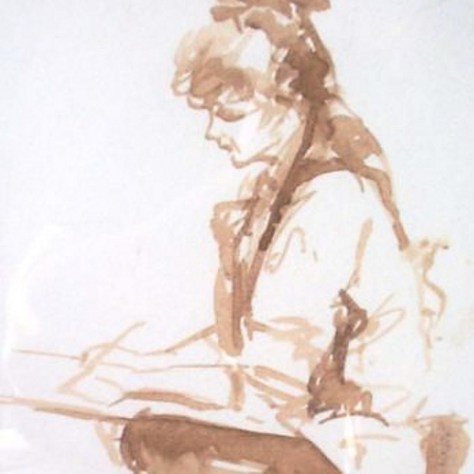
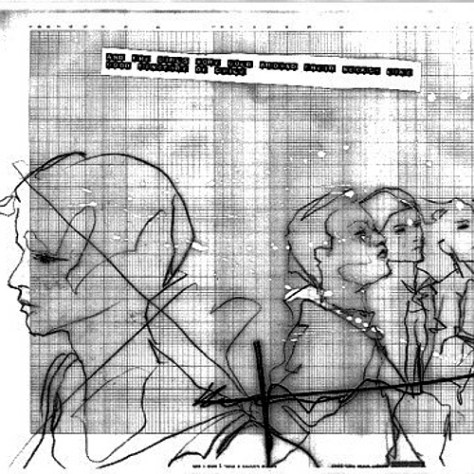
Five minute sketch of fellow student at life drawing class.

back to blog menu

April 25 2000

I feel I have finally arrived at a point in my painting career where my work seems to have direction and motivation of its own.
I can remember the first painting I did at Primary School that showed me that I was capable of something special. For the first time I wasn’t the outsider child – I had done something that my peers approved of; I wasn’t used to their positive response and immediately destroyed the painting.
I have always painted and loved the visual arts since. It has provided my only source of continual mental security despite the intense difficulties I have had with it – particularly since adolescence. Thirty years from that first painting I am achieving what I have only recently realised I was looking for. At last my work is reflecting directly what I am personally, without the sense of political or methodological artifice that previous work contained. When I leave any painting I have no care for it anymore; I just need to move on to the next piece of work. If people appreciate it, I am grateful – if not, to be honest, I couldn’t care. I will not modify my work for the benefit of those that think I do it on a whim for public or critical approval. It is difficult to say with any certainty what the current work is about beyond its obvious themes of isolation, loneliness and the dysfunctionality of our modern technologically, media driven society.
People are forgetting that Art drives Science. The artist conceptualises the new, the dangerous and the unacceptable. The scientists follow, and attempt to rationalise these ideas.

april-25-2000

“heroin” 1993


back to blog menu

Giving up Art

Somebody once said that painting was a compromise. That has to rate as the understatement of all time; painting is not a compromise – it has become, at least on a personal level, an absolutely bankrupt ideal.
Whatever ideals or concepts are considered for the subject of a painting, or for that matter any art practise, it has become clear to this point in time that they will not be achieved. As soon as the first mark is made, no matter what care is taken, the idea is unrealisable. That first mark is a compromise, but from that point on the entire exercise becomes another failure.
I love that old romantic notion that you so often get shoved in your face when at some exhibition of one of the old great and goods – you know where they’re on their deathbed and the last words are along the line of ‘now I am beginning to understand’ – I think the technical term for that is ‘bullshit’.
The need that I have to make a painting that is not a failure is obsessional – there is no way that I can see myself not continuing in it. But with an escalating record of failure behind me it certainly does not make it any easier.
The aims of Art, at least in the terms that I personally define them, are worthwhile – but I feel, ultimately unobtainable.
I defy any artist out there to say that they have created what they set out to achieve. They’re either lying, or not trying hard enough.
Or they’re making wall decorations.

giving-up-art

“You’ll be wanting a happy ending then.” 2000


back to blog menu

The neo-modern

We are at a point in time, culturally and socially, arguably similar to that of the late nineteenth century. New communication technologies open the world to us in a manner similar to the way industrialisation of the late 1800’s brought aspects of world culture to its then new audience. The modern ‘surfer’ can aimlessly travel the world via the internet taking in the new modernity as easily as could the ‘flaneur’ of Baudelaire’s day – the ‘passionate spectator’ of Haussmann’s Paris. Artistically too we are at a point of change. Since its common coinage as a descriptor of Art that followed high Modernism attempts have been made to adequately sum up the identity of the Post-Modern in relation to the visual arts. In the critical environment of post-modernism even the work of the Modern has been redefined and consequently the theorising behind it too – Jean-Francois Lyotard destroys the clear cut definitions of modern and post-modern by demonstrating that by their precipitation of each other, they actually become each other. Similarly he showed, through a raft of definitions of post-modernity, that you cannot define a thing if you have not experienced it in its totality. Will the post-modern end on its own? If it is left to follow its logical path it can only end with the end of Art – as the only obvious target would seem to be the quest for incessant originality; an originality that only actually exists in the critical assessment of work rather than its creation.
There is no original work. What is actually being addressed are works that fall within the tenets of what is considered classically acceptable as a ‘modern’, and it is this notion of classicism that should be addressed; not the false notion of post-modernism. Classicism is not an aesthetic judgement – it is a political judgement of the artistic vanguard and establishment who work together to maintain it, and through it their own validation. Modernism in the visual arts is useful only as a definition, not a creed as Clement Greenberg saw it. What this man did for the arts was useful in that it gave us a critical reference for Western work that stood outside of, what were then, traditional Western terms of interpretation. His approach and methodologies, though biased and extremely selective, have widened the approach to art production and criticism since. In fact it could be argued that the extreme selectiveness he employed were instrumental in opening up the art historical debates from other perspectives. Already it is obvious that we are in need of a new modernism, a return to an aesthetic sensibility. Though work that is being produced now has moved on from the idea of the democratic ‘anyone calling themselves an artist is an artist’ argument, the criticism has not. The artist now is not satisfied with the work standing as a statement of almost nihilistic ‘anti-art’ sentiment. This argument has been taken to absolute extremes and can no longer be validated as original. Instead we are seeing a return to arguments of content and quality. It still isn’t fashionable, hence the general difficulty in obtaining a fixed definition of a work’s meaning from the artist. Those creating now are still living in the shadow of post-structuralist philosophy and many still look on it as some great shibboleth – never to be challenged. In the quest for originality the artists, guided by the critics and philosophers, turned their eye inwards onto the subject of art itself as subject. In essence, it was the only choice that could follow on from the mutated Modernism that followed what was undoubtedly the United States’ greatest contribution to western art. Work that was produced in direct opposition to Greenberg’s vague notions of ‘quality’ had to be pulled into the pantheon somehow and in the early sixties that still involved rigidly structuralist, Modernist criticism. In reality one intellectual elite had only been replaced by another that was then spuriously claiming a democratisation of art was on its way. What replaced the aesthetic value imbued by any artist was the exhibitive value assigned by the art establishment to the point where culture is now not viewed as an abstract concept validated retrospectively by society but as a badge of intellectual merit planned in advance by committees of state.
It is possible to work with an underlying eclectic approach to both subject matter and methodologies without having to resort to hackneyed arguments about the post-modern. Many artists whose work would seem to follow on from Dadaist ant-art sympathies see their work as having personal and social significance beyond these arguments; they do not see their work as a vehicle for a message alone – in fact I would argue that many of the new British artists, whose work in particular seems to be described in this fashion, would consider the aestheticism of their work is far more important.
The Post-modern is useful only in terms of further defining Modernism from its origins and is essentially only a continuity of modernism – sometimes termed hyper-modernism. These are all useful, to a greater or lesser degree, in terms of avoiding the ideas of the ‘end of (Art) history’ but with regards to the actual creation of artworks they are invalid. People do not set out to create a work of ‘Post-modern Art’. If we must have a new label, let it be a New Modernism – a return to the critical aesthetic giving the artist the opportunity to create work that has some relevance to the new modern audience – an audience already familiar with ‘modern art’, where validation of quality is not founded on post-modern hyper-obsession with language and semiology and the artist is not ground into politically correct subservience. I do not see this as a retrograde step – it can be the only way forward – to let the artist communicate without the bonds of corporate and state art politics.
To those claims of ‘Art is Dead – long live Art’ – Post-modernism is dead – long live Neo-modernism.

the-neo-modern

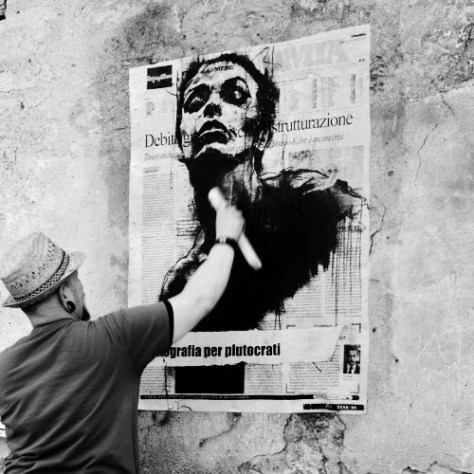
Street art – art that engages with the public.


back to blog menu

The democratisation of art

There is a world of difference between the ideas of ‘anything an artist spits is art’ and ‘anyone calling themselves an artist is an artist.’
Since the Dadaist practise has been appropriated into the modernist art canon and the ethos behind it celebrated and mutated to justify any kind of pseudo-artistic excess we have been more often subjected to this bogus democratisation of art.
Without wanting to disappear into the pedantry of semiotics most of us, in and out of the rarefied celebrity-fest that is the ‘art world’, have a fairly constant idea of what an artist is and what an artist does. In general we do not call somebody an athlete unless they display a certain level of prowess at an athletic skill. We all know people who take part in athletic events at a level we would consider less than Olympian – but we do not identify them primarily as athletes. Similarly not everybody who takes part in ‘artistic’ activities would be primarily identified as artists.
All the effort, desire and luck in the world will never make me an athlete – and should I choose to exercise my athletic skills in a public arena representing my country in place of somebody with far more ability, I would expect to be drummed out by the spectators (probably at gunpoint). Even in a postmodern world there is little room for ‘irony’ in sporting arenas, or many other arenas for that manner. Second rate is second rate, and unfortunately in the current art world the over used concept of ‘irony’ has become a major apologist for ‘second rate’ artistic practise. No matter what critical and semiological gloss is applied bad art is bad art – ‘you can’t polish a turd’ – is the phrase I think I’m after.
Anybody cannot become proficient at anything. It might be unfair, undemocratic and un-pc, but it’s a hard fact of life. If this was not the case we would not have a cultural history (that is still continued and added to) celebrating the abilities of those who stood above their peers in whatever fields. There is at current, a glut of deranged celebrities, who feel that they can not only shine in any environment they choose to visit, but honestly believe we live in awe at their apparent accession to the throne of new renaissance man.
In catering to the inflated ego of some rapidly diminishing celebrity their sycophantic curatorial buddies do nothing except devalue the work that others who have no drive but to create ‘artwork’ do.
Neither do four years at the right art college make an artist (and believe me its got more to do with the right college than ability, drive or obsession). How the hell do you teach a wholly subjective subject? They’ll tell you that they can’t – consequently anything goes and everything is Art. Anything goes does it? Travel around a hundred small, privately organised and generally self-funded exhibitions and you’ll find out that most of the truly inspired and individualistic artists out there were subjected to extreme humiliation to make their own work fall within the confines of the shadow of some sad, under-exhibited tutor rattling around in the cultural morass of postmodern theory.
Anything goes – except a few things, unless they’re ironic, or you’re shagging the lecturer.
BITTER AND TWISTED? You’d better bloody believe it.

the-democratisation-of-art

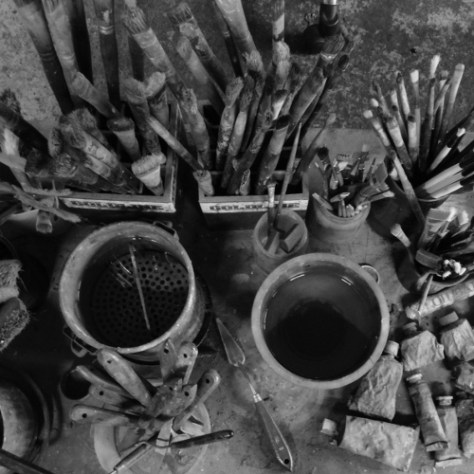
Tools of the trade.


back to blog menu