The ongoing project to record an image from a political demonstration every day – starting with January 2017 and now on to May. The source materials are the news and social media, in print and via the internet.
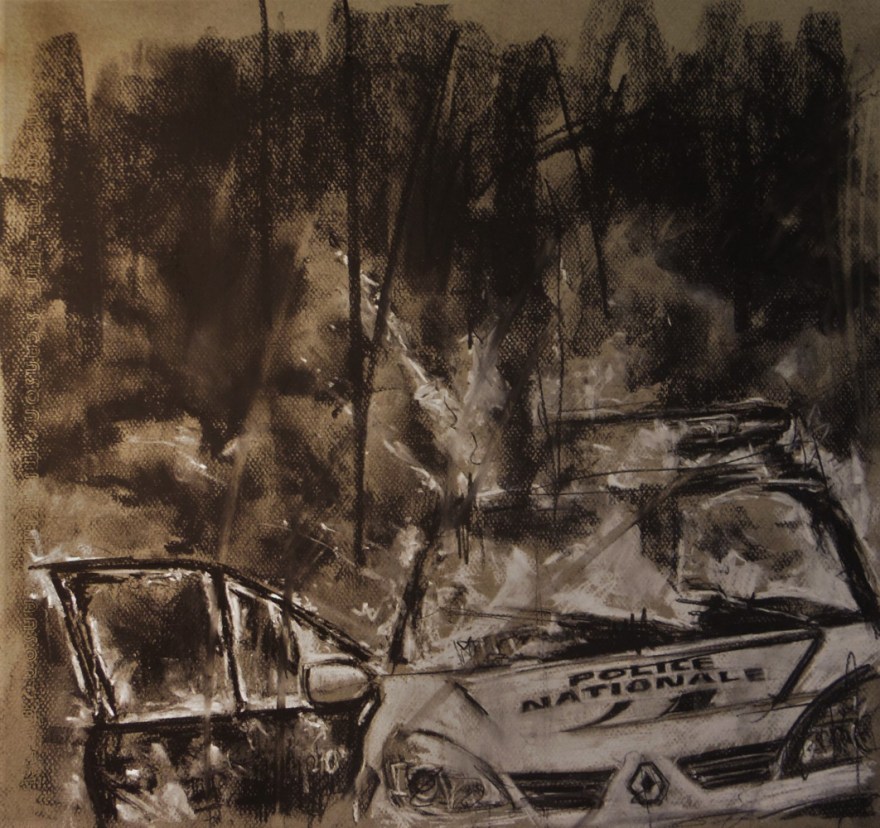
‘where there’s smoke’, conte and chalk on paper, 50 x 50 cm, 2017
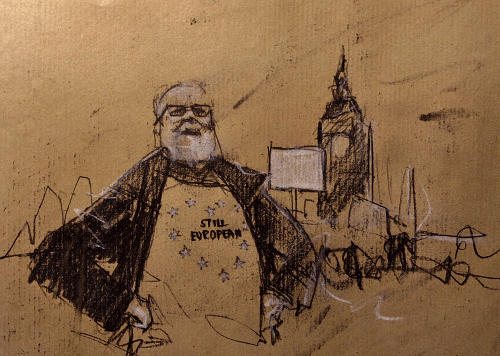
‘may 31’, conte and chalk on paper, 20 x 25 cm, 2017
‘may 30’, conte and chalk on paper, 20 x 25 cm, 2017
‘may 29’, conte and chalk on paper, 20 x 25 cm, 2017
‘may 28’, conte and chalk on paper, 20 x 25 cm, 2017
‘may 27’, conte and chalk on paper, 20 x 25 cm, 2017
‘may 26’, conte and chalk on paper, 20 x 25 cm, 2017
‘may 25’, conte and chalk on paper, 20 x 25 cm, 2017
‘may 24’, conte and chalk on paper, 20 x 25 cm, 2017
‘may 23’, conte and chalk on paper, 20 x 25 cm, 2017
‘may 22’, conte and chalk on paper, 20 x 25 cm, 2017
‘may 21’, conte and chalk on paper, 20 x 25 cm, 2017
‘may 20’, conte and chalk on paper, 20 x 25 cm, 2017
‘may 19’, conte and chalk on paper, 20 x 25 cm, 2017
‘may 18’, conte and chalk on paper, 20 x 25 cm, 2017
‘may 17’, conte and chalk on paper, 20 x 25 cm, 2017
‘may 16’, conte and chalk on paper, 20 x 25 cm, 2017
‘may 15’, conte and chalk on paper, 20 x 25 cm, 2017
‘may 14’, conte and chalk on paper, 20 x 25 cm, 2017
‘may 13’, conte and chalk on paper, 20 x 25 cm, 2017
‘may 12’, conte and chalk on paper, 20 x 25 cm, 2017
‘may 11’, conte and chalk on paper, 20 x 25 cm, 2017
‘may 10’, conte and chalk on paper, 20 x 25 cm, 2017
‘may 9’, conte and chalk on paper, 20 x 25 cm, 2017
‘may 8’, conte and chalk on paper, 20 x 25 cm, 2017
‘may 7’, conte and chalk on paper, 20 x 25 cm, 2017
‘may 6’, conte and chalk on paper, 20 x 25 cm, 2017
‘may 5’, conte and chalk on paper, 20 x 25 cm, 2017
‘may 4’, conte and chalk on paper, 20 x 25 cm, 2017
‘may 3’, conte and chalk on paper, 20 x 25 cm, 2017
‘may 2’, conte and chalk on paper, 20 x 25 cm, 2017
‘may 1’, conte and chalk on paper, 20 x 25 cm, 2017
I don’t want to see or hear another comment on a news website stating that the result of the Brexit referendum was an indication of a clear majority of the UK population wanting the UK to leave European Union membership.
The occasional online moron, who clearly have no access to a dictionary, have even been declaring it a ‘unanimous decision’ in favour of Brexit. The fucking cretins… for their information here’s a dictionary definition of ‘unanimous’:
unanimous
/juːˈnænɪməs/
adjective
1. in complete or absolute agreement
2. characterized by complete agreement: a unanimous decision
Alright? So it wasn’t a unanimous decision. In fact it was 51.89% in favour of leaving and 48.11% in favour of remaining on a turnout of 72.21%. So in actual fact, and in terms of the numbers of the British electorate in total:
37.46% voted for Brexit
34.74% voted to remain
27.80% did not vote
So in actual fact a little over a third of the electorate actually chose to take the UK down the tumultuous political river we’re now paddling – with little sign of any active paddle work.
Brexiters… you’re NOT in the majority. Admittedly a third of the electorate didn’t bother to turn out, for whatever reasons, but that clearly shows that a UK Brexit wasn’t a major concern to that third if they couldn’t be bothered to make their mark on the ballot paper. They were contented enough to assume everything would stay as it is.
Some of the commentary I’ve suffered via the media and in person displays a level of idiocy that defies reason. Thick as pigshit reasons for leaving the EU I’ve encountered include, unbelievably:
“When we leave Europe they have to give us back all the money we’ve paid in since 1973.”
“I want Brexit because I don’t agree with all the money we give to corrupt African states.”
“Britain was great when it was an empire and I want Great Britain back.”
“Because the EU closed the coal mines.”
“We need to stop immigrants coming here to use the NHS for free.”
“We can get our own car industry back and stop being made to build Japanese cars.”
“I don’t like David Cameron.”
I understand the frustrations that some people have with the problems of the European Union. It is now, in essence, another neo-liberal political talking shop that has contributed to the problems ordinary people face today. But its origins were steeped in socially progressive communitarianism; controlling the excesses of unregulated capitalism and creating the cultural spaces for social and welfare reforms by levelling the playing fields of business between member states – primarily reinforcing the ongoing project to bring peace to a Europe that had warred for decades.
Following the increasing influence of Friedman free-market economics in the 1980s many of the interventionist policies have been reduced or destroyed and now we have an economic area that is essentially operating with the same predatory capitalist outlook as the United States of America.
These are the issues that effect the day to day lives of working people and these are the issues that need taking to task. The essence of working, and living, together as a borderless union of individually different states (with less overall integration than the USA) is a positive and not a negative thing. Despite having no customs borders, despite having the same money, despite having freedom of movement of people, nobody would say that the Spanish are the same as the French or the Greeks. All the states within the European Union have their own specific social and cultural identities. They have not been subsumed into a superstate of bureaucratic anonymity.
The idea of a greater over-arching community of individual states where each has its voice heard is a positive step away from the petty, divisive politics of narcissistic nationalism and it should be encouraged and returned to more fully.
The problems that this union has should be addressed, and I’m sure that they will be considering the still parlous state that the world is in economically (whatever politicians say we are NOT out of the financial crisis that hit the world initially in 2007/8); not to mention the impending problems of climate change that cannot be successfully approached without a united front. Leaving the union puts the UK in a position of weakness when it comes to these two most urgent issues; we cannot expect to be treated favourably by our nearest neighbours when we walk away from communal debate and action.
The European Union needs to instigate serious investigation, debate and action to address the issues that are fanning the fires of petty nationalist fractures and that can only happen from within by the members themselves who have a vested interest because of their membership.
If the UK is on the outside of the EU I think it will be the European politicians telling the British politicians ‘to whistle’ and not the other way around.
The horrific Grenfell Tower fire has hammered a hole through the political commentariat’s wall of belief that Britons live in a meritocratic society; that the old divisions of wealth and poverty have been consigned to the grave of history and that our current political order is, by its nature, egalitarian. The tragic outcome of this fire is just another symptom of social organisation that has maintained the same authority that stretches back to a supposed long distant and supposed disappeared feudal state.
Since the forty years that Margaret Thatcher came to power in the UK the public have been incessantly fed the line that she, her political class and their supporting articles of dogma were necessary to ‘save the country’ from the excesses of trade unionism. The media, and consequently a million bar-stool philosophers, have repeated this so frequently that it’s considered an unchallenged statement of fact and not clichéd, politicised opinion. This late seventies Thatcherite and Reaganite creed, underpinned by the supposed ‘scientific’ theorising and advice of the Chicago School economist Milton Friedman became the accepted credible, economical, political norm and has stayed with us since.
Over the last couple of days UK government ministers are watching the news coverage of the inferno and are wringing their hands and saying that such a thing should never happen in this day and age. But they have conveniently ignored that exactly the same ideological focus on the unchallenged rationalality of cost-cutting, efficiency-driven, free-market, trickle-down, laissez-faire political economy has inflicted exactly the same misery, death and grieving upon poor, voiceless communities elsewhere in the world. Well, for these professional politicians, now it’s on their doorstep and it’s now very unavoidable. To top that, it’s happened not just in the city of the place of government, but in the most affluent residential area of that city – The Royal Borough of Kensington and Chelsea. And to the new dawning awareness of the governing classes and established media the message is getting out and being widely circulated without their authority.
The tragic story of Grenfell Towers is not slowly unfolding through measured and authorised news releases via the television, radio and press, but spreading in an exponential explosion of angry, sad and chaotic personal stories created and delivered through mobile phones and home computers. We have seen citizen (social) media bringing a far more diverse range of not just critical opinion, but previously hidden facts to the table for the wider public to consider. It has not just been a sobering realisation of how forty years of Toryism (red and blue) has shredded any sense of broad social cohesion in the UK, but it has also been a very sobering realisation to the governing classes that they can no longer control the information that is reaching the governed.
Within hours of it happening the public are discovering that even in the midst of a crisis, as terrible as this, the machinations of state bureaucracy continue to manipulate the poor and powerless to the benefit of the powerful and wealthy. Stories are becoming common knowledge that survivors are being rehoused 200 miles away (despite official promises to the contrary) under threat of ‘making themselves homeless if they refuse the offer’. Others are being forced into residential elderly care against their will within hours of losing spouses. Survivors, who possess only the clothes on their backs, are being given derisory ten pound payments to buy food (and anything else they need), when public generosity has already donated hundreds of thousands of pounds. And particularly important for the residents in the area no civic official is releasing a credible estimation of the number of dead.
But the injustices in the treatment of the tenants of the block are not just as a result of the lamentable civic response to the fire. According to a senior government minister the cladding on the tower block that seemed so instrumental in accelerating the spread of the fire was banned for such use in the US, Europe and even the UK itself; and from other media reports, the decision on which cladding was chosen was made on the basis that it was £2 cheaper per panel than the top graded fire-resistant cladding required for such a building. For many years the residents of Grenfell Towers have been trying to bring the local council’s attention to their fears of the fire risks in their block. The council has not only ignored them but even threatened them with legal action if they did not desist in their campaign and demands. The residents were only stopped from taking further legal action against the borough council because the UK government has legislated away the previous entitlements to universal legal financial aid. As a tragic full-stop to that particular episode the two residents instrumental in leading that campaign are known to have died in the blaze; they won’t be making any more demands on the borough council.
The repeated demands made by professionals (coroners and firefighting experts) to retrofit existing social housing with sprinkler systems was watered down by government ministers and not pursued. This was primarily justified on the basis of the economics of such work. Recently government ministers have voted in favour of retrofitting a sprinkler system in their workplace the House of Commons. So it’s not just the economics that drive these decisions; it’s also the unstated consideration of who’s worthy of such expenditure. Clearly the working class, or poor, or ethnic minority residents, those considered reliant on social housing, are not considered economically significant enough to tip the scales in their favour.
I’m writing this three days after the fire was first reported; already there is enough information in the public domain to know that there must be a demand for a formal Inquest into the cause of this tragedy but again we witness the desperate scrabbling of the maintenance of the social order… The Prime Minister has declared that there must be a formal public enquiry into the fire at Grenfell Towers. This sounds very laudable, but what is really needed is a Coroner’s Inquest. Despite its title of public enquiry such an enquiry does not involve the public. If a public enquiry is held the survivors and other witnesses will not be entitled to speak, question, give evidence, or cross-examine those considered potentially responsible. A public enquiry is controlled by the government that instigates it; a Coroner’s Inquest is at least designed to be independent of government influence.
The political establishment, particularly those supportive of the neoliberal agenda (that’s the same one that drove the world to near economic collapse ten years ago) will not want their ideological sacred cows challenged. From their personal perspective they see the established order as beneficial to all because in general their personal perspective only takes in the view of others like themselves. The politicians will shy away from a fully open investigation and inquest because it will absolutely undermine their integrity, their philosophy, their ideology and their future authority.
This fire will be formally shown to be the combined result of failed housing policy (social and private), failed expectations of the benefits of public service privatisation, failure of adequate funding of the public sector at the expense of propping up a failed banking sector, failure in the belief of the benefits of deregulation in health and safety legislation etc etc… All central tenets of the dogmatic economic faith that is represented by neoliberalism. This doctrine has probably had the most damaging effect on the greater number of people on the planet, not to mention the planet itself, than any other previously discredited political philosophy; it’s time is up.
The formal end of feudalism in England is supposedly legally marked by the Tenures Abolition Act of 1660 but all this really did was to reinforce the power, wealth and landed status of the established aristocracy by removing their financial and military obligations to the monarch. It also laid the way for broader powers of tax collection levied against the general population. The current creed of neoliberalism is the modern maintenance of this system, The powerful rich entrench their privilege through their control of the media and its message to the public. It promotes their agenda as the only pragmatic political and economic solution to the problems that society is confronting – without realising that the problems society is confronting are generally of their ideology’s making.
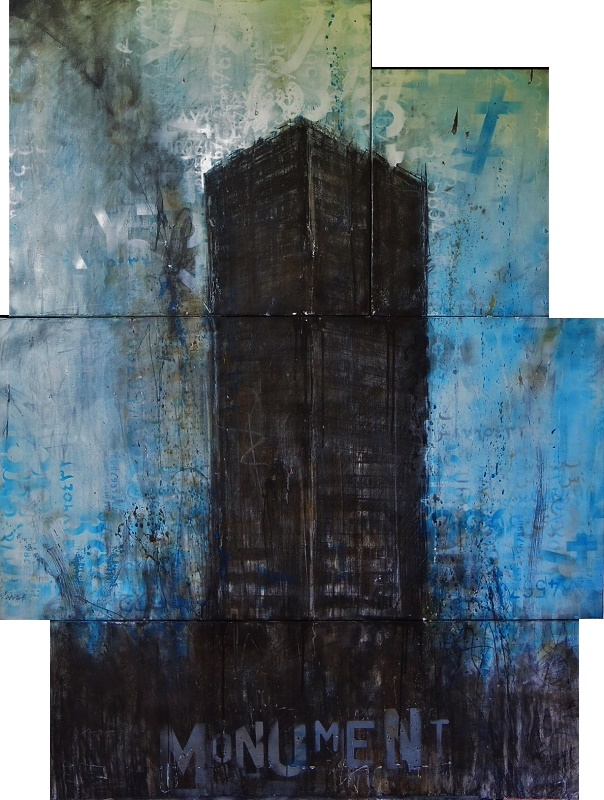
“Monument”, conte and aerosol on canvas, 120 x 80 cm, 2017
The ongoing project to record an image from a political demonstration every day – starting with January 2017 and now on to April. The source materials are the news and social media, in print and via the internet.
‘american history drawing’ conte on paper, 30 x 50 cm
The ongoing project to record an image from a political demonstration every day – starting with January 2017 and now on to March. The source materials are the news and social media, in print and via the internet.
Thirty or so years ago I was drawing on newspaper and old packaging as a means of saving money on art materials; I didn’t see the point in wasting money on making work that wasn’t going to be exhibited or sold. At the same time I even used old jeans and bed sheets as affordable replacements for canvas to paint on. This developed into an accidentally discovered aesthetic of finished conte and pastel drawings on recycled card packaging that went much further than my original money-saving idea from the 1980s.
With the explosion of the new ‘urban art’ movement around the turn of the millennium I found this aesthetic to actually be in demand and have probably sold more drawings on recycled card and newspaper than on expensive art papers. This method of drawing (and I am not laying claim to being its originator) is now becoming relatively mainstream and I am frequently asked, by students and other artists, on the methods I use for the treatment and preservation of art made this way.
Well as should be the way for all artists, I want to develop other avenues rather than sitting still, so alongside this existing drawing method I have also been returning to a more finished process. After several months of experimenting; rejecting the dead-ends and pursuing the interesting developments, I’m coming to a personally new method of a more exacting drawing that incorporates gouache as a base on canvas.
These are the first six of these ‘finished drawings’.
‘bright lights (because we were angels)’, mixed media on canvas, 40 x 26 cm, 2017
‘hug bubble (because we were angels)’, mixed media on canvas, 26 x 40 cm, 2017
‘blame and the rest (because we were angels)’, mixed media on canvas, 40 x 25 cm , 2017
‘it’s hard to see you again (because we were angels)’, mixed media on canvas, 20 x 40 cm, 2017
‘the flowers (because we were angels)’, mixed media on canvas, 40 x 25 cm, 2017
‘the shadow of innocence (because we were angels)’, mixed media on canvas, 40 x 25 cm, 2017
The ongoing project to record an image from a political demonstration every day – starting with January 2017 and now on to February. The source materials are the news and social media, in print and via the internet.
“Et l’histoire se repetant”, conte and pastel on paper, 64 x 33 cm, 2017
‘February 1’, conte and pastel on paper, 13 x 15 cm, 2017
‘February 2’, conte and pastel on paper, 14 x 20 cm, 2017
‘February 3’, conte and pastel on paper, 13 x 15 cm, 2017
‘February 4’, conte and pastel on paper, 16 x 18 cm, 2017
‘February 5’, conte and pastel on paper, 20 x 16 cm, 2017
‘February 6’, conte and pastel on paper, 16 x 15 cm, 2017
‘February 7’, conte and pastel on paper, 19 x 16 cm, 2017
‘February 8’, conte and pastel on paper, 16 x15 cm, 2017
‘February 9’, conte and pastel on paper, 19 x 16 cm, 2017
‘February 10’, conte and pastel on paper, 18 x 15 cm, 2017
‘February 11’, conte and pastel on paper, 15 x 18 cm, 2017
‘February 12’, conte and pastel on paper, 19 x 13 cm, 2017
‘February 13’, conte and pastel on paper, 13 x 20 cm, 2017
‘February 14’, conte and pastel on paper, 15 x 18 cm, 2017
‘February 15’, conte and pastel on paper, 17 x 13 cm, 2017
‘February 16’, conte and pastel on paper, 18 x 19 cm, 2017
‘February 17’, conte and pastel on paper, 12 x 18 cm, 2017
‘February 18’, conte and pastel on paper, 13 x 18 cm, 2017
‘February 19’, conte and pastel on paper, 19 x 18 cm, 2017
‘February 20’, conte and pastel on paper, 15 x 20 cm 2017
‘February 21’, conte and pastel on paper, 13 x 20 cm, 2017
‘February 22’, conte and pastel on paper, 19 x 16 cm, 2017
‘February 23’, conte and pastel on paper, 15 x 20 cm, 2017
‘February 24’, conte and pastel on paper, 15 x 20 cm, 2017
‘February 25’, conte and pastel on paper, 16 x 17 cm, 2017
‘February 26’, conte and pastel on paper, 14 x 20 cm, 2017
‘February 27’, conte and pastel on paper, 15 x 20 cm, 2017
‘February 28’, conte and pastel on paper, 15 x 20 cm, 2017
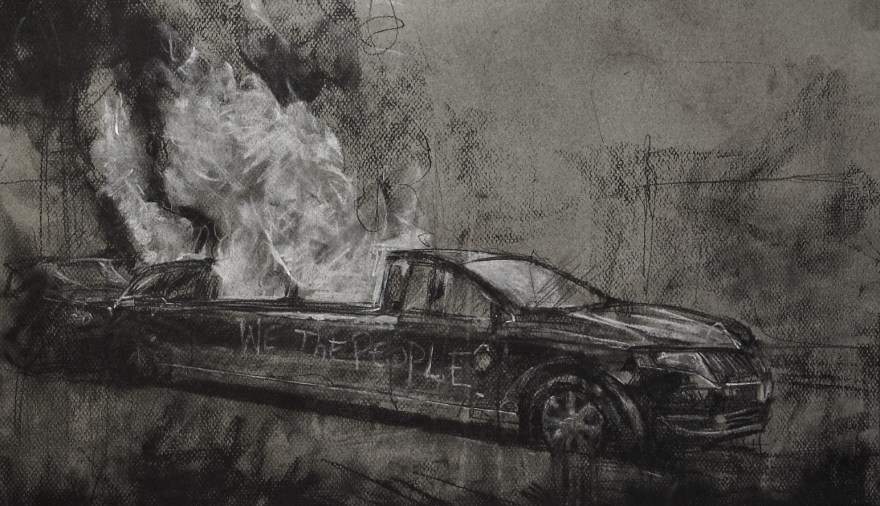
A project to record an image from a political demonstration every day – starting with January 2017. The source materials are the news and social media, in print and via the internet.
“We the people”, conte and pastel on paper, 50 x 28 cm, 2017
‘1 january’, conte and chalk on paper, 15 x 15 cm
‘2 january’, conte and chalk on paper, 15 x 19 cm
‘3 january’, conte and chalk on paper, 15 x 15 cm
‘4 january’, conte and chalk on paper, 19 x 15 cm
‘5 january’, conte and chalk on paper, 19 x 15 cm
‘6 january’, conte and chalk on paper, 15 x 19 cm
‘7 january’, conte and chalk on paper, 19 x 15 cm
‘8 january’, conte and chalk on paper, 11 x 11 cm
‘9 january’, conte and chalk on paper, 11 x 11 cm
’10 january’, conte and chalk on paper, 13 x 12 cm
’11 january’, conte and chalk on paper, 15 x 13 cm
’12 january’, conte and chalk on paper, 19 x 15 cm
’13 january’, conte and chalk on paper, 11 x 13 cm
’14 january’, conte and chalk on paper, 15 x 14 cm
’15 january’, conte and chalk on paper, 13 x 11 cm
’16 january’, conte and chalk on paper, 11 x 10 cm
’17 january’, conte and chalk on paper, 11 x 10 cm
’18 january’, conte and chalk on paper, 15 x 13 cm
’19 january’, conte and chalk on paper, 15 x 13 cm
’20 january’, conte and chalk on paper, 15 x 21 cm
’21 january’, conte and chalk on paper, 10 x 12 cm
’22 january’, conte and chalk on paper, 13 x 15 cm
’23 january’, conte and chalk on paper, 13 x 15 cm
’24 january’, conte and chalk on paper, 15 x 19 cm
’25 january’, conte and chalk on paper, 15 x 16 cm
’26 january’, conte and chalk on paper, 20 x 16 cm
’27 january’, conte and chalk on paper, 16 x 17 cm
’28 january’, conte and chalk on paper, 16 x 15 cm
’29 january’, conte and chalk on paper, 15 x 9 cm
’30 january’, conte and chalk on paper, 19 x 17 cm
’31 january’, conte and chalk on paper, 15 x 17 cm
Galerie Itinerance proposed a project to the Paris city authorities. A project that mobilized more than 100 street artists from 15 different countries, who volunteered to put their work on and in a building before its destruction on April 8, 2014, to make room for new social housing . An exceptional project, with more than 4,500 m2 of floor space and as many sections of walls and ceilings, 9 floors and basements, 36 apartments of 4 to 5 rooms, sometimes even furnished.And in the end, everything disappeared in the rubble.
I was given an apartment to work on and created a story of an imagined resident, sorry to be seeing the end of his home that held the greater part of his adult memories.
Tour Treize project, Paris 4
Tour Treize project, Paris 6
Tour Treize project, Paris 5
Tour Treize project, Paris 2
Tour Treize project, Paris 3
Tour Treize project, Paris 7
Tour Treize project, Paris 12
Tour Treize project, Paris 8
Tour Treize project, Paris 10
Tour Treize project, Paris 11
Tour Treize project, Paris 9
Tour Treize project, Paris 15
Tour Treize project, Paris 13
Tour Treize project, Paris 19
Tour Treize project, Paris 16
Tour Treize project, Paris 1
Tour Treize project, Paris 17
Tour Treize project, Paris 18
Tour Treize project, Paris 21
Tour Treize project, Paris 23
Tour Treize project, Paris 24
Tour Treize project, Paris 22
Tour Treize project, Paris 28
Tour Treize project, Paris 25
Tour Treize project, Paris 29
Tour Treize project, Paris 30
Tour Treize project, Paris 35
Tour Treize project, Paris 14
Tour Treize project, Paris 20
Tour Treize project, Paris 26
Tour Treize project, Paris 32
Tour Treize project, Paris 27
Tour Treize project, Paris 33
Tour Treize project, Paris 31
Tour Treize project, Paris 34
Tour Treize project, Paris 36
The text in english: I remember the first time writing arose on our walls. It was our street in the summer of 1940. I was only ten and it excited me. And, it was a boy from our street, but I never saw the boy again. The next time someone drew on our walls was in ’68. Everyone was angry. And I was angry too. We had a beautiful city, and it could have been a beautiful time. I was angry with the paint on the wall of our pretty street. Then we came here, living for a future. All was clean and the direction steered clear. The cities, the promise, the hope. And the loss. Missed certainties and stolen promises. Lost family and lost chances to say, just, “Sorry.” And now they steal the last of my future. This hollow concrete tower of future is obsolete. Obsolete like my dead, sweet wife. Obsolete like the family that never visits. And obsolete like me. Obsolete. Like the words on the wall I watched a young man spray only last week. And the child in me returned. I laughed and I wished I could leave that vibrant mark. Paint and not dust. Color and not shadow.
Le texte en français:
Je me souviens de la première fois qu’un écrit est apparu sur nos murs. C’était dans notre rue pendant l’été 1940. Je n’avais que 10 ans et ça m’excitait. C’était un garçon de notre rue, mais je ne l’ai jamais revu.
La deuxième fois que quelqu’un a dessiné sur nos murs était en 68. Tout le monde était en colère. Et j’étais en colère aussi. Nous avions une belle ville, et ça aurait pu être un très beau moment. J’étais en colère de cette peinture sur le mur. C’était notre jolie rue.
Puis nous sommes venus ici, vivant pour un avenir. Tout était propre et le sens orienté clairement. Les cités, la promesse, l’espoir. Et la perte.
Les certitudes manquées et les promesses volées. Famille perdue et chances perdues de dire, juste, « Désolé. »
Et maintenant ils volent le reste de mon avenir. Cette tour de béton creuse de l’avenir est obsolète. Obsolète comme ma douce femme morte. Obsolète comme la famille qui ne rend jamais visite . Et obsolète comme moi. Obsolète. Comme les mots sur le mur que j’ai vu un jeune homme peindre. Juste la semaine dernière.
Et l’enfant en moi est revenu, j’ai ri et j’ai voulu pouvoir laisser cette marque vibrante.
De la peinture et pas de la poussière.
De la couleur et non de l’ombre.








 guydenning.org