Behemoth show

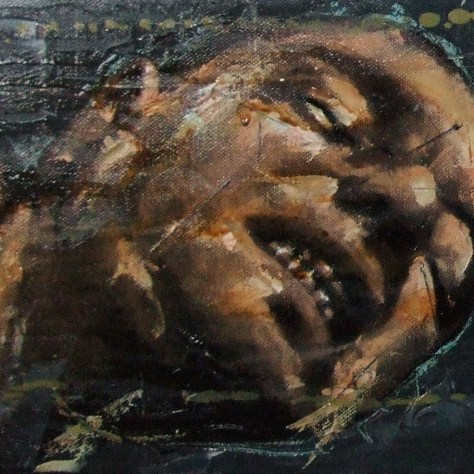
For the last two years I have been working through a long held obsession; the visual and emotional attachment to Dreyer’s 1928 film La Passion de Jeanne d’Arc. I can’t be precise about when I first saw the film, all I know for sure is that whenever it was that it drilled its way into my head it has never left. I have made over two hundred sketches, finished drawings, collages and paintings since deciding to actually approach the project with some degree of rigour and I think there is potentially still more to be done. The obsessional aspect for me has been the intensity of the performance, as Jeanne, by Renée Jeanne Falconetti and I have studied it intensely. At no point, even when watching scenes almost frame by frame, does she appear to be acting. Is there such a thing to an actor as a perfect performance? I’m not an actor or a student of the theory of acting; I’m just an audience member, the target of her work, but I’m convinced it has to be one of the greatest cinematic performances of all time.
Well the paintings are shortly to be shown in St. Martin in the Fields in London and I’ll be travelling back for the opening night. I hope the audience is forgiving of the obsession and can feel some degree of support for the reason why I have chosen the subject – as a metaphor for an apparent loss of political faith in a rational, caring world.

behemoth-show

“Halabja”


back to blog menu

New York apology

The show at Brooklynite Gallery in New York has now closed and I have an apology to make. Not to anybody specific, but to an imaginary idea of ‘American’ that has rattled around my head for years. As an attempt to mitigate my crime I’ll offer an excuse of sorts…
Because of my political beliefs and because of the ubiquity of popular American culture in my quarters of Europe I visited New York with very set prejudices against that country’s people. I was wrong and I apologise for my bigotry.
I enjoyed the hospitality and friendliness that I met from all quarters. The cordiality offered to shoppers, that seems so false when repeated as a set script in the UK branches of American chains, was as honestly meant as the “Bonne journée” I get in every shop in France. The willingness to help a lost tourist in New York is in stark contrast to the willingness to run away from the same in London. And the willingness to talk to a complete stranger over ridiculous reasons of artistic interest are another trait that connects the New Yorker far more to the mainland European than the Brit…
Obviously there was the all-pervasive consumer culture, the excesses of terrorism paranoia, and the tacky tourist kitsch that wound me up… but you can’t tar everything with the same brush can you? Something that had been easily done by myself in the past. I should extend my excuses for the things I hate on this side of the Atlantic to the other. In general people are people and they just want to get on – despite the attempted media programming.
So that apology made, I can only say that when the opportunity arises again to travel to America in general and New York in particular, I will go with less cynicism.
The gallery, in Bedford-Stuyvesant, Brooklyn, was surpassed only by the enthusiasm and support of its directors – Rae and Hope McGrath. I could rattle on about all that they did to make exhibiting as pleasurable and easy as possible but the list would go on for ever. But in my mind, the most important thing that they did, was to take a great deal of time out to take Colleen and I around all the parts of their city that every tourist should see – but most probably doesn’t. They showed us why they loved where they live and it was contagious; so thankyou to Rae and Hope. And thanks to the rest of the New York we briefly saw that made it such a memorable visit.
We will return at the soonest opportunity.

new-york-apology

New York


back to blog menu

Brooklynite gallery show

The work for the New York show with David Walker has been finished; the last job was the framing by Le Tunnadine prior to shipping (I wouldn’t trust anyone else!). It’s been an interesting set of paintings as I’ve been able to work on a lot of disparate ideas that have been rattling around my head for years.
Two pieces on the subject of the loss of political faith, which in a general sense thematically connect to a painting inspired by one of my favourite books – William Golding’s ‘The Spire’. This has been a particularly difficult painting that started as a six-foot wide diptych and finished as a three foot square single canvas.
The subject of Lilith has returned, inspired by comments from a local woman on the last Lilith painting. There’s still one piece to do to tie the original Lilith painting (currently in a collection on the other side of America) with the two paintings showing in Brooklyn but I’m not sure when that will come to fruition; and there are a couple of smaller painted self-portraits (that originated from a misguided idea to post a drawn self-portrait a day on this blog) which in turn led to a larger painting that returns to the series of ‘imaginary self-portraits’ I completed in the mid-nineties. The larger self-portrait is also the second panel of the original ‘The Spire’ diptych. It all seems to go round in circles…
Now I’ve got to finish the Behemoth show work for the St Martin-in-the-Fields show this September and hammer into the preparatory drawings for the Bologna exhibition inspired by Dante’s Inferno. If anybody’s interested and they want a good translation of the Inferno, I can recommend the Robin Kirkpatrick (Penguin Classics). Not that I know bugger-all.

brooklynite-gallery-show

“The Spire (Jocelin’s nail)”


back to blog menu

The philosopher-kings

It’s Turner Prize time, and once again, those that challenge the clear shibboleth that all conceptualist installationism is at the apex of contemporary cultural achievement are assaulted with the cries of ‘Philistine’.
Does it not occur to these narrow-minded doctrinaires that there may be other opinions beyond their own?
The public that criticise this work do not always do it out of an instinctive prejudice against anything ‘new’ or ‘difficult’ (and by God that’s a boring and far-stretched defence now).
Does it not occur to these self-appointed guardians of ‘high’ culture that there is increasing dissent of this pseudo-intellectual orthodoxy from within its own church?
Perhaps not for them, but for most people, art must contain both craft and a conceit. Why is that such an abhorrent principle? Permanently dazzled by their own superior analysis of the world, they tower over us, tossing morsels of sagacity to the great unwashed, uncomprehending hordes of simpletons below.
If we don’t agree with them we’re simply WRONG. Perish the thought that there might be another opinion.
No doubt they take time off from standing on the shirt-tails of us intellectual minnows to sit on the Left Bank of the Seine appearing to read a well-thumbed copy of Finnegan’s Wake.

the-philosopher-kings

street paste-up work 1993


back to blog menu

Diet of worms

The incredibly fortuitous timing of Damien Hirst’s “Beautiful Inside My Head Forever”, the Sotheby’s sale/exhibition where he sold over £100 million of work on the week that the global financial markets imploded, seemed to present the art world with an obvious full-stop to not only the YBA phenomenon, but also the glut of contemporary conceptualism. The negative response has been gathering, slowed perhaps a little by the critics not wanting to seem as if they’re jumping on a ‘reactionary’ bandwagon. It is a long history to undermine too quickly; many careers have been built on preaching and promoting the faith of the institutional conceptualist market.
And following this the “Pop Life” show at Tate Modern has also received mixed reviews, with many critics focusing on the lack of irony in a show that celebrates the initial mocking nature of the Pop sensibility. Art that triumphed commercialism in a knowing fashion has become, particularly in this show it would seem, a sad parody of its ideological underpinning. It is no longer celebrated for the commercial, supposedly democratic, process of its mass-production. The focus of this art is now nothing more than its financial value. The only true hint of irony came when one of the contributing artists objected to the original show title of “Sold Out”, as if this celebratory acceptance of the value in art being decided by the investors and not the creators was beyond the pale. It seems that some of the artists want to have their cake and eat it, and now it is clear that they may not be the masters of their own careers to the extent they had recently thought. And out of this crisis of faith comes Damien Hirst… again…
I mentioned in my previous post that Hirst was rejecting conceptualist object making. Since that newspaper interview he has opened an exhibition of paintings at the Wallace Collection which, as far as I can see, has been universally critically derided. Not having seen the actual work in the flesh I’m not in a position to comment, however I am pretty sure that on the basis of what I have seen online they are not the worst paintings to have been let loose on the world in recent years – which is the impression we are being fed.
Perhaps they consider him a modern-day cultural Luther and this exhibition his personal Ninety-Five Theses.
Perhaps they’re worried that the supply of indulgences might dry up.

diet-of-worms

“Sacrificial self-indulgences” 1994


back to blog menu

I might be wrong

There’s been a tiny tea-cup sized storm in the UK art world… When I first read it I must admit that I sat up and started digging around the internet for clarification and any additional information.
The news was that Damien Hirst, doyen of the YBA scene, has publicly stated that personally, he considers conceptual art and abstraction “total dead ends” and that now he will return to “painting my own paintings from start to finish”
Admittedly my initial response was fairly predictable. Something along the lines of… now that Damien’s said it perhaps the critical fraternity might accept it. ‘It’ being, that the excesses of the increasingly insular contemporary installation and conceptualist crowd have become boring. Not just to the general public, who have in the greater number felt intellectually intimidated by work that is intentionally abstruse, but also by an increasing number of artists themselves. Particularly those who were side-lined and ridiculed at college for maintaining that figurative painting, drawing and sculpture were relevant to a modern audience.
Then, after my cynicism had waned a little and I had given some thought to Hirst’s statement, I had to admit to having some admiration for the bloke. I’ve always held that it is more mature, in all respects, be it in politics, religion or any other pursuit where opinions are hard fought for and held, to have it within yourself to admit you were wrong in the past. I’ve said it before on other subjects, but it applies to my beliefs on art too.
I have chosen, after experimenting in various media and ideas, to work figuratively and in the medium of oil paint on canvas. That is because I personally think this medium has a core relationship with my idea of what constitutes ‘art’. A relationship that has been a continual learning experience from the day I first found I had an aptitude for accurately recording what I saw before me with a pencil on paper. And I have never stopped learning and I base my opinion on that learning. But I know it’s important to realise that I don’t know everything. So I think I’m right. But I might be wrong. Well done Damien.

i-might-be-wrong

paint…


back to blog menu

Not angry

I’ve been angry for years. Ever since a friend woke me up politically back in the early 80s with handed down copies of New Internationalist, Marxism Today and New Society.
I moved on through direct action protests, working with campaign groups and other (less publicly celebrated) organisations; disappeared into the ideological anarchist camp and have since, more or less stayed there.
I’ve tried occasionally to direct that anger through my painting as, deep down and probably as a consequence of being bullied at primary school and being kicked unconscious by Fascists as a teenager, I’ve always considered myself allergic to physical violence. It was easier to shout from a gallery wall (some would probably say ‘softer’) than to sit in the back of a van, with a bunch of fellow anti-fascists, waiting for trouble to turn up outside an Asian family newsagent. To be honest I was crap at it too – as anybody that knew me then will testify. I won’t be auditioning for any future Luke Skywalker roles; the force has long gone.
And sadly (I think) I now find it increasingly difficult to maintain that political anger. It used to be easy to whip up enthusiasm amongst friends and new compatriots when an offensive political issue raised its head. The world IS going to hell in its proverbial handcart. I don’t think I’m being unduly pessimistic or dismissive of previous similar claims throughout history; I think resignation is the pragmatic approach.
Religion seems to be the new political creed. Now that (apparently) all the old ideologies have died there’s no point attempting to effect change – just pray for a divine intervention to sort it all out for us. The UK is in the middle of its fourth Afghan war and it is plain what strategic direction that is going. Global free-market capitalism has upended and shown its fundamental flaws but the machine is not only allowed to carry on – the taxpayer has to support it. There is clearly a scientific consensus on human induced climate change but little political effort is making real difference because of excessively noisy multinational corporate lobbying. I don’t know why we worry about a mass extinction instigated by an ‘odds-on’ meteor strike – it looks like humanity’s doing a good job on its own.
There clearly needs to be a major global social or climactic crisis that interrupts TV transmissions for a week or so. That might generate a bit of mass-enthusiasm for progressive political change. So I’ll be waiting. And I won’t be angry anymore – my head can’t afford it. I’ll just be resigned to the fact that I’ll be waiting a bit longer.
Don’t expect any more angry paintings – I don’t think they’re in me anymore. Perhaps my lights will go out before the world’s. I hope so – for the sake of my children and my grandchildren.

not-angry

“I’ll not sing in your church” 2009


back to blog menu

If the work is too easy

Two years ago there was a fire in my studio in which I lost twenty years of accumulated artwork. Even though I had no desire to sell it, or realistic intention of fixing the problems that had become increasingly apparent through living with it, for some reason it was left to the fire to create the full-stop that this document of my artistic life clearly needed. Friends and family thought it was terrible; I thought it was a bloody relief.
It wasn’t about anything as gloriously romantic as catharsis, after all I hadn’t instigated it. It was an accident – it was just a line drawn in the sand behind me. It was the line that symbolically separated the old life of struggling to financially support a painting career from the new life, where I was in the position to be able to earn enough from painting sales to maintain a painting career without other jobs.
I have had two years now of near continuous painting with nearly no distractions. Consequently I also have two years of failed canvases and drawings that I dare not show, let alone attempt to sell. I need another full-stop – another fire. But this time I will be burning them myself, and it will be a pleasure.
I have decided that I need to slow down with my output and if collectors are supporting me by buying the work then I need to be sure that I have applied myself to the fullest in that work.
So there are going to be fewer shows (future solo shows that are mounted are certainly less likely to be consistently themed shows) and less finished work – much less finished work… but I hope that it will be appreciated that the work I send off as ‘finished’ is, in my mind, stronger.
I have been working solidly now as a full-time painter for two years. Near day in, day out; sometimes twelve hours a day. Particularly in the last six months of this time I have seen a strengthening of my technique and the development of an increasingly self-critical eye. This has reflected in the positive comments the work has received and it doesn’t deserve to be ignored; it has to be treated like a gift.
I will use that eye and I will be more judicious in self-editing. If every piece doesn’t stand stronger on the lessons learnt of the piece before then it doesn’t get out of the studio.
If the work is too easy then there’s no point in doing it is there?

if-the-work-is-too-easy

“Self” 2010


back to blog menu

Four, one, five, two, three

The order in which the Cremaster Cycle films were made.
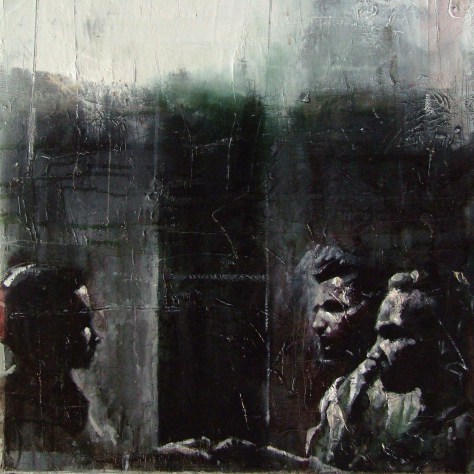
I have always been impressed with the clearly evident, aesthetic craft of Mathew Barney’s Cremaster Cycle; as each film was finished and still shots started to seep into the art news magazines I was becoming increasingly impatient for a viewing. When I did see the films I wasn’t disappointed. I would not make a direct comparison between the Cremaster films and some of the films of David Lynch – a comparison that is frequently heard – because clearly the targeted audience and ideal viewing environment is so different, however there is one key element that Barney’s shares with Lynch. That is the creator’s clear love of the visual aesthetic for its own ends. Narrative is clearly secondary and much of the meaning contained is personal to the director, even to the extent of being absolutely unfathomable to the viewer. To appreciate this work the audience just has to share the same love of looking; I feel it is as simple as that. In my opinion it is clear from its careful construction (evident whether you like the work or not) that the artist views the medium of film in a similar way that many painters view their medium.
Any narrative is at best buried beneath the layers of fragmented visual metaphor and allegory; apparently even Barney has difficulty fully explaining some of the reasons for the film’s content. I don’t think this is necessarily a weakness or an admission of intentional obscurantism. It is the same process that I identify in my own work once it is completed. So much informs the artist through the working method and practice that minor and frequently apparently insignificant influencing feeds from daily life, incorporated during the process of formulating the work, are frequently forgotten.
Finding not only the visual impact of the films thoroughly stimulating, but the working methodologies clearly similar to my own, I decided to pay a respectful nod to the art of Barney with my own practice. Following on the long tradition of artists referring to other artist’s work I am working from available videos and stills of the Cremaster Cycle and adapting the work of this contemporary art medium into an art medium with more directly personal significance and relevance.
I have worked through the available footage of the films that I have been able to source and followed the sections that repeatedly visually struck me the most. I have then slowly watched and studied them, more or less frame by frame, sketched from the screen captures, and gradually assembled and edited this preparatory material into proposals for a few new paintings.
As I have done this, I have investigated other avenues that the film’s clear references have led to. This has led to ideas and influences in my work that to a viewer may have no direct reference to the Cremaster Cycle but to me are, or were at the time of finding them, directly relevant to my interpretation of Barney’s films.
The first inspiration from Cremaster that led me to the idea of working from them came from a personal consideration that these films seemed almost to be in the tradition of the painted still life: particularly the sixteenth and seventeenth century Northern European still-lives of careful compositional construction, often loaded with symbolic reference and frequently a vehicle for the display of the craft of the artist.
In the past I have been accused of talking both prolix and bollix, so I’ll summarise briefly:
In taking the inspiration for my current work from the analysis of another artist’s work I am doing nothing more radical than artists have done for centuries. I’m happy to acknowledge that this section of Barney’s work is something that has impressed me immensely and I am just acknowledging this formally by working from it in a similar way that I’d work from the inspiration of other art, music, literature, film or performance.
four-one-five-two-three

“cycle 2” 2009


back to blog menu
Affectation, affectation

A friend has had her work rejected by a gallery on the grounds that it is too stylised and tending towards ‘affectation’. All said in the politest way possible of course.
Apparently (allegedly this is news) there are degrees of affectation in art; and also, so it seems, there are limits on its acceptability in the eyes and minds of the particularly critically astute viewers.
Those artists who insist on continuing to plough the obviously decrepit and irrelevant furrow of expressive figurative painting are accused (with a patronising and authoritative nod) of ‘affectation’; as if there were a higher form of culturally accepted art that did not rely on affectation.
It reminded me of the story of the philosopher Diogenes, whilst he was at the Athenian theatre one day (I’m assuming it was Diogenes of Sinope but I can’t seem to track down the story online).
A group of youths from the wealthy city of Sybaris entered; all decked out in the finest clothes, jewellery and make up, striding through with the confidence that they were as natural as water or air. Diogenes, a confirmed critic of all excess (and Cynic of course), stands up and shouts at them “Affectation, affectation.”
A little later another group walk in; this time it’s the residents of Croton, known for their more ascetic style of dress and life, who also walk with the confidence of supposed authenticity. Once again Diogenes stands up and shouts “Affectation, more affectation.”
To the gallerist: It’s art… the cultural apex of conspicuous artificiality. Show me please, what in your mind, passes for an ‘authentic’, artifice-free, piece of art.
Do you purists not think there may be an etymological link between the words ‘art’ and ‘artifice’?

affectation-affectation

“Royal wedding” 2011


back to blog menu