Stuck

Stuckism was, and still is, far more than just an anti-conceptualist standpoint taken by a few artists, apparently ‘stuck’ using an ‘antiquated’ medium in a pseudo-naïve style. The timing of the rise of Stuckism coincided with the popular rise of the ultimately democratic medium of self-publicity, the internet, and consequently many people painting in this style from all over the world assign the name of ‘Stuckism’ to their work and broadcast it to the world without really understanding the reasons behind its foundation. Because of the apparent initial similarities of the very individual paint techniques practiced by those initially working under the banner of Stuckism, and no doubt also due to the fact that the group assigned themselves an ‘ism’ to work together under, the popular media and the general public interpreted the name in a similar manner to the countless other well known ‘ism’ art movements. The idea of Stuckism as a technique stuck.
What is key to the whole understanding of Stuckism is not the aesthetic sensibility of the work of the movement’s practitioners or even the manner in which it came to prominence, but the point in time that it came to prominence. Though I’d be loath to put the responsibility for anything as culturally wide scale as an art ‘movement’ or even ‘anti-movement’ on the shoulders of one individual I’ll maintain the Billy versus Tracey story as a convenience that people can relate too. Billy Childish and the originating Stuckists did not respond to the YBAs in an oppositional sense, and then start to paint in the way they did. The reasons that the Stuckist artists paint the way they do are the same reasons that many others, myself included, continued to paint through the nineties when the art education establishment was pushing the art party line that conceptualism was king. To use a now clichéd word, this return to figuration and paint was nothing more than an end of the century “zeitgeist”.
It was the obvious route to take if someone who wished to be perceived of as an artist, wanted to achieve that goal in the old-fashioned and empirical manner of comparative achievement of applied and accumulated efforts. What does that mean? Work basically. That is, the continual practice of technique, the continual exercise of self-editorial control and the continual development of patience in the face of producing work you may not be happy with. And of course, the decidedly undemocratic, un-postmodern belief that there may be such unfashionable, un-pc things as recognition of the western male dominated art history, the belief in the existence of innate talent and ability or, at the very least, the Romantic idealistic sensibility of the artist.
Before I get lynched please note that I only stated that the western male dominated art history should be recognized. I have never suggested that it should be the only history. Modernism and the movements that led to it are not without fault, but also, and importantly, that does not mean that they are not without some merit.
There are other ‘isms’ associated with Stuckism and on a personal basis at least, the reasons that I am happy to be associated with the Stuckist term is through one that I have attempted, in a small way, to champion – Neomodernism. I have been previously subject to attempted baiting by some critical halfwit asking which came first, Remodernism, Defastenism, Stuckism or Neomodernism. Needless to say I told them where to stick the question. I’m not in the ring to claim this or that ‘ism’ was first or second.
If these idiots posing as experts extended their analysis beyond the insightful puddle-like depths of tabloid journalism they would realize that this variety of cultural responses is the obvious outcome of any number of geographically diverse artists, bloody minded enough to shoot career aspirations through the foot; driven through frustration to the point where they will willingly bite the hand that most might prefer fed them. Once again – it is nothing more than the spirit of the times of those that hold a belief in the value of independent thought. It is artists refusing to accept that the commonly accepted notions of what constitutes art (figurative painting and sculpture) are dead.
Like Stuckism, Neomodernism is not a return to something that came before stylistically. It is an attempt to progress art from its current moribund obsession with pseudo-intellectual analyses – but with reference to all art history. It is a celebration of creative spirit over academic, politically correct desiccation. It is a renaissance of that old art battle ground where the Romantics take on the Classicists.
Anybody involved with the art world will be aware of the term Modernism when taken in the Greenbergian sense. Like any other history it was extremely selective and exclusive and because of this, not despite it, as it was usually taken in the last thirty years, it opened up the cultural debate to other important avenues that were equally dogmatic in the hands of their academic champions. Feminist art, black art, queer art; the list goes on.
In my opinion (a phrase you rarely hear from the defenders and maintainers of the current hegemony) the work I consider most likely to stand the test of the time is that which is grounded in applied effort, application of craft and workmanship and celebration of the values of art established generally, though not exclusively, over the last six centuries. An art that a public audience can engage with, without being told pre-emptively what to think about it or how to correctly interpret it.
I am sure that the current artistic vanguard will be seen in the future art histories as a ‘blip’ – perhaps (if today’s cultural history makers are lucky) even an interesting blip. With the applied perspective of the distance of time and when viewed by a general public not subject to the current critical bullying; when the current raft of people who call themselves artists are viewed in the context of artists before and after, I am sure that those currently outside of the chosen establishment circle will be vindicated in their rejection of current supposed valid contemporary practice.
I also maintain another difference of critical definition that some refuse to accept. And even though it may only be a matter of semantics I think it is a characterization that adds lucidity to understanding not only the current art world politics, but those that preceded it. That is the difference between the vanguard and the avant-garde. The vanguard is the established order; the avant-garde is the challenging unorthodoxy. The current British conceptual and installation art driven establishment cannot by definition be the avant-garde. It is in fact the old Classical orthodoxy itself, pompously declaring intellectual superiority and authority over any art that cannot be assimilated.
The return to an aesthetic and medium that the public recognize will be championed by the new Romantics, the Stuckist avant-garde. Whether the current art establishment likes it or not.
Art history is littered with episodes of challenge to the established cultural order and of course, that is the way it should be. The only way an artist can justify their practice as being relevant to its audience is to push forward down different roads to those currently in the mainstream, engaging the viewing public with fresh interpretations of the one constant subject of art. Not art itself (one of the current curatorial clichés) but humanity, even if that means re-investigating previously utilized media, subject matter or critical sensibilities.
There is little difference between the last great culturally fascistic order (the nineteenth century European art academies) and that which now holds sway. Allegedly they differ because the work that challenged the old academy is the foundation of what stands now – as if all that preceded is absolutely irrelevant. A very selective and convenient history.
The reason that Modernism took hold critically as well as in the mind of the public was twofold. Firstly the new work bore direct relevance for a western world audience that was in the grip of rapid industrialization, urbanisation and mechanized warfare. But, secondly, I would suggest that what was more significant to the old European academic fall from grace was its relative cultural parochialism outside of the western nation’s capitals. Today’s cultural empire, despite protestations of being inclusive, is just as exclusive. There might be the occasional loudly celebrated trumpeting of ‘new’ aesthetic sensibilities (Australian aboriginal art and the current commercial obsession with contemporary Chinese work are prime examples), but these are rarely inclusive beyond their being the latest fashionable item for the wealthy art cognoscenti to accommodate in their collections. They are, shamefully, the cultural equivalent to the whinging middle class liberal of old loudly proclaiming ‘Look at me, some of my best friends are black’.
When it comes to the larger, global art arena we are still in thrall to a few private and public collections, despite the huge wealth of variety around the world. The A list supports a few favoured biennales, world shows and of course a few select ‘competitions’, of which the Turner is perhaps the best known here, demonstrating that nothing has changed relatively in terms of real inclusivity.
Perhaps the most significant difference between the time of the Impressionists and the time of the Stuckists is the current insidiously pervasive nature of global media. Today this is a lazy media that no longer even bothers to seek out its source material. Why should it waste its time, money and effort if its agents, the arts journalists, need only to stay in the office to be spoon-fed by galleries and promoters of whoever or whatever will be the next big thing. Why should they challenge a critical discourse that even they, masters of language and the written word, cannot fully fathom? Are the general public going to challenge the accepted wisdom if even the art media doesn’t?
Is Modernism dead? Yes – of course it is. High Modernism, Greenbergian Modernism, Formalism whatever you want to call it, is dead. It moved from the radical American painterly investigations of medium (and occasionally spirituality) in the 1950s into the bargain print section of B&Q and IKEA. But similarly the intellectual and nihilistic posturing of Duchamp is equally dead and irrelevant. It was an interesting philosophical exercise, tied to the uncertainties and horrors of its time, a time that is nearly a century past. Like the musically opposed excesses of prog-rock and punk, we have had our artistic extremes of excessive introspection and even more excessive anti-art nihilism. Now it is time to move on, looking to the past art histories with respect, and working their lessons into future work without falling victim to the current incessant obsession with novelty.
I am not opposed to conceptual art. I have seen installations that have moved me to real joy – but this is a distinct rarity. What I am opposed to is the current glut of deliberately obscure work disguising a paucity of talent – which is usually the case with what is today considered ‘conceptual art’. I would argue that all art should be ‘conceptual’. The arguments usually used against figurative painting work both ways. If a painter, disassociated from the work, produces nothing more than illustration or decoration then an installation or assemblage, if produced with equal lack of integrity, is probably no more than land-fill with a wall label.
My ego and id is inextricably bound up in every piece of finished work I produce; my work is both conceptual and primal. This is not a stance I have formulated. This is the position of most painters that I know. On a personal level painting is the medium of self-discovery. I don’t want my practice to interminably ‘investigate art itself’. I want an art that is honest, personal and capable of communicating to the viewer. Art that investigates art is no longer art that can engage interest, except to students of art critical theory or art history. Who in their right mind would want to produce work for such a small audience? Unless of course they are only doing it to achieve immediate critical success amongst those who they know hold the key to their being recognised as serious contenders for entry into the pantheon of art history.
I am fed up reading reviews of exhibitions that simultaneously say the same and yet say nothing. Reviews that celebrate the conceptual significance of a twenty-something year old’s installation. Recently graduated art students are not philosophers. They do not have the intellectual discipline. Believe me – I have spent time talking with published practitioners of philosophy whose capacity for thorough and organised analysis astounds, impresses and occasionally frightens me. I’ve talked to recent Fine Art graduates too – graduates that inevitably know the market more thoroughly than the history; this has had the occasion to frighten me, but certainly not astound or impress.
Painting pictures is important. People outside of the art world understand it without great tracts of explanation. That is its problem for the art critical industry – figurative painting and sculpture undermines their supposed intellectual authority and allows the public audience to engage without their mediation. It is this that Stuckism is about – the celebration of a truly democratic and inclusive art. Consequently this also means acting occasionally as a more confrontational campaigning body. Along with the Stuckists I too maintain that the critical and curatorial fraternities can shove the Turner Prize and its like up their arses. It’s no different than the other national gongs like knighthoods and MBEs. We don’t need the spurious stamp of acceptance gained by the judgements of a few individuals with vested interests acting in the egomaniacal notion that they can arbitrate the taste of nation. When a student contacts me out of interest in my working methods, or an individual on low wages is willing to pay for a painting in monthly instalments over a period of years, or praise for my work comes from another painter – that is when I feel justified in my choice of working direction.
The most important aspect of the Stuckist manifesto is the one that’s usually ignored – that Stuckism is an international non-movement. This is why it can be associated with Defastenism, Remodernism and Neomodernism. The Stuckist manifestos were good in bringing to the fore a challenge that was noticed and comprehensible to the public. They can be read, understood and be found refreshing and honest.
Unfortunately the manifesto is a point of reference for journalists, critics and historians to be able to accredit the ‘movement’ without having to apply any level of effort in personal analysis, but the manifesto in relation to the wider movement is unimportant. The important aspect is that there is a genuine avant-garde (who just happen to champion craft, application of effort and art that communicates outside of the arena of established fine art criticism) who are willing to challenge a vanguard that hang onto the coat tails of an art theory that is nearly a century old.
On a personal note, when first becoming aware of the Stuckists, certain aspects of their manifesto made me realise that I wasn’t the only person feeling the same way. I’m not a Stuckist painter. I’m not a Neomodernist painter. I’m just a painter. Their manifesto was penned in October 1998 – the Stuckists were painters before they were called Stuckists.
So you see – Stuckism is so much more than a style, medium or technique. Stuckism is a vital challenge to an arrogant art elite, based like the old academies, on financial interests. Stuckism, like Neomodernism or Defastenism or a hundred other ‘isms’ is only a convenience for people’s comprehension of aspects of the cultural world that they really don’t have the time to examine themselves – oh and lazy journalists.
stuck

From “The Pharmaceutical Bestiary” show.
 

back to blog menu

Stars

You know when bad things seem to conspire to bring misery upon your life like a western government spreading peace and democracy upon the Middle East? Well lately a lot of shite seems to have come my way, but with the help of a loving family and gloriously fine artist friends, the cloud actually DOES seem to have a silver lining. There have been various trade union related crises at the hospital, and more than a Texan restaurant’s serving of hassle has been served up on my plate. This has been a major factor in me not producing any work lately and on top of this I’ve received a ludicrous demand from the Inland Revenue that should be considered a worthy Booker Prize nominee (best work of fiction, retrospective 2004). So it’s safe to say that generally I’ve felt pretty shitty lately.
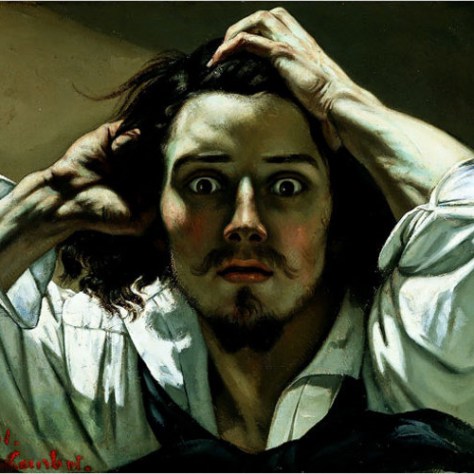
I took some time out to visit the Rebels and Martyrs show at the National with my sixteen year old son Luke (who also has a healthy interest in art and a natural talent to music). It was probably the most enjoyable day I’ve ever spent with him and I suppose it would be an equivalent to a footballing father and son going to see a big game. The show was wonderful and it has forced me to look more carefully at the work of Gustave Courbet who has definitely become my latest ‘cause-celebre’. There was a self-portrait that if executed today could be considered self-indulgently staged. All wide-eyed and tormented hands grasping the head as he stares at the viewer. Pure artifice (which after all is exactly what art should be) but beautifully painted; unfortunately it resides in a private collection and I can’t find it online so if you didn’t catch it this time I don’t hold out much hope in the future. Expect future blog posts celebrating this painter.
After this we ambled around Cork Street galleries for an hour or so and then Luke took me to Camden market. With a bit of food and a couple of drinks to finish the day it turned out to be something we both agreed should be repeated. Back to home and Colleen and I have decided that we really should pull our fingers out and finally get married (she’s had me on approval now for twelve years). And now that my parents have declared they want to move to France as well, it seems that this dream too is about to become a reality inside perhaps a year. All being well we’ll set up some kind of artist/writer retreat (sounds great doesn’t it? I think it’s basically a posh B&B!) where perhaps I might do some private tuition too.
I received an unexpected call from Juno Doran who was passing Bristol on her way to a weekend away in Devon and she wanted to pop in to say hello, which she did. Her husband Paul came too, they treated us to a fantastic meal which they made here, we stayed up until stupid o’clock drinking good wine, talking art, religion and philosophy bollocks and introducing each other to our personal musical tastes. What a way to live eh?
Others have said it frequently, but for some reason (perhaps it was the way it was justified philosophically) Juno made it hit home. I realised that I should be painting full-time. I shouldn’t be staring at a bloody computer screen all day building NHS websites and then spending evenings and weekends fitting in my painting. I should be staring at canvas and breathing in the smell of turpentine 24/7. I’m forty one this year, how long have we got on this bloody planet? I need to sort my life out and start doing what I was put here for. Cheers Juno, cheers Colleen, cheers Luke, Mum and Dad – you’re all stars.

stars

“Le Désespéré” by Gustave Courbet


back to blog menu

Six degrees of separation

I’ve just received a couple of interesting emails. One that you’ll have to take on trust as being genuine, bearing out the old adage that you’re only six people away from anybody else in the world. A friend of a friend knows an extremely famous artist in this country who is quite happy to admit (when drunk and to friends at least) that there is no real great degree of effort involved in being successful in the current contemporary British art scene. Apparently opportunities come their way like ‘flies to a turd’ (not my words). This person can amble around at a leisurely pace, pursuing whatever interests they wish to progress, and ‘exploring’ new media without fear of lack of financial support as their name alone assures a positive response to funding applications made on their behalf. It wasn’t this that really wound me up. Nope. What did it for me was the admission that if they needed money, all they had to do was ‘scribble some crap’ on a piece of paper as there were currently no shortage of potential buyers willing to invest in the brand.
On the following day I get an email from a 22 year old from Minneapolis who’s greatly enamoured with my work (it was nice in an email but the praise would have embarrassed me if I met them in public). As well as letting me know that it’s as ridiculously expensive to study in America as it is in this country, and that the same financial supported and driven student art cliques exist there as well as here he included this little throw away…
“There are so many people here obsessed with the idea of being an artist that they never learn to be a painter first. So they have art parties and play in art bands and live in art spaces. But they don’t actually do anything.”
This little observation reminded me of an incident years ago when I was ambling round London on a week day (for a job interview). Purely by accident I strolled down a side street off of a main road and went past a building entrance stuffed with beautifully, languidly draped, smoke enrobed fashion victims. I can’t remember the precise uniform details of the requisite sartorial fascism at that time – but rest assured they were all sporting it. They were too busy sprawling beautifully over the pavement to trouble themselves with getting out of the way of the irksome pedestrians so I informed them that they were all, to an individual, a consummate band of masturbators (or some such observation).
As they had now gained my undeserving attention I also took note of which establishment’s maw had vomited them onto the thoroughfare. It was one of the Central St Martins’ college buildings. No doubt (as this was at least six years ago) there are some present day gallery superstars who share the memory.

six-degrees-of-separation

Art students – working…


back to blog menu

France – we’re coming!

Well I’ve just returned from France via Marseille and one of the most obvious art-related sights there has to be Mont Sainte-Victoire. I can understand why Cezanne was so impressed by the subject that he painted it more than sixty times – however, despite his obsession with the subject (and Cezanne was a good one for obsessions) I don’t think I’ve seen many of his paintings that have caught the scale of the mountain. One notable exception is Montagne Sainte-Victoire Seen from Les Lauves, completed between 1902-1904, currently in the Philadelphia Museum of Art; most of these paintings though seem to be more about paint technique referring to spatial volume on the canvas than spatial volume in reality. I’m not saying I could do any better mind.
Also, another cliché of art talk came to mind when driving around Aix en Provence and Arles. The famous ‘light is different’ phrase, though usually applied to Saint Ives in Cornwall, seemed appropriate when bearing in mind Van Gogh’s canvases. Admittedly the sun was blazing the entire time of our visit but you can’t help ‘seeing’ his paintings wherever you go. His colours weren’t artificial at all – the place actually is that bright. There were strange clouds too, no doubt due to a combination of the geography and climate of the place, that though not as twisted and tortuous as he painted them could obviously have provided the inspiration.
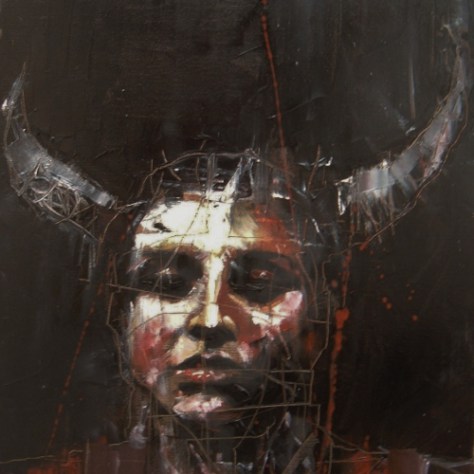
So – back in the west country and inspired to paint (I obviously needed some kind of mental creative invigoration). I know I haven’t painted the butcher thing yet, or a hundred other proposed new subjects come to that, but I’m winding up for another larger Icarus, perhaps something Minotaur inspired (I came back with a lovely little casting of a bull that I bought from a roadside wine and fruit seller) and probably a return to the Young Spartans theme.
I know it’s only going to be a matter of time – but we will move to France. The cultural climate there IS different; despite my persistent attempts to tell myself I’m living in some kind of mad idealised world of how I want France to be it actually is how I perceive it. The people are friendly (and gloriously ideal subjects for painting), the food is varied, good value and healthy. Smokers aren’t yet subject to potential summary execution and there’s always the wine and coffee. Ahh – the wine and coffee.
Apparently Aix en Provence is twinned with Bath. I know where I’d rather be.

france-were-coming

“Minotaur Woman” 2005


back to blog menu

Catching up on the news

Found this in yesterday’s Observer. The ICA’s Director of Exhibitions “Jens Hoffmann notes: … a lot of people spend more time reading labels than actually looking at the works of art”
I’m not saying anything d’you hear me? Absolutely nothing.
Rachel Cooke, reviewer of the current ICA treat ‘Surprise Surprise’ seems underwhelmed. I’ll be taking her advice then and ignoring the ICA show and instead check out the National’s ‘Rebels and Martyrs’ exhibition. I don’t need to travel 120 miles for prescribed public education in contemporary junk assemblage. If I’m going to learn something I’ll look at some nineteenth century painting techniques thank you very much; that’s actually useful to me. I suspect the punters there that aren’t painters might be enjoying the paintings too. Deluded fools – obviously they have absolutely no idea at all what’s good for them.

catching-up-on-the-news

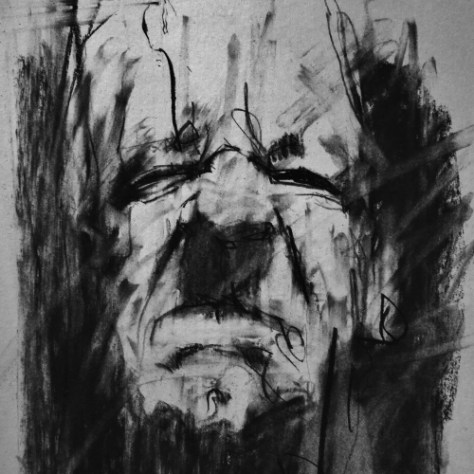
“twenty four hours in the life of a madman”


back to blog menu

Questions I get asked…

…range from the “simple that almost answer themselves” to the “don’t ask me that because you’ll die of starvation before I get half way through”. Another painter has noticed that I’m doing smaller work and they’ve wondered why – considering that “small paintings [are] actually more difficult/problematic technically”. Simplistically, that is the reason I’m doing smaller work! Working on a large scale has its own peculiar problems, not least of which is the ludicrously obvious problem of working out how you’re going to fill the space. The key to this, in my opinion at any rate, is to specifically avoid ‘filler’.
Everything that is in any painting ‘needs’ to be there but with the luxury of a large canvas you get the opportunity to reduce – most viewers of a large painting stand back so that they can fit it into their field of vision in one comfortable viewing (if you’re in a gallery trying to appreciate a twelve foot wide painting and your view is interrupted by some goon virtually rubbing their nose on the surface of the canvas then that’s probably another painter studying technique). With a large painting you have the luxury of flinging the paint about, perhaps benefiting from the occasional ‘happy accident’. What I’m attempting, by working on a smaller scale, is to avoid this ‘happy accident’ situation. I’m trying to maintain absolute control over my work; that’s why I’m working on a smaller scale.
As to the other question of late “What exactly is the purpose of art?” I suppose it’s my fault for my last blog entry – but in my opinion art is about communication. And communication, to be successful, either requires a singular clarity of the language used (which is always going to be problematic with visual art), or a singular clarity of the end message. It doesn’t matter whether the message is social, spiritual, philosophical or aesthetic – but for the message to be given any weight it has to be well or, at the least, honestly informed. I have read on philosophy and theology but I would never consider myself informed sufficiently to proselytise through my painting. I do however, know my medium, and I also read widely on current affairs and political history; consequently most of my painting tend simultaneously to these directions. That is the purpose of art for me.
What annoys me with the British art world today, is the current glut of twenty-something cod-philosopher art graduates producing work that they think is in the grand Romantic tradition (even though, sadly, most of them wouldn’t know what that tradition was).
Oh – I haven’t been doing much painting of late as my time has been taken up fully with trade union duties. The hospital I work at has announced a potential redundancy total of 330.

questions-i-get-asked

“the garden of earthly delights” 2007


back to blog menu

Is art fit for purpose?

Art is in the display of the object and not the creation of the object. Whether we like it or not the gallery or museum are intrinsic to the value (financial or critical) of the art object. The artist seeks the exhibition and the attention. They may not seek the associated celebrity status, they may not seek the extremes of financial reward that can be generated through engineered publicity but they do seek the exhibition of their work.
If these arenas are important, then they are important for a reason, and the only common reason I can think of is that it puts the notion of the creator of the work, as an artist, in the public domain. Put plain and simply – recognition and/or communication with a public audience is what is sought when an artist works. Would an individual want to be recognized as an artist without consideration taken of the value of the work? Or again, put plainly, do they just want celebrity status for having work on display? Probably not, or at least that’s what most would claim. Most artists want their work to be evaluated by an audience and found to be worthy of entering the common memory (for whatever period of time) so art plainly has to engage with the audience at some point in the exhibitive process.
I call this art/viewer engagement ‘communication’. It does not necessarily have to be the didactism of BANKSY. The work of the American Abstract Expressionists equally communicated with the viewer but in a visual manner through the aesthetic level of non-figuration, Damien Hirst’s ‘The impossibility of death in the mind of someone living’ communicates in the sense of spectacle when the viewer is first confronted with the monumentality of the installation; the ‘Pieta’ of Michelangelo communicates in a multitude of ways to differing viewers (religious inspiration, the artist’s love of his work and his capability to transform his medium).
What seems to be lacking today is an awareness of the art object to be able to stand on its own merits without mediation through a critical interpreter. A viewer can appreciate a Caravaggio without having to read the accompanying wall note, in fact without even knowing that it’s a Caravaggio. With almost all the work created today in this country, that passes for ‘significant’ and worthy of entering public collection the same cannot be said. Most honest viewers wonder what they are looking at, they wonder what their appropriate response should be, they take note of the approved reading of the art object and they accept it as the wisdom of the elders.
Don’t accept what you’re told as a viewer (educated in the history of Fine Art or otherwise), take the work at face value and see if YOU the viewer can engage on a personal level with the work. If you do like the work for any reason then take one of two courses of action. Either walk away, happy in the knowledge that the artwork has added in some way to your life experience or go and read the wall note and see if your interpretation was the appropriate response.
If not – don’t assume that you, the viewer, were wrong. There’s a problem with the visual language being used and the artist is at fault. If the art work is meant to be communicating you would have thought the onus would be on the artist to use a language that the audience might understand.
Art works made for the benefit of an art critic audience is not honest work if it’s shown in a public arena. It’s grandstanding for career accolades and probably little more.

is-art-fit-for-purpose

“Monkey pump varnish” 2008


back to blog menu

Envy’s a terrible thing

I think I’ve made it clear previously that I have to work full-time in the NHS to support my being able to paint what I WANT to paint. That’s not good is it? I’m only two dozen or so words into an entry and I’m already SHOUTING. Bloody ‘netiquette’. Anyway, I’ve also been elected ‘Chair of staff-side’ which is basically the trade union side of the local hospital’s staff representative body. I’m not new to union work at this level but it has been an eye-opener to find how modern public service management operate. And it’s rapidly turning into another full-time job. On a personally positive note it has meant going to Gateshead for the recent health delegate conference which gave me the opportunity to visit the new Baltic gallery.
It’s a fantastic venue in a beautifully appointed building, but it suffers (thankfully to a lesser degree) from the same problem as Tate Modern. The marketing boys and girls end up making the gallery the focus rather than the work within it. We’re in the middle of the age of ‘personality galleries’ – most odd.
There was some very interesting work on show but sadly I was too early to catch Sam Taylor-Wood’s latest show. I can’t say I’m a fan of her work however the ‘Still Lives’ did look potentially interesting from the pre-match publicity and I was hoping to be converted. Ah well – there will be other times.
There was a hefty amount of painting there which was cheering; however it didn’t do much for me in the way I hoped. In fact my expectations were reversed and I found the work of James Hugonin and Ian Stephenson to be too clinical and reserved for my personal taste. There were obvious painterly ideological associations with artists like Seurat whom I’ve never jumped up and down about and despite claims of Stephenson to be working in a tradition related to Constable and Turner I failed to see it beyond the association of being English.
The main space in the gallery was taken up by the ongoing ‘self-portrait as a building’ installation work of Dutch artist Mark Manders.
‘Isolated Bathroom’ was one piece that I did find darkly interesting, however any atmosphere of threat generated by the work was lost when presented in a cavernous venue like the Baltic. I’d like to see it again in smaller rooms where I think the work would become the focus of the experience and not the celebrity gallery. The work was quite disparate and seemed generally inchoate. It was indeed like ambling round inside the waking thoughts of the artist, and to be honest, with it taken in entirety, it’s not somewhere I’d choose to go for a walk again. Not because it disturbed me, but just because it didn’t seem worth the effort. In the accompanying blurb it states ‘which is more important, the word ‘cup’ or the cup itself? The cup, of course, because it has colour, because light falls on it, because it casts a shadow.’ But the fact that this is even an issue within the supporting literature amply demonstrates that it’s the words that are more important. I’m not getting into the words and galleries rant again…
The artist’s career is assured. The ‘Short Sad Thoughts’ show at the Baltic will become another worthy c.v. stuffer. He’s done Documenta, MOMA and now the big Biennales no doubt beckon. Good luck to him. I’ve got three jobs to get on with – with short, sad thoughts.

envys-a-terrible-thing

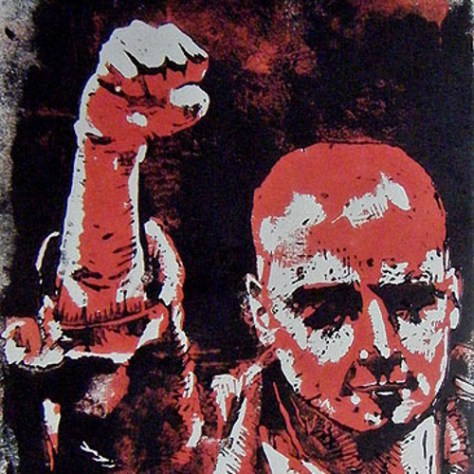
“Mai 68” lino-print


back to blog menu

Brian Haw

I had an interesting day Thursday gone. I had some work on show at the London Affordable Art Fair and the gallery holding it sent me a pile of tickets. Being Billy No-Mates I went up on my own but that allowed me to do something else I’d been promising to do for years… I thought I’d pay a visit to Brian Haw, who’s still camped across the road from that paragon of democracy, the houses of parliament. I don’t know what I expected of Brian when I got there, not that I had any right to expect anything. Here’s a man that’s forsaken any life he had previously (that includes his family) to protest about the despicable behaviour and murderous actions of our government. If you don’t know about him and that he’s been there since June 2001 then that shows what a sterling job the majority of the media in this country are doing in keeping you on-side. It’s also little known that this government has passed legislation to stop protest outside of the great house – however, no doubt much to Blair and his fellow pseudo-dictator chum’s chagrin, it can’t include Brian as he was in situ before the laws were passed.
Initially aimed at the illegal and immoral race for oil control in Iraq, Brian has now extended the protest to encompass all aspects of how children and civilians are being murdered around the world in our name. The great British public voted these great British murdering bastards in after all.
I planned some time ago to paint a portrait of Brian as the third piece in the ongoing series titled ‘Badge makers’ and I wanted to say a ‘thank you’ to him for what he was doing on behalf of the rest of us. He’s had five years of idiots like me coming up, shaking his hand and saying the same old stupid things to him. There’s nothing you can say to him that is adequate enough to express your gratitude – I hope he’ll understand one day when he’s got less reason to be so angry (and he is bloody angry. I don’t even come close). I left him with my packet of tobacco and a promise to see him again – hopefully not there.
I ambled up Bankside to check out the Tate. The proper Tate that is, Tate Britain – which I did mention to somebody on the way in, actually now looks like a small provincial gallery from the outside. Once upon a time it seemed huge, and then they started converting power stations, flour mills, Zeppelin hangers etc. into galleries… Anyway, next time you’re up for some capital cultural edification I’d recommend the old Tate. You’ve now got room to amble around and enjoy the paintings without the usual huge crowds stamping on your head as in the new Tate. I found a Constable that I knew of but had never seen in the flesh before, and I’m not really a fan of Constable. The analysis doesn’t go any deeper I’m afraid – I just don’t get any ‘oomph’ from his paintings. This study however, of a girl in a bonnet, is beautiful. Small and beautiful.
Oh – the art fair? Just me doing the usual art-whore thing really. Mind you there were a couple of galleries that had heard of me – I don’t know whether that’s good or not as they hadn’t contacted me. Probably had me on a list of ‘nutters to lock the door on once you’ve got him out of the building’.

brian-haw

“The badge-maker (portrait of Brian Haw)”


back to blog menu

Know any good butchers?

You know, I’m starting to not mind 2006. Purely in selfish painter terms of course.
Despite the fact that our glorious leaders are priming their respective populations for the next military caravan of doom (Iran). Did you know that Iran has been planning for a long time to move their trading in oil away from the US dollar to another currency? If other countries that are equally as sympathetic to the American cause follow suit it could undermine the whole US economy. The anti-proliferation argument is basically the equivalent to the WMD excuse previously wheeled out – it’s the same old oil, power and money routine.
Despite the fact that there are moves afoot with some American employers to install radio chips in certain employees – and we are the fifty-first state of course, so it’s only a matter of time before they start shoving digital surveillance up UK resident’s arses.
Despite the fact that we’re getting the ludicrously justified identity cards (they’ll fight the insidious war on terror on our behalf apparently).
Despite the fact that the environment is totally up the bloody spout; glaciers are disappearing, along with our previously obviously apparent different seasons. Don’t worry, be happy. Turn on the telly and watch the winter Olympics (before the climatic differences between them and the summer games totally evaporate).
Despite the fact that when I now walk from my local shop with a packet of fags in one hand and a bag of sugar in the other I feel like I’m smuggling illicit drugs into the house.
Anyway, like I said, in selfish mode. I’ve managed to get more paintings completed so far this year than I did in the entirety of 2005. I’ve also had an extremely positive response to the latest piece ‘The Madness of King George’ and now I feel fired up to start something new. I don’t expect to be giving up the day job any moment shortly, but it’s good to at least feel positive about my painting. The ‘screaming head’ video work I did for North Sea Navigator at the Cube in Bristol went down an absolute treat; the band are still talking to me – which is a bonus. Also Naïve John of the Stuckists is encouraging about getting some kind of contribution from me for their Symposium later in the year in Liverpool – I’m looking forward to that.
I’ve got plans to do some paintings of meat. Butchery, carcasses, that sort of thing… best annoy some local butchers I suppose (in a nice way of course).
Yeah, 2006’s looking alright at the moment. Someone’s bound to balls it all up. The smart money’s on Bush/Blair.

know-any-good-butchers

“The madness of King George”


back to blog menu