“Madmen and English Dogs”

These are some of the drawings from a writing/drawing project that I have been working on since the mid 90s; the project is still not complete. These drawings have never been exhibited and they all remain within my personal collection. They are not for sale.


back to work chronology menu

“الربيع الديمقراطي (Arab Spring)”

A selection of drawings and paintings made from the end of 2010 where I took, as  subjects, individuals from online news footage of the ‘Arab Spring’. The works have never been exhibited in a gallery space  – only posted online via my old ‘drawing a day’ blog.

back to work chronology menu

“Ad nauseam”

During the eighties I briefly worked as an artist in an advertising agency; the experience formed a lasting impression of this business and I soon left – I’ve been clean now for decades. This set of work, a critique of advertising and its media, was started in 2008 and the paintings were exhibited at Signal Gallery in London in March 2009.

back to work chronology menu


“The hand of man.”

This is an ongoing series of work under the working title of “The hand of man”.

back to work chronology menu


“Behemoth”

Inspired by Dreyer’s 1928 film La Passion de Jeanne d’Arc, I made over two hundred sketches and thirty finished paintings. I chose the subject as a metaphor for an apparent loss of political faith in a rational, caring world. The paintings were exhibited in the crypt of St Martin in the Fields Church, Trafalgar Square, London in September 2010.


back to work chronology menu

“The Disasters of War”

Frustrated with the mainstream television news mainly focusing on young men in their coverage of the Syrian refugee crisis I instead found more balanced coverage with a variety of internet sources. I took video captures of the refugees and instead focused on the children, women and elderly; these individuals were the source material for many of these drawings. As I was building this collection of drawings I was also preparing for an exhibition at La Neomudejar de Atocha in Madrid and I made a connection to the work of one of my favourite artists (Goya) with the working title of “The Disasters of War”.
These drawings were exhibited partly in Madrid and partly at Brugier Rigail in Paris early 2016. Some have also been pasted up in streets (Liverpool and Watford in the UK and Brest in France).

back to work chronology menu

“L’abri Sadi Carnot”

These drawings were exhibited at Maison de la Fontaine, Brest, France in September 2016. Their making took place over the two preceeding years. I made them in response to discovering the story of the loss of lives in a civilian shelter that was being used by occupying forces to store munitions (in contravention of the Geneva Convention). On September 9 1945 there was an explosion in which as many as 900 people may have lost their lives. There is a memorial of names of individuals that were known to have been present, however the force and heat was so intense that hundreds were never formally identified. This piece of work consisted of 99 drawings of anonymous faces as an attempt to personalise the horror and loss of the event.
The complete set of drawings “L’abri Sadi Carnot (all the people they could have been)” was donated to the city of Brest and its Museum of Art and copies were printed to exhibit permanently in the tunnel itself.

back to work chronology menu

Online art


Way back when… in the early nineties, I remember a gallerist refusing to exhibit my work as long as I had an online presence. His gallery’s policy, and he wasn’t alone, was that their artists would not have web sites of their own. Basically these galleries didn’t want artists selling direct and cutting them out of the loop – which was more of a judgment on the gallerist’s level of trust than the artist (all artists understand the importance of galleries). Well, twenty years or more on, it is clear that the internet has hugely benefited both artists and galleries. Artists who previously found their work difficult to get accepted by commercial galleries were at least able to show it online; I think it’s probably one of the driving forces behind the ongoing popularity of Urban Art. As the tools of e-commerce became freely available to those without web and programming skills the market place broadened and opened the doors to the benefit of both artist and audience.
When I was a kid my parents were always buying me art books for birthdays and christmas presents; it was a simple choice for them and if I received an art book for a gift then I was a happy bunny. I have kept every art book I was given and I now have a personal library of near 500 titles on art alone. One of the main reasons for this love of art books was that it enabled me to study the work of artists when I would never be in the financial position to ever see the works in the flesh, at the world’s public museums and galleries.
So putting my work online also performs the same function. Not everybody is in the position to be able to drop everything and financially prioritise visiting galleries over feeding a family. For some people even art books are a luxury, but the internet is a far more democratic beast in that regard. So, over the next couple of weeks, I am going to start posting some more ‘exhibition sets’. Most of them are sets of work from past gallery exhibitions. Some are just sets of work that worked under a common theme or idea that interested me for a while.
There’s been a lot of theoretical art-bollocks written on the subject of “The Work of Art In The Age of Mechanical Reproduction” (Walter Benjamin), suggesting the idea of the loss of the ‘aura’ of the authenticity of viewing original art by reproduction. But for the greater number of people who love the visual arts, it’s the gallery catalogues, published monographs and now the internet that make the pursuit so easy (and affordable) to maintain.
So I hope those that want to see my work are now able to see a little bit more.


back to blog menu

Street art, vandalism and me

I’ve frequently been accused by contemporary graffiti purists of jumping on a bandwagon by painting in the street. Today when I make a mural it’s authorised by the building’s owner or a local authority (I’m too slow to beat the police in a 100 metre sprint now) and admittedly, because of this requirement, it is harder to make work as political as I did when I started. That’s another reason for working with the paste-ups too. I get the time to make and finish the image in the studio and when it’s ready it can be pasted up with a minimum of fuss. I feel that the private individual has as much right to put work into public view as business does with its massive advertising campaigns – it’s just that generally the individual doesn’t have the money to buy the authority. I do try to be responsible in my siting of my work; I wouldn’t paste up a drawing on an historic building without permission – unless the siting was specific to any political point that I couldn’t make any other way. Also, I only use water based adhesives and the work is just on paper so it’s not going to be there for a huge amount of time. In my mind it’s free public art that the public purse doesn’t have to pay for – one of the side benefits of all unauthorised street art.

Going back to 1980 and my street graffiti…

In the early 1980s I wasn’t very interested in the hip hop scene or its music as it started to develop in the UK. Admittedly, there was a large and varied black music scene in nearby Bristol that did have some attractions, but in the small rural town where I lived in north Somerset it was the punk scene and the growing community of politicised travellers (defined as the ‘peace convoy’ by the media) that attracted me more.
The anarcho-punk of CRASS, Poison Girls, Conflict and Dead Kennedys struck me with their musical ideology and their cut and paste visual aesthetic and I decided to follow their visual lead. I made my own paste-up, photocopied pieces that expressed my anger at whatever the Thatcher government was doing at the time to piss me off. I was angry at the Falkland’s War, the treatment of the striking miners, the Poll Tax, the installation of nuclear missiles at Greenham Common and many other things – and I made and pasted up A4 and A3 sized, photocopied objections. At the time I didn’t consider it art or graffiti; it was just my way of expressing frustration at the world I lived in.
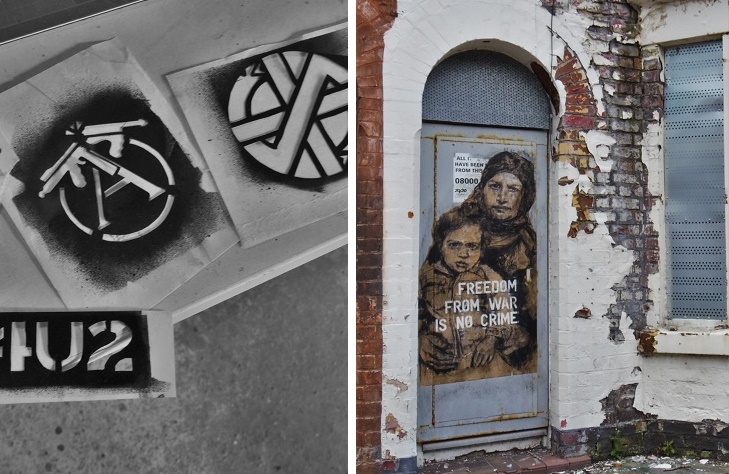
A can of Holts white primer car paint would sit happily inside the left pocket of a jacket and stay warm enough to be sprayed on a cold night. Text stencils on card would fold up and tuck away in the inside right pocket when not needed. It was easy, it was quick and it was all within my control.
And if I found New York subway style graffiti in my small, rural, English ex-mining town (an aesthetic I considered incongruous to the location at the time) I would just stencil “WHY?” or stencil marks out of ten at the end of it rather than attack it by tagging.
If I found racist or National Front graffiti I would obliterate it. At the two local job centres I regularly attended I would stencil “UB NAUGHTY” on their walls (a play on the name of the Unemployment Benefit form UB40). It would be removed and I would put it back again – repeatedly. It became a game. On roadside kerbs I stencilled “GET OFF YOUR KNEES” and “MY GOD, IT’S FULL OF STARS”, on walls I stencilled “NOTHING HAPPENED HERE”, “FIGHT WAR NOT WARS”, “DESTROY POWER NOT PEOPLE” and I always carried stencils of the CND sign, the logo of the band CRASS and their anarchy broken gun symbol to spray anywhere. If you read “KEEPER OFF THY GRASS”, “MIND THEE ANIMAL” or “JUMPING UP & DOWN THERE” in Bristol or Bath in the 80s that was me – so it wasn’t just politics.
I’d cut and paste newspaper photographs and add them to my own drawings and apply cryptic phrases that only meant anything to myself. It was just an attempt to make people stop, look, read and question the reason for the message. To notice that not everything pasted on a wall or bus shelter translated as ‘buy this’. It was fun.
And now people have asked for photographic evidence of my 1980s street work while they forget that photographs in the 80s required film, developing and consequently money to waste. This would have been not only a ridiculous expense but also a ridiculous habit. Why would any sensible person record, and keep for posterity, evidence of what was considered a criminal act? And, I also thought, who would possibly want to see it? At that time, from the punk (as opposed to the hip hop) perspective, I never discovered a like-minded community of people doing the same thing as if it was an intrinsic part of their youth culture. It was never about gaining peer kudos so I never developed an identifiable tag. Firstly because I didn’t want to identify myself as the individual responsible for an act that would have been defined as criminal damage. Secondly, the graffiti tag was specifically identified as being part of a subculture that I didn’t feel represented my concerns at the time (the fellow punk vandals that I knew didn’t spray tags). Thirdly, whatever most punk graffiti was about (and its reasons were many and varied) it was never about the identity of the individual making it.
Like the essence of the music I was listening to at the time it was generally about expressing anger at the unfairness of contemporary society without resorting to violence. This was pre-internet when the media was very limited and controlled so we decided to take a degree of that control back ourselves and pasted-up information about nuclear disarmament, animal rights, apartheid, pollution and a hundred other issues. All made possible with a spray can and stencil or crudely photocopied poster art.
The DIY aesthetic and methodology was inspired (via punk) by the spirit of Paris ’68. Using street walls as a platform for the message was inspired by the spirit of Paris ’68. Didactic, surreal, satirical, polite and rude were all appropriate methods of making the message and that heterogeneous approach too was inspired by the spirit of Paris ’68.
Because the contemporary adult audience is one that grew up with the aesthetic of hip hop graffiti being part of their normal visual consumption (rather than being transgressive vandalism), street art is now embedded within the mainstream of culture generally; we have artists being paid by local authorities to put up enormous murals which add positively to the urban visual environment. But most of this work is decorative and frequently artists are commissioned on the basis that they will not make work that challenges the political orthodoxy. Undoubtedly it is certainly an improvement to the urban landscape when we lose commercial advertising space to individual artistic murals; it returns that public space to its community where it becomes a site of interaction and not a site of a silent acceptance of the rights of consumerism, but I do worry that perhaps we are losing some of the reasoning that brought many street artists out onto the street in the first place.

imgp8075
card stencils and a paste-up in Liverpool in 2016

back to blog menu


A New York gallery offer

I have just politely refused to work with a New York based gallerist – and it was not an easy decision to make. The only deciding factor was that the gallerist expected to initially take 65 percent of the value of any work sold. I replied that I had never given more than 50 percent in commission and I wouldn’t be happy in changing that any time soon. The best offer that could be made in response was that should my work sell at an “extraordinarily high level” the commission figure could be potentially negotiated down to 60 or 55 percent. And I should also be aware that the gallery’s existing artists were very happy with this arrangement.
Today most galleries charge a 50 percent commission to artists on sales of their work only because it has become the established practice. When someone starts in the gallery business they clearly look at other galleries and see that a 50 percent commission rate seems the standard. Admittedly this is not always the case and even today it is possible for a high value, established artist to negotiate a commission rate that is nearer to the artist receiving 60 or even 70 percent of the sale price – but that is the exception.
At the start of the twentieth century the commission many galleries charged their artists was between 20 and 30 percent, but for this lower level of commission the artist was expected to aid in the selling of the work by attending every opening night; they were expected to contribute towards all transport costs, framing costs, publicity costs and contribute to any discounts offered to art buyers. Also the gallery had no formal expectation of loyalty from the artist should a better offer arrive from another gallery. But even with this comparably low rate of commission there were still notable exceptions. In the first quarter of the twentieth century the Galerie Bernheim-Jeune, through the policy of its director Felix Fénéon, paid outright for the work on delivery to the gallery and the artist would also receive a commission on the sale. Similarly, during the same period of time, the artist/dealer/gallerist Herwath Walden only charged a commission to the artist of 10 to 15 percent on sales of their work.
As some artists felt less able to contribute to all the aspects of the art business outside of making the art they accepted higher commission rates to the galleries on the condition of the galleries taking on various financial and business tasks associated with selling the art. As more galleries saw the benefit of taking control of the administration and publicising of their businesses away from being reliant on their artists so they also followed this model. The gallery charged 50 percent commission on any sale but if they wanted the artist to attend the opening then the gallery paid for the artist’s travel and accommodation. The gallery covered all framing and hanging and exhibition costs, all art transport costs from and to the studio, any discounts offered to collectors, exhibition and artist publicity.
Now it has become standard practice that a gallery offers to sell an artist’s work for a 50 percent commission (because… that’s what all other galleries are doing) but in some cases they are also now expecting the artist to pay for the transport of work to (and sometimes from) the gallery, they frequently demand artists attend openings (even at the artist’s expense), they often expect the artist to also share the cut in their earnings should the gallery negotiate a discount with a buyer and they occasionally even expect the artist to financially contribute to advertising and publicity costs.
Because most artists consider themselves the least powerful part of the gallery/artist/collector relationship they have been reluctant to refuse demands put upon them by the other parties. The galleries often forget that if an artist has an unsuccessful solo show then that artist is dependent on other galleries or other sources of income as it would be near impossible again for the same artist to show at the same gallery inside a year. The gallery however can immediately present another artist that may attract a better financial reward. And this can be done, dependent on the energy of the gallerist, as many as twelve times a year; there are not many businesses that operate with the assistance of perpetually renewed stock taken on unpaid consignment.
The established familiarity of the 50 percent commission rate has now led to some new galleries approaching artists and asking for 60 percent commission on the understanding that the gallery will provide all the services that the 50 percent commission rate once offered. Unfortunately some artists, particularly those at the start of their careers, are sometimes so desperate to show their work that they accept these higher rates. It is a sad day when the galleries earn more from the sale of artwork than the artists themselves. The often repeated justification is that the gallerist has the expenses of the building to consider – as if the artist was living and working in a rent-free, bill-free bubble.
Perhaps the gallery is justified with higher commission rates if they are situated in a particularly expensive area – but equally the siting of a gallery in a wealthy tourist area, or established ‘art gallery quarter’ should remove some of the risk of not attracting buyers in the first place. Perhaps the gallery is justified with higher commission rates if they consider an unknown artist or ‘difficult’ artist a commercial risk – but they also know that discovering a new talent can be immensely rewarding both financially and in terms of reputation.
It is ironic that this gallerist considers the artist taking 50 percent of the galleries potential income (before government taxation etc) to be unreasonable but it is fair for the gallery to take 65 percent from the artist. That level of charge is today considered unacceptable when it is applied via formal taxation (in exchange for public services) – so why is it acceptable for a commercial business relationship contract?
Perhaps, if the gallery expects 60 percent, or even 50 percent, of the price of the artist’s work they should expect to provide not only the appropriate venue for the exhibition, sales and marketing expertise, but also the circumstances that enable the artist to concentrate solely on their respective area of expertise – the making of the art.
So should any New York gallerist be interested in my work – feel free to get in touch. Just don’t offer commission rates that make the mafia look reasonable.

2670-the-oppressive-heft-of-gallery-psychiatry-30-x-25-cm-december-2016
“The oppressive heft of gallery psychiatry” conte and chalk on card, 30 x 25 cm

back to blog menu