Watching the politicians (Brexit again)

When Cameron opened his mouth and declared that a referendum would be run on the UK’s membership of the EU I knew it would descend into insanity. Regardless of the claims of ‘listening to the people’ this was only ever suggested in an ever futile attempt to unify a Conservative Party that has been divided on the issue for decades; any British citizen that thinks it was a project launched to eagerly listen and address their desires for ‘more control of borders’ or ‘freedom from eurocrats’ is deluded. The political masters in Westmister don’t care about your desires beyond maintaining their grip on power and wealth.

The EU stated its position from the outset. There could not be a situation where a member of a club leaves that club and keeps the entitlements of that club without financially contributing to its running. It isn’t a difficult concept to understand.

More significantly, and this was always going to be the keystone failure of any of the extreme Brexiteer demands, the border between Northern Ireland and the Republic of Ireland would be the major problem to resolve. The Good Friday Agreement was a major and complicated arrangement, negotiated to accommodate the political and social histories and aspirations of what had previously seemed impossibly intractable differences. This agreement built the rules of civic and state responsibilities between two state governments establishing the governance of Northen Ireland within the UK, the relationship between the UK and the Republic of Ireland and the relationship between Northern Ireland and the Republic of Ireland.

Following Bloody Sunday in 1972 both overt and secret negotiation between the different parties continued. Agreements were made, lost and modified. Slowly political progress crawled its way towards the Good Friday Agreement via the Sunningdale Agreement (1973), the Anglo-Irish Agreement (1985) and The Downing Street Declaration (1993). In a nutshell… it was fucking complicated. But clearly the politicians of today don’t do complicated.

One of the key parts underpinning the success of the peace was the removal of border controls between the north and south of the island – something easily made possible because both states were members of the European community.

Brexiters continually demand the right to ‘take control of their borders’ but don’t seem to recognise the importance of a border between what will become two independent economic states. It’s another case of having your cake and eating it. They want to pick and choose what borders they recognise; it doesn’t work like that. Europe has tried to accommodate this by offering Northern Ireland stays (economically) within the EU and the border can then be at ports and airports – but the Brexiters don’t want any part of the UK subject to EU economic legislative control.

So since the Brexit decision we’ve had to listen to pig-shit thick politicians come up with ideas like the as yet uninvented technological solutions of scanning (I presume moving) vehicles and mobile customs officers (based no-one knows where). If an invisible, electronic border was possible why would we have physical borders anywhere in the world?

And while I’m here… the endlessly touted cry of the UK economy being saved by ‘World Trade Rules’…

The nearest thing I can compare this to is Doctor Who’s sonic screwdriver or the Star Trek standard of ‘reverse the polarity’ on whatever technological fix isn’t saving the day so that it… saves the day.

World Trade Rules is not a simple solution, nor a quick one. The UK would not be starting with all the other players from the same point. If a preferential arrangement is made for one country, then under World Trade Rules it must be offered to all. The UK cannot pick and choose who it offers tariff free trade with. And importantly the UK, particularly in manufacturing and agriculture (the mainstays of the real economy that affects the day to day lives of the population), is a small player. Small players do not have power, whatever romantic and deluded ideas of British exceptionalism are clutched on to.

Now that the British electorate are more informed as to the ramifications of the Brexit potentials on offer surely a further and final referendum offering the three options is the most democratic way forward. Deal, no deal or stop it all – and return to the relative existing economic security of the EU and work from within to adapt it and fix its problems to address the changed world we’re all facing.

The politicians are incapable as long as they’re putting party, ideology and in some cases considerations of personal gain, before their supposed celebration of the people’s will and democratic right.

I’ll put my hands up and happily state that whatever choice is made (should a further, more informed) referendum take place – I will accept it as the informed, democratic choice of the people of Britain. I may disagree with it – but I will accept it.

'watching just watching', conte and gouache on canvas, 20 x 25 cm, 2017
‘watching just watching’, conte and gouache on canvas, 20 x 25 cm, 2017

back to writing menu

“Broken (working formalised)”

The subject matter and methodology of making this set of work has been brewing a long time. The use of broken picture glass in the finished framing goes back to a painting I made in the early 1990s; I returned to it for one small painting about ten years ago and then it was mentally filed for sometime in the future… It looks like the time is now.

“Broken (working formalised)” is the title of the process.
“Imaginary self-portraits at the funeral of the imagination” is the collective title of the set of drawings.

I’ve always considered my work to be a process of starting with an idea that eventually goes wrong (breaking) and after a rest of a few days or so from the work I continue by trying to undo the mistakes and continue forward (mending). So I define my work process as being just repetitions of breaking and mending the artwork until I feel I can leave it at a point where it’s as most unbroken as I can manage at that time. I used to cut some finished paintings and then stitch them together again as a way of formalising that process within the work. The broken glass in the frame (which is then framed again to retain the original glass) is my new way of containing that formal narrative in these drawings.
The idea of ‘imaginary self-portraiture’ is an extension of the fact that every self-portrait (from ancient art history to modern mobile phone selfies) is a creative, rather than a documentary, act. We show what we want to project.
The narratives and titles within the drawings represent personal thoughts and reflections on my life. And the ‘funeral of the imagination’ is a personal observation on our mainstream contemporary visual culture.


back to work chronology menu


“112”

(English text below French text)

“112” – Le projet du centenaire de l’armistice pour La Feuillée

L’idée de ce projet m’est venue de l’intérêt des médias pour le centenaire de la Première Guerre mondiale. Mais, plutôt que de me concentrer sur le début de ce lamentable épisode de notre histoire, j’ai jugé plus opportun de porter mon attention sur l’armistice.
La Première Guerre mondiale est devenue obsédante pour moi lorsque mes parents m’ont emmené à Verdun découvrir les lieux des champs de batailles et visiter les cimetières militaires alors que je n’avais que 12 ans. Avant cela, ma réflexion sur la guerre se réduisait aux petits soldats en plastique, aux chars d’assaut et aux films de guerre diffusés généralement à la télévision le dimanche après-midi. Je ne pense pas que ma vision de la guerre était très différente de celle de la plupart des enfants anglais de l’époque. C’était juste un moment de divertissement dans nos vies, un peu comme les westerns américains ou les mauvaises séries télévisées de science-fiction.
J’ai le souvenir que cette visite à Verdun, a tout changé pour moi. En 1916, en à peine dix mois, près d’un quart de million de soldats sont morts sur un champ de bataille de moins de vingt kilomètres carrés. Le résultat de ces meurtrières batailles s’inscrit dans le paysage, ligne par ligne de pierres tombales. Mon besoin d’essayer de comprendre ce que pouvait représenter dans la réalité ces cimetières, m’a permis de me forger les convictions sociales et politiques qui m’animent aujourd’hui.
Je vis dans un petit village breton du Finistère, et les jours de commémoration de l’armistice, je me rends, accompagné de mon chien, jusqu’au monument aux morts sur la place du village. Au pied de la statue d’un soldat silencieux, je prends quelques minutes pour lire et réfléchir devant les 112 noms gravés de jeunes gens morts pour la patrie.
En cette année de centenaire de l’Armistice de la «der des der» (la dernière des dernières guerres), j’ai souhaité apporter en témoignage de mon respect pour ceux qui ont perdu la vie mais aussi pour leurs familles qui se souviennent, une œuvre d’art créée dans mon atelier, dans ce village qui m’est cher.
Il y a 112 noms inscrits sur ce mémorial, ce qui représente près d’un dixième de la population du village, disparus pendant la première guerre mondiale. J’ai donc pensé que cela pourrait rendre la réalité un peu plus concrète que l’abstraction des nombres ou une liste de noms, si je collais 112 dessins grandeur nature figurant ces soldats autour de cette place.
Ce ne serait que temporaire; le vent, la pluie et le temps repoussent lentement ce geste moderne de mémorial. Mais à mon avis, cela me semble tout à fait approprié de prendre à nouveau conscience de leurs existences et de regarder lentement ces présences nous quitter.
Au tout début de cette année, j’ai prudemment présenté mon projet à Monsieur le Maire et celui-ci m’a immédiatement apporté son soutien et son enthousiasme. Je lui ai alors fournis quelques esquisses préliminaires afin qu’il ait des éléments visuels à soumettre au Conseil Municipal, à l’Association Locale des Anciens Combattants, puis aux résidents des propriétés proches de la place. Tous ont unanimement approuvé ce projet.

J’aimerais remercier pour leur soutien :

Régis Le Goff (le maire actuel)
Le conseil et la communauté locale
L’association des Anciens combattants
Ti Adam
Mimi Gillet
Patricia Paulus
Ian Harwood
Nath Oxygène
Colleen

Mais également remercier les entreprises qui se sont engagées sur ce projet:

Jakar Pastels
Calipage (Carhaix)
CLAP services (Brest)


plus d’images en bas de cette page


“112” – The Armistice Centenary project for La Feuillée

The idea for this project came with the media interest in centenary of the start of the First World War. But rather than focus on the beginning of this lamentable episode of modern history I thought it more appropriate to look at the armistice and the end of the ‘war to end all wars’.
The First World War became something of a personal obsession when, at the age of twelve, my parents took me to the war cemeteries at Verdun whilst on a holiday. Until that time my consideration of war extended to plastic toy soldiers, model tanks and the films that played on television, usually on a Sunday afternoon. I don’t think my view of war was very different to that of most British children of that time. It was just another entertainment intermission in our lives much like American westerns or bad TV sci-fi serials.
That visit to Verdun changed everything for me. In approximately just ten months of 1916 nearly a quarter of a million soldiers died on a battlefield of less than eight square miles. The result of that one battle, of one war, had been written into that landscape by line, after line, after line of gravestones. My attempt to comprehend the reality of what the graveyards and cemeteries represented then went on to inform much of my social and political beliefs that I hold now.
So, living in a small Breton village in Finistere, when Armistice day is remembered, I always take the time to walk the dog down to the memorial in the village square and spend a few minutes quietly thinking and looking at the list of names carved on the stone beneath the silent statue of a single soldier. But with this year, and the centenary of the Armistice I thought it might count as a small token of my respect to those that lost their lives, and the families that remember them, if I could do make an artwork that could indicate the physical loss of those men.
There are 112 names marked as lost during the years of the First World War; nearly a tenth of the village’s population. So I thought it might make the actuality of that loss a little more concrete than the abstraction of numbers or a list of names, if I could paste up 112 life-size drawings of soldiers around the square.
It would only be temporary; the wind, rain and time would slowly take this modern gesture of a memorial away again. But to my mind that seemed quite appropriate – to make a clear note of intent to realise their presence again, and to watch as that presence slowly leaves us. With only the memorial erected by their community to stand as the rightful, long-term heir to their personal sacrifice and the grief of their loved ones.
I cautiously raised the suggestion of the project early this year with the commune’s mayor and he was immediately supportive and enthusiastic. I showed him the few preliminary sketches I had made and he took them away to show the council and the local association for old soldiers; they were all in favour of the project. He then asked all the residents in the properties around the square and they too were happy for me to continue.

And I also need to thank:

Régis Le Goff (the current mayor)
The council and local community
The association of military veterans
Ti Adam
Mimi Gillet
Patricia Paulus
Ian Harwood
Nath Oxygene
Colleen

Also some material expenses have been met by the following companies:

Jakar Pastels
Calipage (Carhaix)
CLAP services (Brest)

studio

back to work chronology menu


Climate Action Now

These last few months we have seen extremes of weather around the world that should be making all of us sit up and seriously address the problem we have known about, but have been ignoring for the last few decades.
Climate change is not something that is coming. That particular train left the station years ago. Climate change is happening now and we need serious actions to be taken at a governmental and international level to arrest the worst potential outcomes.
This is an existential crisis for humanity – it is THAT serious. But the world’s politicians are more interested in maintaining the economic order that brought us here than making an effective difference.
Perhaps it is our fault too. We expect these elected public servants to maintain the machinery of state without too much involvement on our part, bar the odd election. So their minds need focusing and it’s up to the electorate to do it.
The extremes of weather that we are now being told by our media to accept as the ‘new normal’ are not going to disappear in our or our children’s lifetime. We have continued to pump increasingly large volumes of climate warming gases into the atmosphere over the last ten years that have yet to realise their full effects. And this doesn’t even take into account the increasing volume of methane ejections likely from warming deep seas and melting tundra.
I’m trying to think of the appropriate, scientific, critical, mature, reasoned and temperate language to use but the only phrase that keeps coming to mind is: WE ARE FUCKED.
The arctic ice (that which remains) is at its thickest point, now only two metres deep. The same areas, just north of Canada and only six years ago,were between three and five metres deep. Once it has all gone, and it WILL go, there will be nothing reflecting sunlight back into space – only amplifying the problem of warming sea water.
We need serious and immediate action to be taken at a global, governmental level.
Demand of your political representatives that they research the issues online and then that they act.

We need:

  • Serious protection and encouraged growth of natural carbon sinks such as the Amazon rainforest
  • Solar panels and other green energy solutions installed on all properties that use electricity
  • Free to use, good quality and readily accessible public transport
  • Reduction and eventual cessation of meat-based diets
  • Increased greening of urban environments
  • Reduction and eventual cessation of non-essential, long-distance shipping and air freight.
  • State built and maintained housing for all that want it.

And that’s just a short starting list. The politicos will jump up and down and declare that this list is all unaffordable and inefficient – whilst simultaneously they and their colleagues are finding the funds to fight oil wars or refinance a banking sector that helped bring us to this catastrophic point.
We need to ditch the failed economics that brought us here, or it will destroy us. We need to abandon the failed dogmatic religion of endless economic growth and accept that we have had (in the western world at least) the best of it. We need state intervention because without it we’re going down.
Ask your representatives if they accept that the crisis is, in human terms, existential.
If they do not accept the gravity of the situation they need calling out on all social medias with the evidence presented by 97% of the qualified scientific opinion.
If they do accept it then ask what is their personal assessment of a potential solution ‘in an ideal world’.
Do they accept that the solutions must be as drastic as I have suggested? If not, what would they suggest to be as equally effective.
If they accept the scientific opinion, particularly that recently raised that says we’re probably at serious ‘tipping point’ temperatures already, then ask them why are they not acting accordingly.
Call them out.
Or vote them out.
We are running out of time.

Climate scientists reveal their fears for the future

climate action now

back to writing menu


Free download – decorate your world

There isn’t much an artist can do except add to the shouts for change. The fossil fuel industry is still leading the charge for the impending destruction of our living environment. Added to this, industrialised farming is carving through carbon-capturing forests so that they can produce meat, where a plant-based diet would ensure a more responsible usage of the resources available for all the people of the planet. And our governments continue to prevaricate and procrastinate while the planet warms.
I have been writing on the street since the 1980s and the respectable and responsible model citizens among us have declared it ‘vandalism’…
Well the real act of vandalism is being inflicted on the planet; our living environment. It’s being done in the name of the ‘free market’ as this, we are continually being told, is the most efficient way for us to live.
Well, enough is enough. The free market has failed us. We need a new model and the execution of that change can only be made at governmental level. We are told we need to recycle plastics more – but nobody legislates against excessive packaging to stop the problem at source. We are told we need to take fewer car journeys – but nobody legislates for free public transport for all. We are told to save energy – but nobody legislates for free programmes of domestic insulation and green power production.
We are told we need to build a green economy but nobody legislates the free, or even  affordable, tools to do so.
Big business continues to financially clean up, while it ecologically vandalises.
So, as a model citizen, within a free market, I give you free posters. To print and paste where you will and to add to the demands for change. Before it’s too late.
Society gets the vandals it deserves.


Cliquez sur le lien ci-dessous pour le fichier zip (qualité d’impression A0, A3 ou qualité www).
les trois affiches A0 300 dpi imprimer ou photocopier (fichier zip) 32.6MB (telecharge francais)
les trois affiches A3 300 dpi imprimer ou photocopier (fichier zip) 6.94MB (telecharge francais)
tous les trois pour une utilisation Internet, 2000 x 2000 px (fichier zip) 1.93MB (telecharge francais)

thumb - agir pour leur climat wwwthumb - changeons le systeme pas le climat wwwthumb - climat l'avenir c'est maintenant www


Click on the link below for the zip file (A0 print quality, A3 print quality or web quality).
all three posters A0 300dpi print or copy shop (zip file) 32.6MB (english download)
all three posters A3 300dpi print or copy shop (zip file) 6.94MB (english download)
all three for internet use 100 dpi 2000 x 2000 px (zip file) 1.93MB (english download)

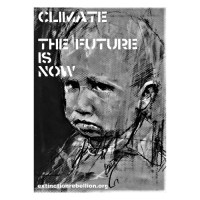
thumb - climate the future is now wwwthumb - change the system not the climate wwwthumb - act for their climate www


Click on the link below for the zip file and you can save all four to your computer.
all four MODEL CITIZEN posters (zip file) 5.02MB


carrion grey

“We are your future” A4 download
(zip file stencils and posters)
to print and paste as you see fit.


climate action weapons bw

“C.A.W. (Climate Action Weapons)” stencil download
(zip file stencils and posters)
to print out, stick to card, cut out and stencil away the day.


OK… not strictly ‘art’ but following on from the above… We are increasingly being told that the consumer has the responsibility to recycle packaging. And we are now increasingly understanding that it’s not necessarily being recycled when we sort it and send it all off. So, in the spirit of letting the market meet our desires…
If you feel that government isn’t doing enough to stop the production of unnecessary packaging at source take the challenge with their economic rule book in mind.
Bundle up all your old packaging and return it to the shop from which it came. Pop this note in with it. Prints two to an A4 sheet. Be an unhappy shopper…

dearshopkeeper IMGP5404


paste-up-bristol.jpg stencil mono paste up south wales stencil green protest banner

back to writing menu

“Do as you’re told (Model Citizen)”

Democracy
[dih-mok-ruh-see]
noun
government by the people; a form of government in which the supreme power is vested in the people and exercised directly by them or by their elected agents under a free electoral system.

Model
[mod-l]
noun
A person or thing regarded as an excellent example of a specified quality.


Do you obey the law? Even when the law is wrong? Do you set a good example to your fellow citizens and conform to the demands of your society’s rules when the only way to improve your society is in opposition to those laws? Would you have stood against the laws that legitimised slavery? Would you have stood against the laws that withheld the vote from women?
The ‘law of the land’ is established primarily by those that benefit most from it; it is only changed when a challenge is made to that establishment’s perceived entitlement of authority. And the self-perceived masters rarely like being reminded that they are, in fact, servants.
When the citizen feels subordinate to the public servant representatives they elect, then it’s time for a new model of citizenship.

Or just continue doing as you’re told.


back to work chronology menu

MAUSA Vauban, Neuf-Brisach

Painting on seventeenth century walls…
I was invited by MAUSA (Musée des Arts Urbains et du Street Art) to mural a room in an old military fort in eastern France.
A section of this UNESCO World Heritage Site has been taken over by MAUSA as the second of its museum spaces dedicated to Urban and Street Art. I worked in a building that was the fortified defence system surrounding the town of Neuf-Brisach. The defences construction was started in 1698 and designed in a star formation of heavy stone and earthworks around the town that was constructed on a grid system.
Apparently, when the construction was complete there was no longer a military use for it. Another shining example of the folly of militarism; we don’t seem to have progressed much three centuries on.


QR code downloadable audio track for the room:

back to work chronology menu


We need a wall of noise.

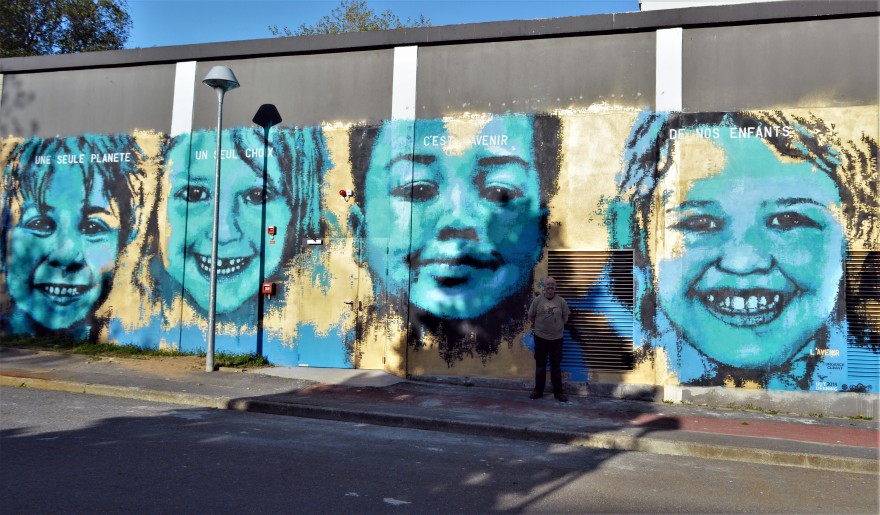
A few weeks ago I was given the opportunity of making this mural. I have always expressed my political opinions through my work. This wall was the perfect opportunity for me to give my politics and art a more relevant focus.
This wall, and the conversations with the people here while I was painting, have led me to make the decision that all my street art in the future must be about the climate crisis we all face.
Our cumulative impact on the planet is now a serious threat to our future existence. In just my lifetime the global population has more than doubled. In the same time industrial activity has doubled the output of carbon dioxide into the atmosphere. The rate of the global temperature rise has also doubled. All of this in just my lifetime. Ironically, one month after I was born in 1965, the American president was warned by scientific advisors of exactly the situation we face now. And yet, fifty years later, this grave problem has not been seriously challenged.
We are now at the end of the time in which we can stop this catastrophic crisis. Fortunately, at the COP 21 Paris climate conference some small progress was made. Also many European governments are beginning to take action. However, the choices that need to be made for our long term survival are not popular for short term political gain.
We must all go much, much further.
We are living way beyond the capacity of the planet we live on to sustain us. Many of us already know this and we must take personal responsibility for the disaster that is gradually unfolding. I am not a politician, I am not an engineer and I am not a scientist so I cannot make change at a state level. I am an ordinary citizen of the world and I am a parent and grandparent so I have an obligation to make what difference I can. I do not eat meat, I do not travel by air, I grow as much vegetables as I can myself and try to buy other food only produced in France or neighbouring countries. My work gives me another opportunity – to spread this message. And I hope people will see and hear it.
This is the change that we can all make. And this is the change that will allow you, in the future, to look your children, and grandchildren in the eye, and say that you did what you could.

3661 bellevue brest wall finished 1
One planet, one choice. It’s our childrens’s future

back to writing menu

“Mai 68”


These drawings were made for an exhibition marking the 50th anniversary of the student protests in Paris of May 1968. The exhibition was held at Galerie Brugier Rigail, Paris.

back to work chronology menu

IF we live

Today is Earth Day 2018. The event, started in 1970 in the USA and becoming international twenty years later, aims to highlight campaigning and activism on environmental issues. That there was an awareness that human impact on our home planet was considered significant enough to mark in this manner over forty years ago increases, for me, the anger and sadness that we find ourselves in our current perilous situation.
I have supported campaigns on issues of pollution, nuclear disarmament, conservation and sustainability since the 1980s and it is increasingly depressing to hear people saying that there is still scientific uncertainty about the damage we are doing to our living environment in regards to anthropogenic global warming. They are wrong – there is overwhelming agreement within the scientific community that the climate is changing and that industrialised humanity is the greatest contributor to that change.
This is the most urgent crisis of not just our generation’s time, but of the totality of humanity’s time. In the twentieth century alone the human population has quadrupled – it doesn’t take a genius to work out that there are serious ramifications for such expansion, particularly when that growth is supported by a demand for increased food and other resources. We are now consuming the planet’s resources faster than they can be replaced. And by ‘we’ I mean the developed world.
As a matter of existential urgency we must stop and reassess our entire relationship with not just the planet but our broader humanity. Where we are is as a result of the economic systems we have chosen to function within and those systems are leading us to oblivion. The conversation to address the most pressing current issue should have started being seriously addressed at governmental levels when I was a child (in the year I was born, 1965, the American government was informed by scientists of the inevitability of climate warming due to increased levels of carbon dioxide to the atmosphere) but insufficient progress has been made.
We have many historical examples (sadly, usually driven by the needs of conflict) where government takes control of the reins to steer their countries out of crisis. There is no reason, bar the greed of a tiny percentage of the population, to stop this happening again and at a global level.
Why can’t we have state-funded solar panels and batteries installed in every building to reduce its dependency on supplied energy?
Why can’t we have state-funded installation of insulation and other energy efficiencies?
Why can’t we be encouraged at a governmental level to move towards a plant-based diet?
Why can’t we have free to use public transport?
Why can’t we have ready access to state-funded, public sector maintained, social housing for all?
Because everything is measured by the failed science of post-war economics and we are told that we cannot afford these things if we also want our nuclear weapons, our proxy wars, our resource conflicts and our state protection from the terrorism encouraged by our resource conflicts. We can’t afford the public sector employment and social public subsidies because the dogma of Chicago School Economics stills holds governments to the line that the free market is so much more efficient. And we can’t afford it currently due to the state subsidy given to the banking sector as a result of their financial efficacy ten years ago.
Cost is irrelevant; money is an abstraction that fuels an economic engine that benefits a miniscule minority while the rest maintain a life of perpetual indebtedness to a largely invisible elite. We need a serious and meaningful change in our sense of priorities and aspirations. The current economic system is fatally sick and needs putting out of its misery once and for all.
That’s where we start. Not just with ‘Earth Days’ but real changes in personal lifestyles. We need broader recognition of media outside of the mainstream, increased political involvement and increased campaigning and activism. And, if  necessary, civil disobedience. When our current elected state functionaries forget that they are the public’s servants and refuse to act in the greater interest, when their self-perceived position in society has become the ends and not the means… they need reminding that we are their masters.
This issue is too important for another fifty years of debate. And it’s not a debate about how we live in the future – it is about IF we live in the future.
The NEAR future.

3578 the broken wheel 29 x 40 cm february 2018
‘The broken wheel’ conte and chalk on paper, 29 x 40 cm, 2018


back to writing menu